






Narak Chaturdashi is the quiet morning before the lights of Diwali, a day to wash away what weighs on us & step into the festival lighter. In 2026, the day falls on Saturday, 7 November, the eve of Diwali.
Known also as Choti Diwali, Roop Chaudas & Kali Chaudas, it remembers Lord Krishna’s victory over the demon Narakasura & invites each of us into a simple, early-morning cleansing.
Key takeaways
- Date: Narak Chaturdashi 2026 falls on Saturday, 7 November
- Abhyang snan (Mumbai): 5:45 am to 6:42 am at dawn on Sunday, 8 November, before sunrise while Chaturdashi tithi prevails
- This year, two days meet: Choti Diwali on 7 November flows straight into Diwali, with the dawn bath & Lakshmi Puja both on 8 November
- The story: Lord Krishna, with Satyabhama, freed 16,000 captives from Narakasura, ending his reign of fear
- The heart of it: an oil bath before dawn, a lamp for Yama at dusk, & a home made clean & bright for Maa Lakshmi
Narak Chaturdashi 2026 date & abhyang snan muhurat
Narak Chaturdashi falls on Saturday, 7 November 2026, when Chaturdashi tithi begins. The sacred oil bath is taken in the pre-dawn window while Chaturdashi is still present, which this year is the morning of 8 November. Per Drik Panchang, the timings for 2026 are:
- Narak Chaturdashi (India): Saturday, 7 November 2026
- Abhyang snan muhurat (Mumbai): 5:45 am to 6:42 am, Sunday, 8 November 2026
- Chaturdashi tithi begins: 10:47 am, 7 November 2026
- Chaturdashi tithi ends: 11:27 am, 8 November 2026
Amavasya begins as Chaturdashi ends, so Diwali’s Lakshmi Puja follows on the evening of Sunday, 8 November. This year, the dawn bath & the evening lamps of Diwali gently flow into one another on the 8th. All timings on this page are for Mumbai.
Kali Chaudas, a midnight observance, is kept on the night of Saturday, 7 November, when Chaturdashi tithi is present at midnight.
Check Mumbai’s abhyang snan timings on Drik Panchang →
The story behind Narak Chaturdashi
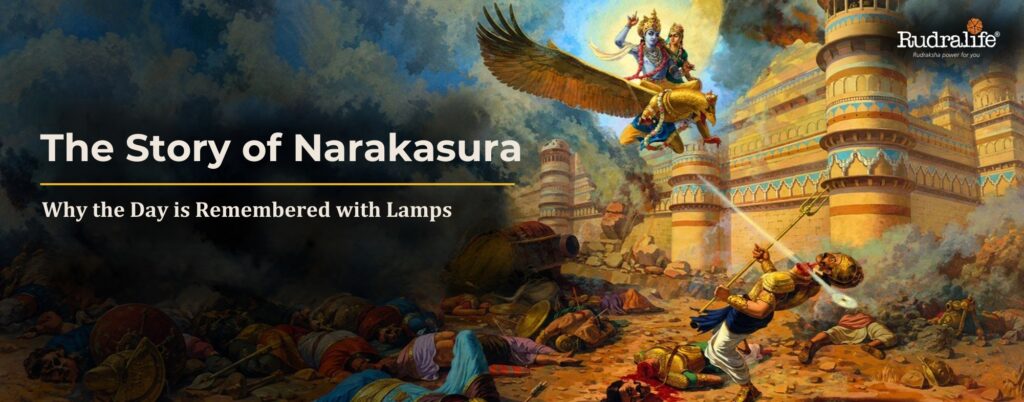
Narakasura, the son of Bhudevi, grew powerful through a boon & ruled from Pragjyotishpura with pride & cruelty. He troubled the devas, took the earrings of Devmata Aditi & held 16,000 women captive in his palace.
Lord Krishna rode out to end his reign, with Satyabhama by his side. In many tellings, it is Satyabhama, herself a form of Bhudevi, who brings the battle to its close. As he fell, Narakasura asked for one blessing: that the day of his end be remembered with lamps & joy, not mourning.
That is why the day carries his name. Krishna is said to have bathed with fragrant oils after the battle, & that cleansing lives on as the abhyang snan devotees take each year.
Read: From Dussehra to Diwali 2026 →
What the day asks of us
Narakasura is not only a figure from the Bhagavata Purana. He is also a quiet reminder of the heaviness each of us carries: anger, pride, laziness, old hurts. The word naraka means a place of suffering, & Narak Chaturdashi is a chance to set that suffering down before Maa Lakshmi is welcomed home.
How Narak Chaturdashi is observed
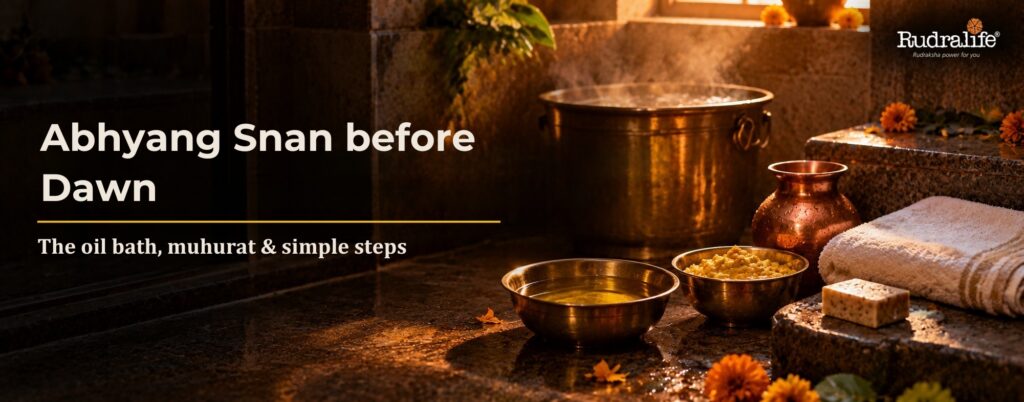
The rituals of the day are simple & can be done at home by the whole family.
- Abhyang snan: Rise before sunrise, apply sesame oil & an ubtan of gram flour, turmeric & herbs, then bathe while Chaturdashi tithi prevails. This is the heart of the day.
- Yama deepam: At dusk, a four-faced lamp is lit facing south, an offering to Lord Yama for the protection of the family.
- Cleaning the home: Corners are swept, clutter is cleared & doorways decorated with rangoli, so the home is ready for Maa Lakshmi.
- Diyas at nightfall: Small lamps are placed along doorsteps & windows, the first lights of Diwali.
- Remembering Krishna: Many families offer prayers to Lord Krishna, & in some homes to Maa Kali or Hanuman ji.
One day, many names
- Choti Diwali: across north India, the gentler eve before the main festival
- Roop Chaudas: in Rajasthan & Gujarat, when the morning bath is also a ritual of renewal & beauty
- Kali Chaudas: in Gujarat & parts of western India, a night of prayer to Maa Kali for protection
- Naraka Chaturdashi as Deepavali: in much of south India, the pre-dawn oil bath on this day is Deepavali itself
In Goa, effigies of Narakasura are made & burnt before dawn, & the morning begins with sweets & family visits.
Rudraksha & the spirit of Narak Chaturdashi
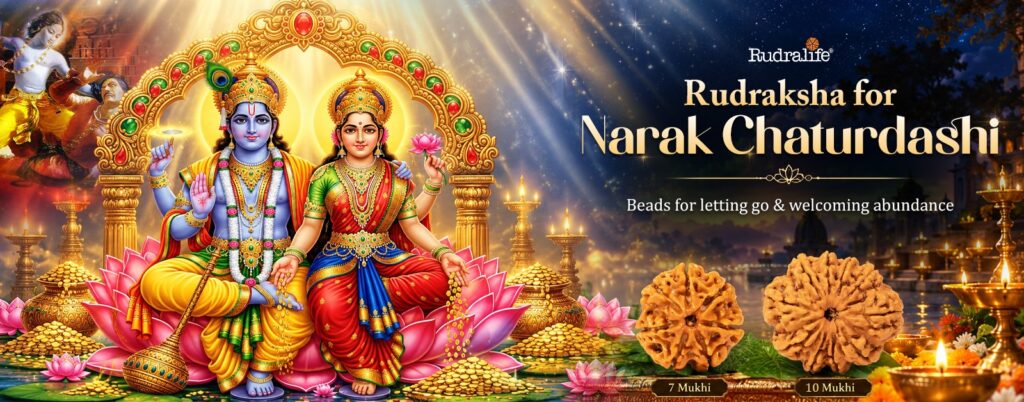
Narak Chaturdashi is a day of letting go, & Rudraksha has long been worn by devotees as a steady companion in that inner work. Like the morning bath, it is not about the outside alone, but about returning to a calmer, clearer self.
- 10 Mukhi Rudraksha: associated with Lord Vishnu, of whom Krishna is an avatar, and traditionally worn for protection & a sense of inner security.
Explore 10 Mukhi Rudraksha → - 7 Mukhi Rudraksha: representing Maa Mahalakshmi, this bead blesses the wearer with abundance, stability & prosperity, a natural companion as Narak Chaturdashi leads into Lakshmi Puja.
Explore 7 Mukhi Rudraksha → - Seven Mukhi Kantha (Shani Kantha): a kantha of 7 Mukhi beads, traditionally worn to invite Maa Lakshmi’s grace & to steady the influence of Shani in one’s life.
Explore Seven Mukhi Kantha (Shani Kantha) → - Ganesh Lakshmi Bandh: placed at your puja place for Lakshmi Puja the next evening, a gentle way to invite Maa Lakshmi’s blessings of prosperity & Ganesh ji’s blessings of new beginnings into the home.
Explore Ganesh Lakshmi Bandh → - Seven Mukhi Cash Box: kept at the puja place during Lakshmi Puja & then in your cash box or locker, inviting Maa Lakshmi’s blessings of steady abundance through the year.
Explore Seven Mukhi Cash Box → - Caring for your Rudraksha: the oil-bath morning is a lovely moment to clean your beads with a soft brush & lightly oil them, as part of your own renewal.
Lakshmi kits for the home & daily wear
For devotees who would like a complete set for the home & for daily wear, Rudralife has curated three Lakshmi kits. Every Rudraksha in them is ACE Certified (Aura Certified & Energised).
- Lakshmi Prosperity Kit: a 7 Mukhi Cash Box, a 7 Mukhi Rudraksha Hanging & a Mahalakshmi Rudraksha Bracelet. Created for those seeking financial growth & abundance at home or in the workplace.
- Lakshmi Fortune Kit: a 7 Mukhi Devi Lakshmi Bracelet, a 5 Mukhi Japa Mala, a 7 Mukhi Cash Box, an Ukanite Bracelet & a Water Kit. It brings together prayers for prosperity, a calm mind & good health, & suits working professionals & business owners.
- Lakshmi Blessings Rudraksha Kit: a 7 Mukhi Rudraksha Japa Mala, a 7 Mukhi Devi Lakshmi Bracelet & a 7 Chakra Rose Quartz Bracelet. A simple daily practice for inviting prosperity, positivity & emotional balance.
Explore all three Lakshmi kits →
Find the Rudraksha suited to you through a date-of-birth analysis based on astro-numerology.
If you prefer to see Rudraksha in person, come visit us.
Frequently asked questions
1. When is Narak Chaturdashi in 2026? Narak Chaturdashi falls on Saturday, 7 November 2026. Chaturdashi tithi begins at 10:47 am that day, & the abhyang snan is taken before sunrise on Sunday, 8 November.
2. What is the abhyang snan muhurat in 2026? In Mumbai, the abhyang snan muhurat is 5:45 am to 6:42 am on Sunday, 8 November.
3. Is Narak Chaturdashi the same as Choti Diwali? Yes. It is also called Choti Diwali, Roop Chaudas & Kali Chaudas, with Kali Chaudas kept on the night of 7 November.
4. Is Narak Chaturdashi the day before Diwali in 2026? Yes. Narak Chaturdashi falls on Saturday, 7 November & Lakshmi Puja on Sunday, 8 November. The abhyang snan is taken at dawn on the 8th, before the evening’s Lakshmi Puja.
5. Why is an oil bath taken on Narak Chaturdashi? It recalls Lord Krishna’s cleansing after his battle with Narakasura. Traditionally, it is believed to wash away heaviness & keep one away from naraka.
6. What is Yama deepam? It is a four-faced lamp lit at dusk facing south, offered to Lord Yama for the wellbeing of the family.
7. Can I wear Rudraksha during the abhyang snan? No. We recommend removing your Rudraksha before the abhyang snan, as soap & ubtan can harm the beads. Wear it again once you have bathed.
8. Which Rudraksha is good to wear during Diwali? Every devotee’s needs are different. A date-of-birth analysis based on astro-numerology can help you find the Rudraksha suited to you.
Bottom line
Narak Chaturdashi is a morning to rise early, bathe with intention & let go of what no longer serves you. In 2026, it falls on Saturday, 7 November, the eve of Diwali, with the abhyang snan at dawn on the 8th, before Lakshmi Puja that evening. Light your lamps, clean your home & your heart, & welcome Maa Lakshmi in.
Get your personalised Rudraksha recommendation →







Leave a comment