





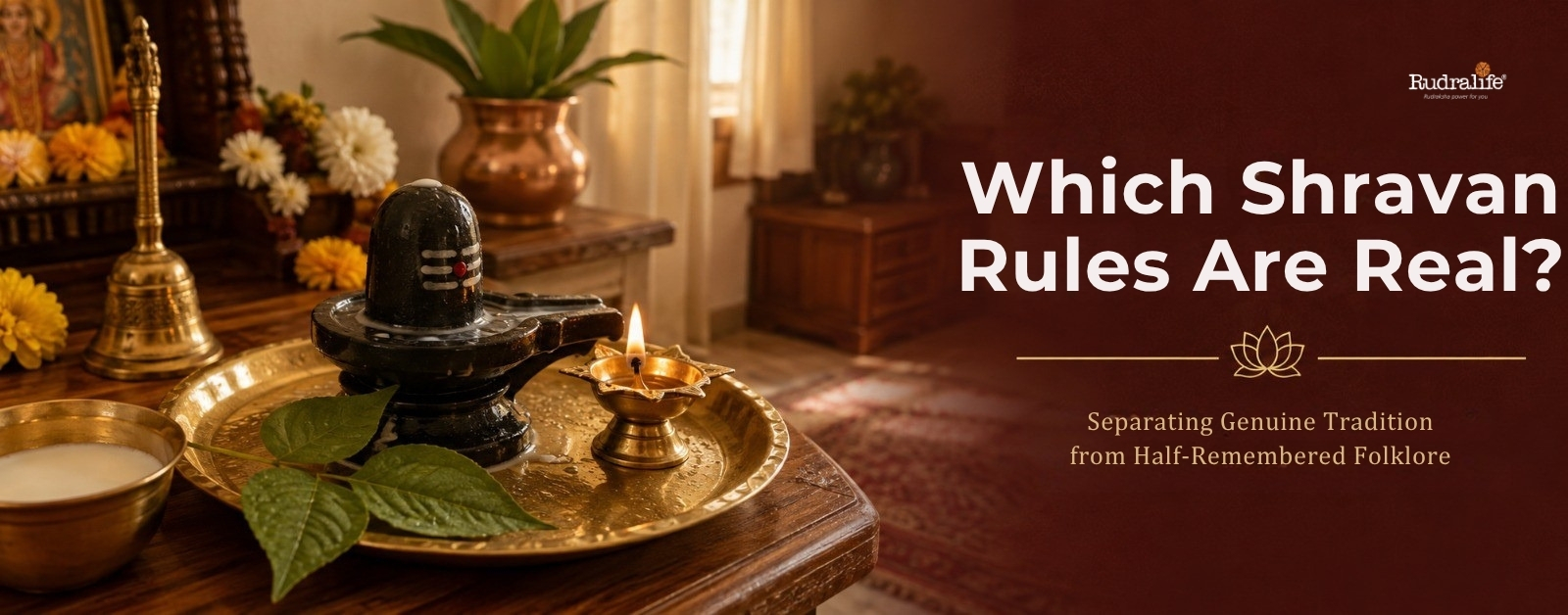
Shravan rules arrive as a long list: fast on Mondays, avoid onion and garlic, don’t cut your hair, don’t hold a wedding. Most devotees follow them without ever being told which parts are scripture and which are custom. This piece sorts through it.
What Are the Actual Shravan Rules?
The core Shravan rules are simple: fast on Mondays if you’re able to, keep to a sattvic vegetarian diet through the month, worship Lord Shiva with water, milk, and bel patra, and avoid non-vegetarian food and alcohol, everything else devotees hear about Shravan tends to be a mix of genuine tradition and half-remembered folklore.
Rudralife has been part of Shravan conversations with devotees for 25 years now, and one thing comes up every year without fail: people asking whether a rule they grew up with is actually a rule, or just something an elder said once that stuck.
This piece separates the two, what the Shravan rules actually ask of devotees, and which popular “rules” are really regional habits.
Key Takeaways
- The genuine religious core of Shravan rules is narrow: Monday fasting, Shiva worship, and a vegetarian, sattvic diet.
- Many food restrictions, avoiding leafy greens, onion, and garlic, trace back to monsoon-season hygiene and Ayurvedic reasoning about weak digestion, not just scripture.
- Fasting every single Monday is not mandatory; sincerity matters more than a perfect streak.
- Avoiding weddings and other major life-event ceremonies during Shravan is a Chaturmas custom, not specific to Shravan itself.
- Some popular “explanations” for these rules, like razors rusting in the monsoon, are folklore rather than settled fact and shouldn’t be treated as the reason to follow the rule.
- Shravan rules vary by region and household, so what’s observed strictly in one family may be treated more loosely in another.
The Core Do’s: Fasting, Worship, and Diet
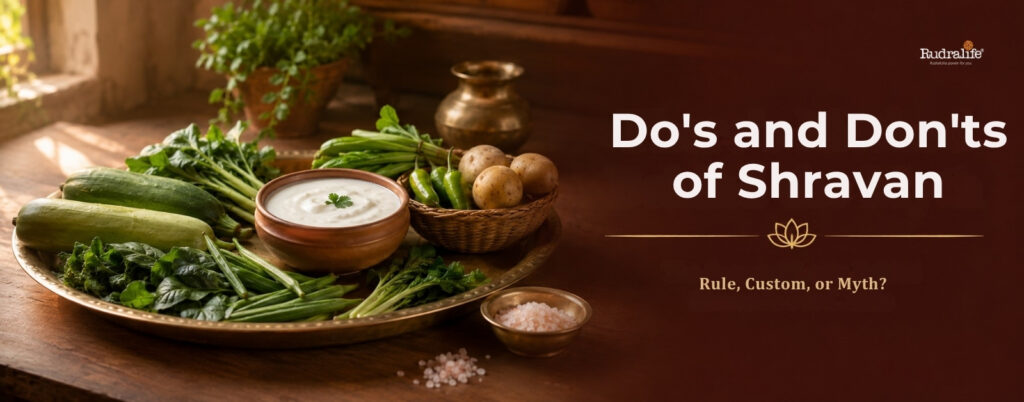
Here’s each of the core do’s taken one at a time.
The Sawan Somvar Vrat The heart of Shravan observance is the Monday fast, when devotees worship Lord Shiva and seek his blessings for health, prosperity, and family wellbeing.
Rudrabhishek / Somvar Puja at Home Devotees offer water, milk, bel patra, dhatura, and white flowers to the Shivling while chanting “Om Namah Shivaye”
For more details on how to perform this puja at home,
Read: Shiva Puja at Home During Shravan → Every step, from Abhishek to aarti.
And if you’re not able to manage the puja every Monday, Rudralife’s Vedic pandits perform it in your name and gotra, and you can watch it live from anywhere.
This is the Rudrabhishek our pandits performed for a recent Shravan Somvar, with each devotee’s name and gotra chanted during the ritual.
Japa Many devotees also chant Japa during Shravan, repeating “Om Namah Shivaya” or the Mahamrityunjaya Mantra using a Rudraksha mala to keep count, as it’s considered one of the most accessible forms of worship through the month.
As part of Rudralife’s 25th anniversary, this Shravan brings offers like never before if you’d like a mala to chant with.
Solah Somwar Vrat Some devotees extend their observance into sixteen consecutive Mondays, though this is a personal commitment rather than a requirement of the month itself.
A sattvic vegetarian diet Most households shift to simple, easily digestible food for the month, and treat fasting days as an opportunity for a lighter Nakta-style meal, a single evening meal eaten after sunset (during Naktakal, roughly 72 minutes past sunset or following the evening Pradosh puja) or taking only fruit and prasad, rather than a complete fast for everyone.
Read: Shravan Fasting Diet, the four types of vrat →
What to eat, what to avoid, and how to choose.
Modified fasting for health conditions Devotees who are diabetic, elderly, pregnant, or on medication are generally advised to skip strict fasting altogether and observe the month through worship and diet alone.
The Common Don’ts: Food, Grooming, and Lifestyle
Here’s each of the common don’ts taken one at a time.
Meat, fish, and eggs. Non-vegetarian food is set aside for the full month by most observing households, not just on fasting days.
Onion and garlic. Both are commonly avoided on fasting days, and by many families through the whole month.
Grains and pulses. These are typically set aside specifically on fasting days, as part of the stricter Monday vrat rather than the whole month.
Leafy green vegetables and brinjal. These are usually avoided through the month more broadly, not only on fasting days.
Shaving and haircuts. Many families avoid these during Shravan, either through the month or specifically on Mondays.
Leather items. Some devotees avoid wearing leather, such as belts or wallets, while performing puja specifically, opting for simple traditional clothing instead.
Weddings, griha pravesh, and other major ceremonies. These are commonly postponed during this period.
Myth or Method? The Practical Wisdom Behind the Rules
Several Shravan rules carry a practical, seasonal logic sitting quietly underneath the devotional one.
Myth: Leafy vegetables are banned for purely religious reasons.
Leafy vegetables are avoided largely because monsoon humidity makes them prone to insects and bacteria, and Ayurveda holds that digestion is naturally weaker during this season.
The rule functions as seasonal food safety carried forward as tradition, rather than a purely devotional restriction.
Myth: Onion and garlic are avoided only because scripture forbids them.
The same seasonal logic extends here, onion and garlic were traditionally believed to draw in more bacteria from monsoon-soaked soil, giving the custom a practical root alongside its devotional one.
Myth: Avoiding non-vegetarian food is only a religious taboo, with no other reasoning behind it.
This one is a mix of reasons rather than religion alone: monsoon is the breeding season for fish and many other species, meat spoils faster in the humidity, and heavier, protein-rich food is simply harder to digest when the body’s digestive fire is already weaker.
Myth: Weddings and griha pravesh are banned specifically because of Shravan.
The postponement of weddings and similar ceremonies during Shravan actually comes from a different source, it’s part of Chaturmas, the four-month period in which Lord Vishnu is considered to be in yogic sleep.
It isn’t specific to Shravan on its own; the custom simply spans the months that include it.
Myth: Razors rust in the monsoon, which is why shaving is avoided.
This is folklore that gets repeated as though it were settled science, it isn’t. The more grounded reason many families avoid haircuts during Shravan is simply customary observance rather than a scriptural or medical rule.
Where the health-based reasoning behind a custom is genuinely well supported, we’ve said so above; where it isn’t, it’s worth treating as one explanation among several rather than the reason.
Common Myths Worth Retiring
Here’s each of these myths taken one at a time.
Myth: Skipping a single Monday fast undoes the whole month.
Missing a Monday isn’t treated as a failure in most traditions, sincerity and consistency over the month matter more than a perfect count of Mondays.
Myth: Shravan rules are identical everywhere in India.
This doesn’t hold up: as covered in our piece on regional Shravan traditions, the month itself starts on different dates depending on the calendar followed, and specific customs like Mangala Gauri Vrat or the Kanwar Yatra are observed with real regional variation rather than one uniform set of rules.
Read: How Shravan Is Celebrated Differently Across India →
Myth: There’s one “correct” version of Shravan, and every other family’s version is a lesser one.
Treating any single family’s version of Shravan as the only correct one is itself one of the more common myths around the month.
Frequently Asked Questions
If I miss a Monday fast because I’m unwell, do I need to make it up later? No. Most traditions treat this as simply resuming the following Monday, without any requirement to compensate for the missed day.
Do the food restrictions apply only on fasting days, or through the whole month? This varies by household, and the Shravan rules around food are among the most regionally variable. Many families avoid non-vegetarian food, onion, and garlic through the entire month, while reserving the stricter grain-free fasting rules for Mondays specifically.
Read: Shravan Fasting Diet →
Is it disrespectful to continue wearing leather items, like a watch strap or belt, outside of puja time? No, the leather guidance is generally specific to the time spent in worship itself, not an all-day rule, though some families do choose to extend it through the month as a personal practice.
Can children or teenagers observe Shravan fasting, or is it meant only for adults? Children can take part in a lighter version of the observance if they wish, such as joining the diet changes or a shortened fast, but strict fasting is usually left to adults who can manage it safely.
Bottom Line
Shravan rules were never meant to be a rigid checklist, they’re a blend of devotional practice and genuinely practical seasonal wisdom, refined over generations into habits that still hold up when you look closely at them.
Knowing which Shravan rules are core to the month, which are regional custom, and which are folklore, and which are folklore repeated a little too confidently makes it easier to observe Shravan in a way that feels sincere rather than anxious about getting every detail exactly right.
If you’d like your Rudraksha mala reviewed or energised as part of your own Shravan routine this year, our team is happy to talk through any of these customs with you directly.
Speak with a Rudralife Expert, Free →
See This Shravan’s Exclusive Offers →
Disclaimer: This article is intended for general informational and educational purposes only. Shravan customs vary widely between families, communities, and regions, and readers should confirm specific practices with their own family tradition or local vedic pandits.
Fasting guidance in this article is general in nature and is not medical advice, anyone with a health condition, including diabetes, pregnancy, or conditions requiring regular medication, should consult a doctor before undertaking any fast.







Leave a comment