





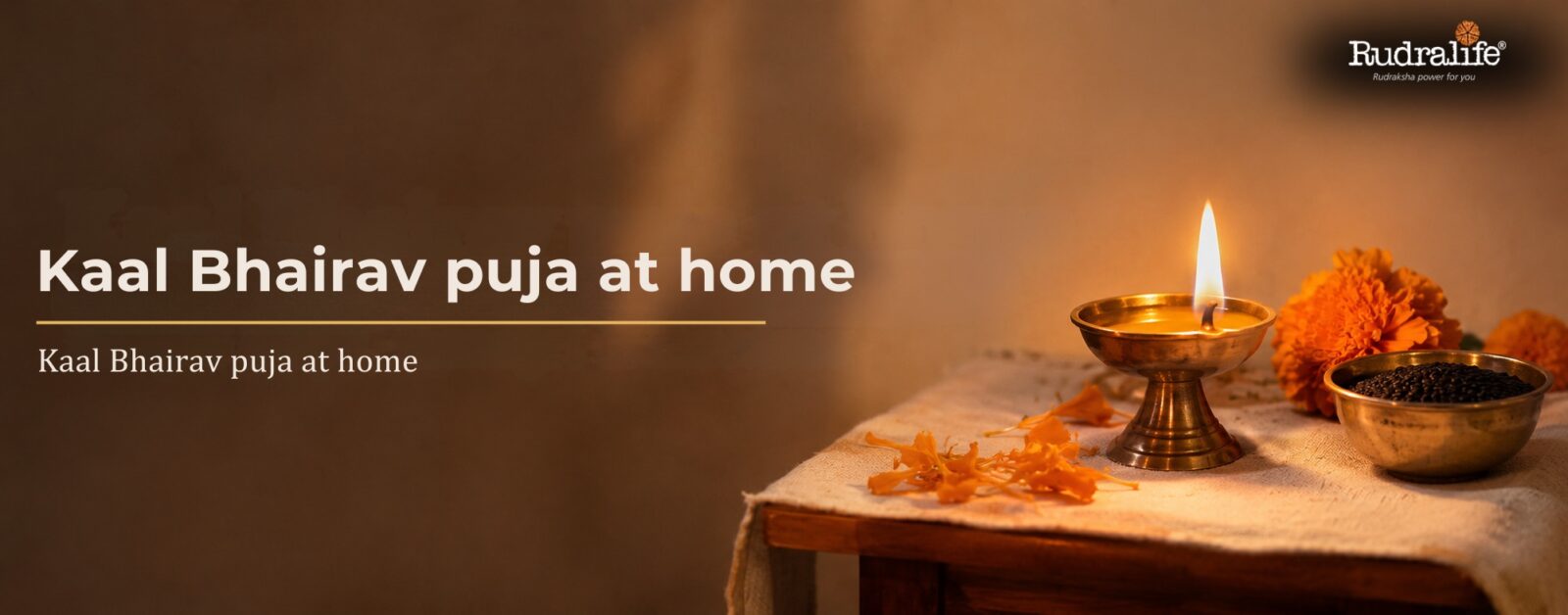
Kaal Bhairav puja at home needs very little: a quiet corner, a small lamp of mustard oil, a handful of black sesame and a steady mind. Devotees turn to Shiva’s protective form on Kalashtami each month, on Tuesdays and Sundays, and above all on Kaal Bhairav Jayanti, which falls on Tuesday, 1 December 2026.
Kaal Bhairav is Lord Shiva as the guardian of time and the Kotwal of Kashi. He is fierce in form, but his worship at home is gentle and simple, and anyone in the family can do it.
This guide covers the best days and time for the puja, a full samagri list, seven simple steps, the mantras to chant, what to keep in mind and how Rudraksha supports your japa.
Key takeaways
- Kaal Bhairav puja at home is done in the evening, after sunset, on Kalashtami, Tuesdays, Sundays or Kaal Bhairav Jayanti
- Kaal Bhairav Jayanti 2026 is on Tuesday, 1 December; in Mumbai, the evening puja window is 6:00 PM to 11:13 PM
- The heart of the puja is a mustard or sesame oil lamp, black sesame, the mantra Om Kaal Bhairavaya Namah and a meal for a dog
- No Rudraksha is directly connected to Kaal Bhairav; devotees chant on a Rudraksha mala and wear Shiva’s Rudraksha. Rudralife recommends Rudraksha by date of birth (Mulank)
- Rudralife’s Vedic pandits perform the Kaal Bhairav Aaradhana on 1 December 2026 at 12:35 PM IST, streamed live on YouTube
When to do Kaal Bhairav puja at home
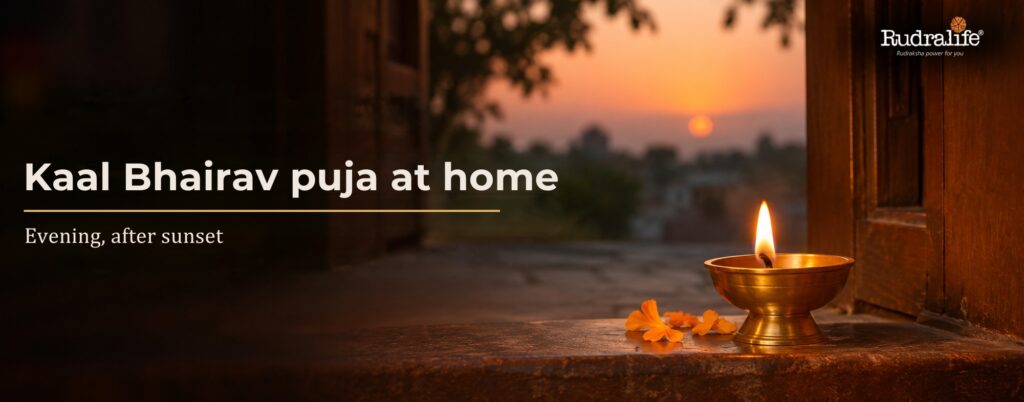
Bhairava is worshipped after sunset, so the puja is done in the evening. Four kinds of days are traditionally chosen:
- Kalashtami: the Ashtami of the waning moon each month, sacred to Kaal Bhairav
- Kaal Bhairav Jayanti: the most important Kalashtami of the year, on Margashirsha Krishna Ashtami
- Tuesdays and Sundays: considered especially auspicious for Bhairav worship
- Any evening of need: when you seek protection, courage or a steady mind
Kaal Bhairav Jayanti 2026 (Mumbai):
- Date: Tuesday, 1 December 2026
- Ashtami tithi: 12:11 AM to 11:13 PM, 1 December (IST)
- Evening puja window: after sunset at 6:00 PM, until Ashtami ends at 11:13 PM
Kalashtami dates ahead (Mumbai):
- 2026: Tuesday, 1 December (Kaal Bhairav Jayanti) and Wednesday, 30 December
- 2027: 29 January, 28 February, 29 March, 28 April, 28 May, 27 June, 26 July, 24 August, 23 September, 22 October, 20 November (Kaal Bhairav Jayanti) and 20 December
Find the exact Kalashtami timing for your city on Drik Panchang →
Tithis can shift by a day depending on your city, so do check your local panchang. Source: Drik Panchang.
Who is Kaal Bhairav?
Kaal Bhairav is the fierce, protective form of Lord Shiva. Kaal is time, and Bhairava is the fearsome one who removes fear. The Shiva Purana tells that he appeared from Shiva to humble Brahma’s pride, and Shiva then made him the guardian, the Kotwal, of Kashi.
He is shown with a dark complexion, a trident and a skull bowl, with a dog, his vahana, by his side. Devotees pray to him for protection, courage and the strength to set down their own pride.
Read: Kaal Bhairav Jayanti 2026 → The date, Mumbai timings and the story of Kashi’s guardian.
Kaal Bhairav puja samagri
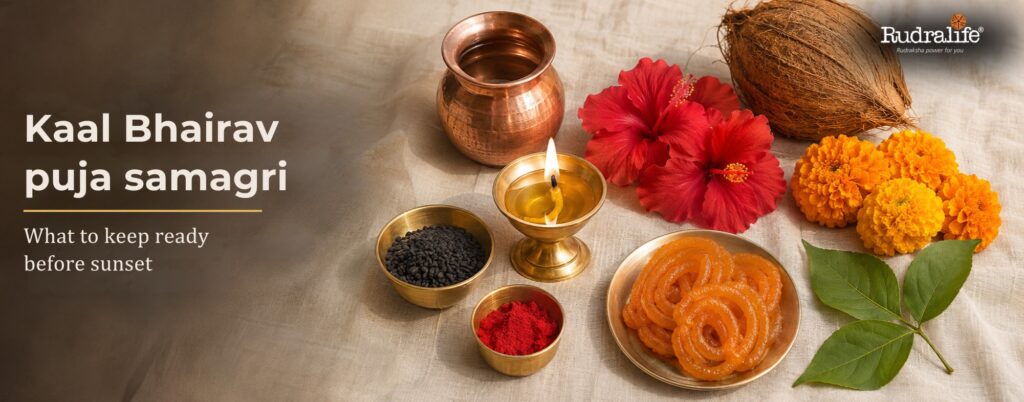
Keep these ready before sunset:
- An image of Kaal Bhairav, or a Shivling
- A diya with mustard oil or sesame oil, and a cotton wick
- Black sesame seeds (kala til)
- Flowers, ideally red hibiscus or marigold, and a few bilva leaves
- Water, a little Ganga jal if you have it, and vibhuti
- Sindoor or kumkum for tilak
- Dhoop or incense
- A coconut and a simple sweet: jalebi or imarti in North India, vada in the South
- A Rudraksha mala for japa
- A roti or some food for a dog
How to do Kaal Bhairav puja at home: 7 simple steps
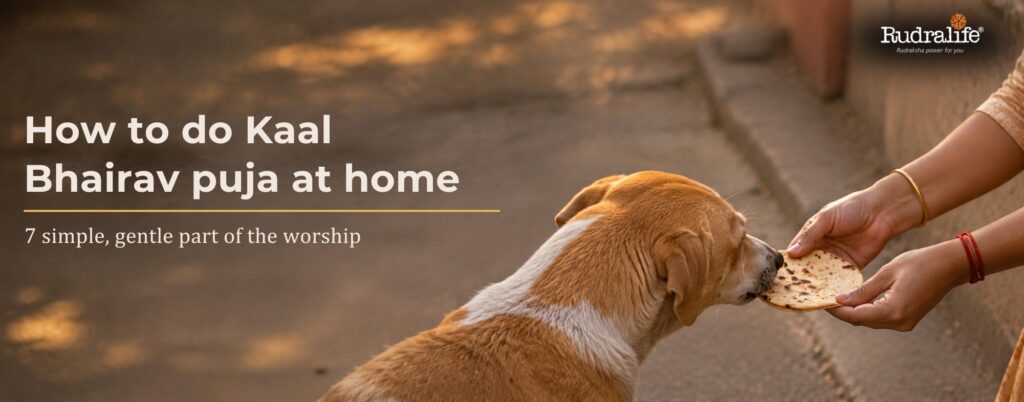
The puja is simple and can be done by anyone in the family. Simple, steady devotion matters more than elaborate ritual.
1. Prepare yourself and the space: Bathe, wear clean clothes and clean the puja corner. Sprinkle a little Ganga jal or water and light dhoop.
2. Set up the altar: Place the image of Kaal Bhairav, or a Shivling, on a clean cloth facing you. Keep the samagri within reach.
3. Take the sankalp: Sit quietly, fold your hands and state your name, your gotra if you know it, and your prayer. Many devotees keep a fast through the day and break it after the puja.
4. Light the lamp: After sunset, light the mustard or sesame oil diya and place it before the image. Offer water, apply tilak, and offer flowers, bilva leaves and black sesame.
5. Chant with a Rudraksha mala: Chant Om Kaal Bhairavaya Namah 108 times, or recite the Kalabhairava Ashtakam. End with Om Namah Shivaya.
6. Offer bhog and aarti: Offer the coconut and sweet, perform a simple aarti and sit in silence for a few minutes. Pray for protection and for the strength to let go of fear and pride.
7. Feed a dog and share prasad: Offer a roti or some food to a dog, Bhairava’s vahana, and share the prasad with the family. Place used flowers at the base of a tree or in flowing water.
Watch: how to do Rudraksha japa →
Mantras for Kaal Bhairav puja
These are the mantras most devotees chant at home:
- ॐ कालभैरवाय नमः · Om Kaal Bhairavaya Namah: the simplest Kaal Bhairav mantra, chanted 108 times on a Rudraksha mala
- ॐ नमः शिवाय · Om Namah Shivaya: the panchakshari mantra of Lord Shiva, to close the japa
- Kalabhairava Ashtakam: eight verses by Adi Shankaracharya praising Kaal Bhairav as the lord of Kashi
The first verse of the Kalabhairava Ashtakam:
देवराजसेव्यमानपावनाङ्घ्रिपङ्कजं व्यालयज्ञसूत्रमिन्दुशेखरं कृपाकरम् । नारदादियोगिवृन्दवन्दितं दिगंबरं काशिकापुराधिनाथकालभैरवं भजे ॥
I worship Kaal Bhairav, lord of the city of Kashi, whose lotus feet are served by Indra, king of the gods; who wears a serpent as his sacred thread and the moon on his head; who is full of compassion; and who is praised by Narada and the great yogis.
Kalabhairava Ashtakam, Adi Shankaracharya
Read: Powerful Shiva Mantras → The mantras of Lord Shiva and how to chant them.
Dos and don’ts for Kaal Bhairav puja at home
Do’s
- Do the puja with a calm, respectful mind. Kaal Bhairav is a protector, and there is nothing to fear in his worship.
- Keep the lamp on a metal plate, away from curtains, and never leave it burning unattended.
- Feed dogs gently and never harm or chase them, as the dog is Bhairava’s vahana.
- Fast only if it suits you. Fasting is a choice, not a rule.
Don’ts
- Don’t bring alcohol into a home puja. Liquor is offered at the Kal Bhairav temple in Ujjain as a tantric temple tradition; at home, a lamp, sesame and a simple sweet are enough.
- Don’t chant tantric mantras without a guru’s guidance. Om Kaal Bhairavaya Namah and the Ashtakam are complete in themselves.
- Don’t throw used flowers in the bin; place them at the base of a tree or in flowing water.
Rudraksha for Kaal Bhairav Jayanti
There is no Rudraksha directly connected to Kaal Bhairav. As he is a form of Lord Shiva, devotees chant on a Rudraksha mala and wear the Rudraksha linked with Shiva.
- 1 Mukhi Rudraksha: Named in the Shiva Purana as Shiva himself, this bead blesses the wearer with deep meditation and the path to liberation. The genuine 1 Mukhi is the South Indian half-moon (Kaju Dana); a 1 Mukhi from Nepal does not exist in any shape.
Explore 1 Mukhi Rudraksha → - 2 Mukhi Rudraksha: Representing Ardhanareshwar, Shiva and Shakti as one, this bead blesses the wearer with harmony in relationships and inner balance.
Explore 2 Mukhi Rudraksha → - 5 Mukhi Rudraksha: Representing Kalagni Rudra, Shiva as the fire of time, this bead blesses the wearer with calm, clarity and steady devotion in japa.
Explore 5 Mukhi Rudraksha → - 11 Mukhi Rudraksha: Named in the Shiva Purana as Rudra himself, this bead blesses the wearer with courage, protection and success in every undertaking.
Explore 11 Mukhi Rudraksha → - 14 Mukhi Rudraksha: Named in the Shiva Purana as Parama Shiva, the supreme Shiva, this bead, known as Deva Mani, blesses the wearer with intuition, protection and steady courage.
Explore 14 Mukhi Rudraksha → - 15 Mukhi Rudraksha: Representing Lord Pashupatinath, Shiva as the lord of all beings, this bead blesses the wearer with compassion, emotional strength and spiritual growth.
Explore 15 Mukhi Rudraksha → - Gaurishankar Rudraksha: Two naturally joined beads representing Lord Shiva and Maa Parvati, this bead blesses the wearer with harmony in marriage and in the family.
Explore Gaurishankar Rudraksha → - Sawar Rudraksha: A rare natural formation of two joined beads, one side carrying a single mukhi and the other several, this bead is revered as Shiva and Parvati together and blesses the wearer with devotion, protection and harmony at home. Its value lies in the joined pair, so a Sawar broken apart and sold as a “1 Mukhi Nepal” is no longer a Sawar.
Explore Sawar Rudraksha →
For daily japa, the Shiv Mala joins one South Indian 1 Mukhi with 108 Indonesian 5 Mukhi beads.
Explore the Shiv Mala →
Rudralife’s Note: The Shastras support wearing all mukhi Rudraksha together. Different mukhis do not conflict with one another, and Rudraksha always acts positively.
Every devotee is different. Rudralife’s recommendation is based on your date of birth through astro-numerology (Mulank). Your Mulank shows your ruling planet, and a Rudraksha for that planet is suggested only when it needs balancing.
Every Rudraksha from Rudralife is authenticated through X-ray at RRTL, Rudralife’s own ISO 9001:2015 lab, and ACE energised before it reaches you.
Get your personalised Rudraksha recommendation →
Prefer to see Rudraksha in person? Visit us at an upcoming Rudralife exhibition →
Kaal Bhairav Aaradhana with Rudralife
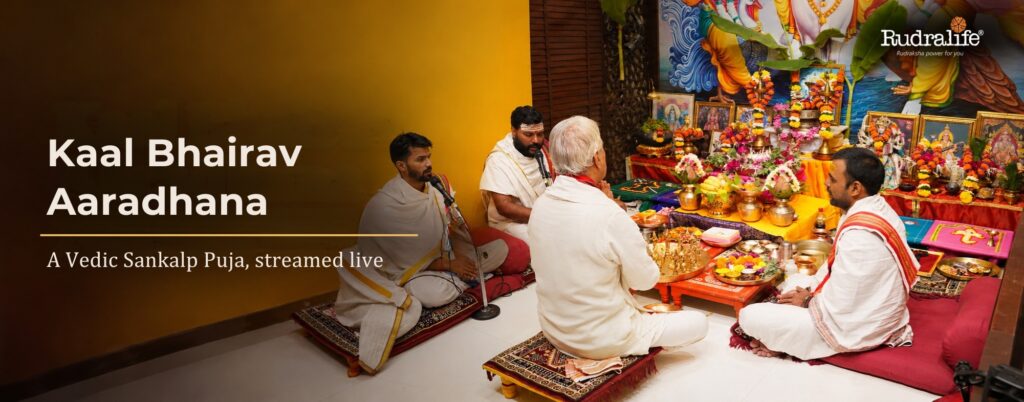
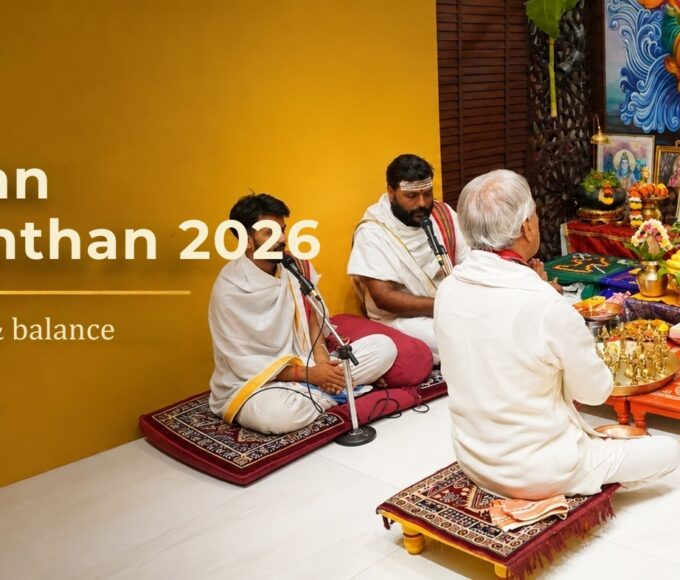
Your home puja is complete in itself. Many devotees also join a Vedic puja on Kaal Bhairav Jayanti. On Tuesday, 1 December 2026, Rudralife’s Vedic pandits perform the Kaal Bhairav Aaradhana, a Vedic Sankalp Puja seeking Kaal Bhairav’s protection, fearlessness and the removal of obstacles.
The pandits take your sankalp with your full name and gotra, as per Vedic scriptures. The puja is streamed live on YouTube, and you receive a personal video on WhatsApp of the Vedic pandits chanting your name and gotra.
- Date: Tuesday, 1 December 2026
- Time: 12:35 PM IST (Amrit Muhurat)
- Duration: 3 to 4 hours
- Vedic pandits: 7
- Mahaprasad: an energised Kaal Bhairav Yantra in black agate, a Rudraksha japa mala, vibhuti, mauli and a booklet of Kaal Bhairav mantras and stories
Book the Kaal Bhairav Aaradhana →
FAQ
- Can Kaal Bhairav puja be done at home? Yes. A simple puja with a mustard oil lamp, black sesame, flowers and the mantra Om Kaal Bhairavaya Namah can be done by anyone in the family.
- What is the best day for Kaal Bhairav puja? Kalashtami, the Ashtami of the waning moon, is the most important day each month. Tuesdays and Sundays are also considered auspicious, and Kaal Bhairav Jayanti is the most sacred day of the year.
- What time should Kaal Bhairav puja be done? In the evening, after sunset. On Kaal Bhairav Jayanti 2026, the window in Mumbai is 6:00 PM to 11:13 PM. For any other city, please check Drik Panchang.
- Which oil is used for the Kaal Bhairav lamp? Mustard oil or sesame oil is traditionally used.
- What should I offer Kaal Bhairav at home? Black sesame, flowers, bilva leaves, a coconut and a simple sweet such as jalebi, imarti or vada. Feeding a dog is also part of the puja.
- Can women do Kaal Bhairav puja? Yes. Anyone in the family can do the puja with sincere devotion.
- Which Rudraksha is best for Kaal Bhairav puja? No Rudraksha is directly connected to Kaal Bhairav. Devotees chant on a Rudraksha mala, most often 5 Mukhi, and wear the Rudraksha linked with Lord Shiva. For a recommendation suited to you, Rudralife looks at your date of birth through astro-numerology.
The bottom line
Kaal Bhairav puja at home asks very little of us: a lamp lit after sunset, a few grains of sesame, a mantra repeated with a steady mind and a meal for a dog.
Whether you keep it on Kalashtami, on a quiet Tuesday or on Kaal Bhairav Jayanti, the guardian of Kashi is said to protect those who come to him with a simple heart. For 25 years, Rudralife has walked alongside devotees through every festival season, and we wish you a peaceful puja.
Check our upcoming exhibitions in your city →
Related reading
- Kaal Bhairav Jayanti 2026
- What Is Rudraksha? A Complete Beginner’s Guide
- Kalabhairavashtakam, Wikipedia
Disclaimer: Puja customs vary between families and communities, and tithi timings differ by city. Please confirm your observance with your family tradition or local panchang. Those with health conditions, expecting mothers and the elderly should choose a fast that suits them.





Leave a comment