






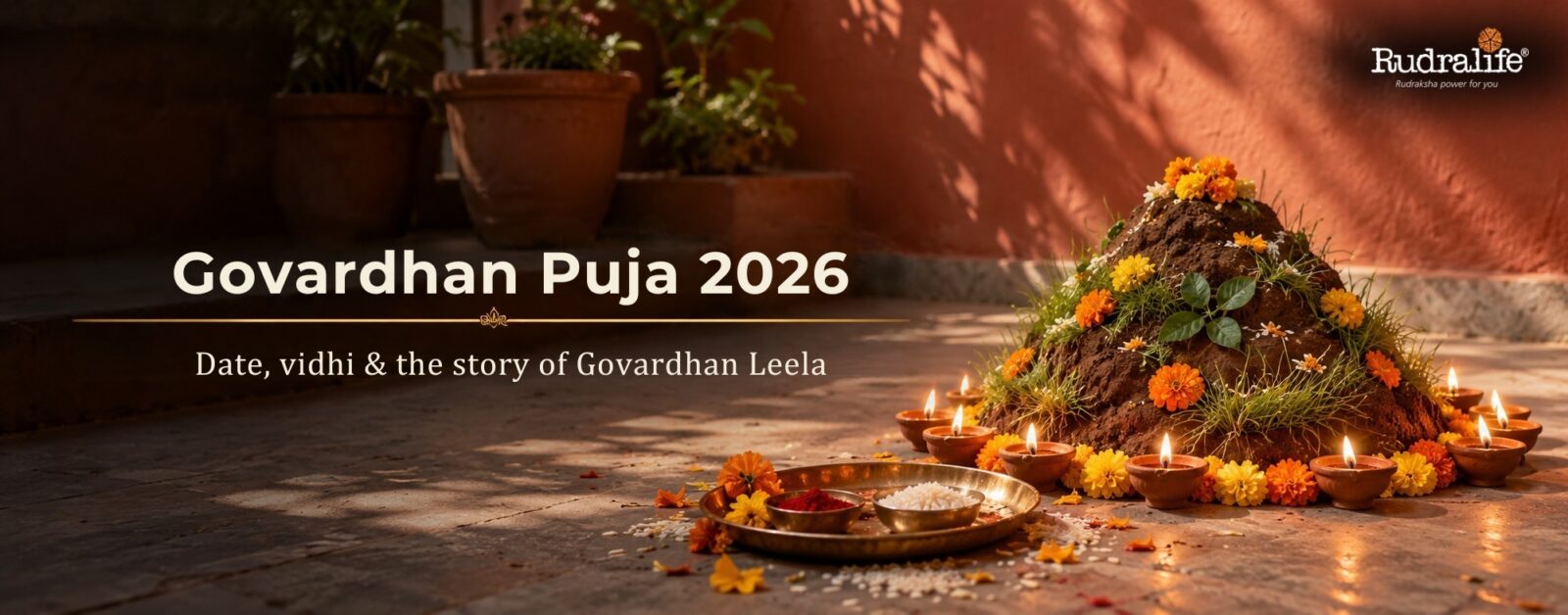
Govardhan Puja 2026 falls on Monday, 9 November, the day after Diwali, on Kartik Shukla Pratipada. It honours the day young Shri Krishna lifted Govardhan Parvat on his little finger to shelter the people & cattle of Vrindavan.
Families offer Annakut, a mountain of home-cooked food, as thanks for everything the earth provides.
Key takeaways
- Govardhan Puja 2026 is observed on Monday, 9 November, on Kartik Shukla Pratipada
- The festival remembers Shri Krishna lifting Govardhan Parvat to protect Vrindavan from Indra’s rains
- Annakut, meaning “mountain of food,” is offered to Shri Krishna as gratitude for nature’s abundance
- Many families shape a small Govardhan from cow dung, worship cows & perform parikrama
- Devotees often wear Rudraksha associated with Lord Vishnu & Goddess Lakshmi on this day for devotion & abundance
Govardhan Puja 2026 date & muhurat
In 2026, Govardhan Puja is observed on Monday, 9 November, the day after Diwali, on Kartik Shukla Pratipada.
- Diwali (Lakshmi Puja): Sunday, 8 November
- Govardhan Puja & Annakut: Monday, 9 November
- Pratahkala muhurat (New Delhi): [verify on Drik Panchang]
- Sayankala muhurat (New Delhi): [verify on Drik Panchang]
- Bhai Dooj: Wednesday, 11 November
In Gujarat, the same Pratipada marks the Gujarati New Year, & in Maharashtra & Karnataka it is celebrated as Bali Pratipada or Padwa.
Not sure which Rudraksha suits you this festive season? Get a personalised recommendation →
The story of Govardhan Leela
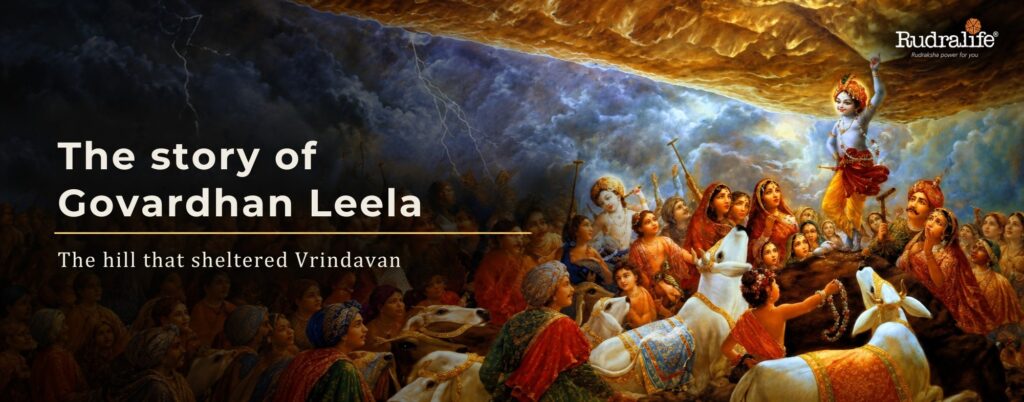
Every year, the people of Vraj offered a grand yagna to Indra, the lord of rain. Young Shri Krishna gently asked them why. It was Govardhan Parvat, he said, that gave their cows grass, their wells water & their homes shelter. So that year, the villagers offered their thanks to the hill instead.
Indra, hurt by the change, sent seven days of relentless rain. Shri Krishna lifted Govardhan Parvat on the little finger of his left hand & held it like an umbrella. Every family, every cow & calf found shelter beneath it until the storm passed. Indra understood, bowed before Shri Krishna & the rains stopped.
The leela carries a quiet message. Gratitude belongs to what truly sustains us, & true protection comes from surrender to the Divine rather than fear.
Explore Rudraksha for devotion & inner peace →
Annakut & how Govardhan Puja is performed at home
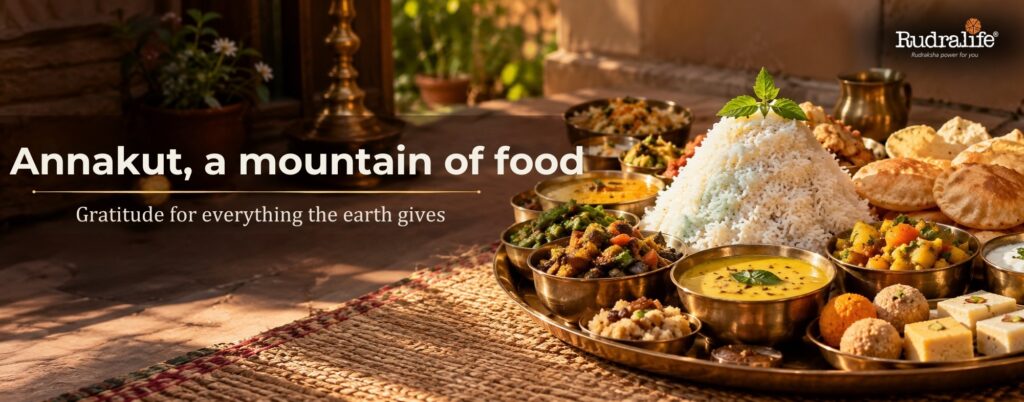
Annakut means “mountain of food.” Families cook grains, dal, seasonal vegetables, kadhi & sweets, then arrange them in the shape of a hill before Shri Krishna. Many temples prepare chhappan bhog, 56 offerings, on this day.
The traditional home vidhi is simple:
1. Make the Govardhan: shape a small hill from cow dung or clay in the courtyard or puja space, & decorate it with flowers, grass & small diyas.
2. Take sankalp: hold water & akshat, & say your name, gotra & the occasion.
3. Worship Shri Krishna & Govardhan: offer roli, rice, flowers, tulsi leaves, milk & batasha.
4. Offer Annakut: place the prepared food before Shri Krishna with gratitude.
5. Parikrama: walk around the Govardhan seven times, chanting Shri Krishna’s name.
6. Gau puja: honour cows with tilak & garlands, & feed them green fodder & jaggery.
7. Aarti & prasad: end with aarti, then share the Annakut as prasad with family & neighbours.
However simple your puja, what Shri Krishna receives is the bhav behind it. A handful of food offered with gratitude is Annakut enough.
See this season’s pujas & exclusive offers →
Rudraksha for Govardhan Puja
Govardhan Puja is a day of devotion to Shri Krishna & gratitude for abundance, & two Rudraksha are traditionally linked to these blessings. [Dr Tanay to confirm both associations]
- 10 Mukhi Rudraksha: Representing Lord Vishnu, of whom Shri Krishna is an avatar, this bead blesses the wearer with protection, calm & steady devotion.
- 7 Mukhi Rudraksha: Representing Goddess Mahalakshmi, this bead blesses the wearer with prosperity, abundance & a sense of plenty at home.
As with every Rudraksha, authenticity matters more than anything else. Rudralife beads are X-ray verified at RRTL, Rudralife’s own ISO 9001:2015 lab, & energised before they reach devotees.
If you prefer to see Rudraksha in person, come visit us at an exhibition.
Find the Rudraksha that suits you →
FAQ
1. When is Govardhan Puja in 2026? Govardhan Puja is on Monday, 9 November 2026, the day after Diwali, on Kartik Shukla Pratipada.
2. Why is Govardhan Puja celebrated? It remembers the day Shri Krishna lifted Govardhan Parvat to shelter the people & cattle of Vrindavan from Indra’s seven days of rain.
3. What is Annakut? Annakut means “mountain of food.” Families & temples prepare many dishes, often 56, & offer them to Shri Krishna as gratitude for nature’s abundance.
4. Is Govardhan Puja celebrated the day after Diwali? Usually, yes. In 2026, Diwali is on Sunday, 8 November, & Govardhan Puja follows on Monday, 9 November.
5. Why are cows worshipped on Govardhan Puja? Shri Krishna grew up as a cowherd, & cows were among those he sheltered under Govardhan. Gau puja honours them as a source of nourishment.
6. How many times is Govardhan parikrama done at home? Traditionally, seven times around the small Govardhan made at home, while chanting Shri Krishna’s name.
7. Which Rudraksha can I wear on Govardhan Puja? Devotees often choose the 10 Mukhi Rudraksha, associated with Lord Vishnu, & the 7 Mukhi Rudraksha, associated with Goddess Mahalakshmi. [Dr Tanay to confirm]
8. Is Govardhan Puja the same as Gujarati New Year? They usually fall on the same Pratipada. In Gujarat, the day is celebrated as Bestu Varas, the start of the new year.
Bottom line
Govardhan Puja 2026, on Monday, 9 November, is a day to give thanks for what quietly sustains us. Shape a small Govardhan, offer Annakut with love & remember the child who held a mountain so that no one would be left in the rain.
Related reading
- From Dussehra to Diwali 2026: 20 Sacred Days of Preparation
- Diwali & Lakshmi Puja 2026 with Rudraksha
- Rudraksha as an auspicious Dhanteras purchase
- Govardhan Hill, Wikipedia
Disclaimer
The festival dates & muhurat timings in this article are taken from Drik Panchang & may vary by city & family tradition. Please confirm with your local panchang or family priest before beginning the puja.





Leave a comment