







Two days after Diwali, the festival season closes on its gentlest note.
Bhai Dooj 2026 falls on Wednesday, 11 November, when sisters apply a tilak on their brothers’ foreheads, light a diya & pray for their long life. Brothers, in turn, offer a gift & a promise to stand by their sisters always.
Here is everything you need for the day: the date & muhurat, the stories behind it, a simple tilak vidhi & a way to let the blessing stay long after the lamps are put away.
Key takeaways
- Bhai Dooj 2026 is on Wednesday, 11 November, on Kartik Shukla Dwitiya
- he traditional aparahna tilak muhurat is 1:29 PM to 3:45 PM in Mumbai; the Dwitiya tithi ends around 3:53 PM.
- The festival is also known as Yama Dwitiya, Bhau Beej, Bhai Beej, Bhai Phonta & Bhai Tika
- It is rooted in two stories: Yama visiting his sister Yamuna, & Krishna visiting Subhadra after defeating Narakasura
- The ritual is simple: tilak, akshat, aarti, sweets & a prayer for the brother’s long life
- A Rudraksha bracelet chosen through date-of-birth analysis is a meaningful gift that stays with a sibling all year
Bhai Dooj 2026 date & tilak muhurat
Date: Wednesday, 11 November 2026
Tithi: Kartik Shukla Dwitiya
Dwitiya tithi begins: Tuesday, 10 November 2026, around 2:00 PM
Dwitiya tithi ends: Wednesday, 11 November 2026, around 3:53 PM
Aparahna tilak muhurat: 1:29 PM to 3:45 PM (Mumbai)
Tradition holds the aparahna, the early afternoon, as the most fitting time for the tilak, as long as the Dwitiya tithi still prevails. Since muhurat timings shift with sunrise in each city, it is worth confirming your local timing on Drik Panchang before the ceremony.
For devotees abroad, the date follows the local tithi. In the USA, Bhai Dooj 2026 falls a day earlier, on Tuesday, 10 November, while Australia observes it on the same day as India.
Check your city’s tilak muhurat on Drik Panchang →
Planning the whole festival week? See our Diwali 2026 calendar →
What is Bhai Dooj?
Bhai Dooj is the last of the five days of Diwali, observed on the second day (dooj, or dwitiya) of the bright fortnight of Kartik. In the panchang, it is called Yama Dwitiya, a name that points to its oldest story.
At its heart, the day is about one quiet wish: that a brother lives long & well. Sisters pray for his protection, & brothers promise theirs in return.
Where Raksha Bandhan is marked by the rakhi, Bhai Dooj is marked by the tilak, the aarti & a shared meal at the sister’s home. Gifts are exchanged too, & many families now choose Rudraksha, a gift that keeps the day’s prayer close all year.
The stories behind Bhai Dooj

Yama & Yamuna
Yama, the lord of death, & Yamuna, the river goddess, are believed to be twins, children of Surya. Yamuna would often invite her brother home, but his duties kept him away.
On Kartik Shukla Dwitiya, he finally came. Yamuna welcomed him with an aarti, a tilak on his forehead & a meal cooked with love.
Moved by her care, Yama offered her a boon. She asked that every brother who receives a tilak from his sister on this day be free from the fear of untimely death. Yama granted it, & the day came to be known as Yama Dwitiya.
Krishna & Subhadra
Another story tells of Lord Krishna returning after defeating the demon Narakasura. His sister Subhadra received him with flowers, sweets & a tilak on his forehead. Many families see this welcome as the gentle origin of the tilak ceremony performed today.
Read: Narak Chaturdashi 2026, the story of Narakasura →
How to perform the Bhai Dooj tilak

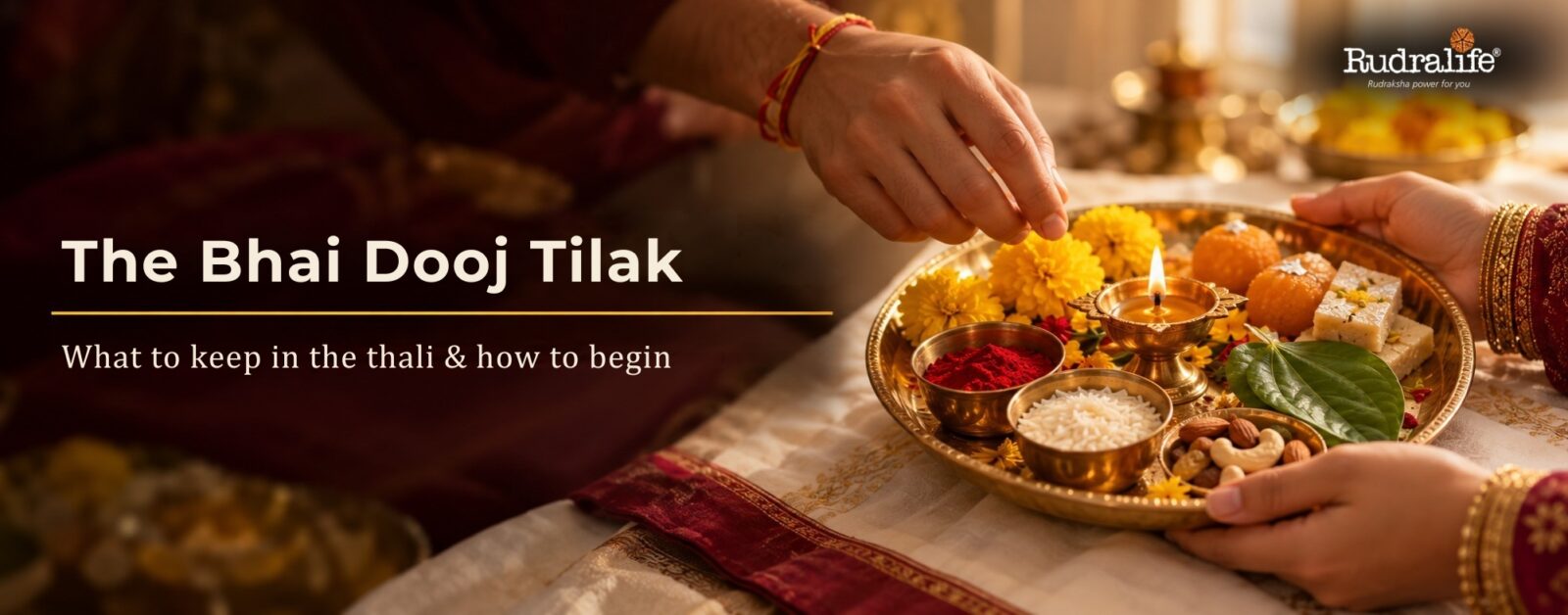
For the thali, keep ready:
- Roli or kumkum
- Akshat (unbroken rice)
- A diya with ghee or oil
- Sweets & a few dry fruits
- Flowers, a coconut or betel leaf, as per family custom
The ceremony:
1. Both brother & sister bathe & wear fresh clothes. In many homes, the sister keeps a fast until the tilak is done.
2. The brother sits on a clean asana, traditionally facing east, & the sister sits facing him.
3. She lights the diya & offers a short prayer to Lord Ganesha & to Yama & Yamuna.
4. She applies the tilak on his forehead with her ring finger & places akshat over it.
5. She performs his aarti & offers him sweets.
6. The brother touches her feet if she is elder, offers a gift & shares the meal she has prepared. Many siblings now exchange Rudraksha bracelets at this moment, a gift both can wear every day.
In Mathura, siblings traditionally bathe together in the Yamuna at Vishram Ghat on this day, in keeping with Yamuna’s boon.
Bhai Dooj across India
- Bhau Beej, Maharashtra & Goa: Sisters perform aarti for their brothers, often followed by a family meal.
- Bhai Beej, Gujarat: Brothers visit their sisters’ homes for the tilak & a festive lunch.
- Bhai Phonta, Bengal: Sisters fast until they apply a phonta of sandalwood paste, kajal & ghee on the brother’s forehead.
- Chitragupta Puja: Many Kayastha families also worship Chitragupta, the divine record-keeper, on this day.
Rudraksha: a Bhai Dooj gift that carries the blessing forward
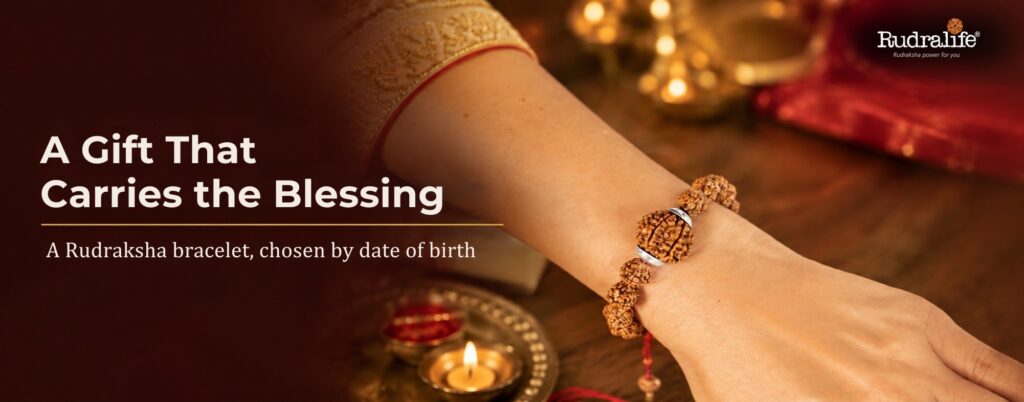
The tilak lasts a day, but the prayer behind it is meant to stay. This is why many families choose a gift that the brother or sister can keep close.
Rudraksha is born of Lord Shiva’s tears, & devotees have worn it for protection, calm & good health for generations. A Rudraksha bracelet, worn on the wrist every day, becomes a gentle reminder of the sibling who gave it & the prayer that came with it.
At Rudralife, we suggest Rudraksha through a date-of-birth analysis using astro-numerology, so the bead suits the person who will wear it. All you need is your sibling’s date of birth.
Not sure which suits them? Find the Rudraksha suited to your sibling →
If you prefer to see Rudraksha in person, come visit us at an exhibition →
Celebrating when siblings live apart
Not every family can sit together on Bhai Dooj. Many sisters perform the tilak over a video call at the muhurat, keeping a small thali & diya ready on their side, while the brother lights a diya on his. Others send roli, akshat & sweets ahead so the brother can apply the tilak himself at the right time.
Sending a gift ahead? Explore Rudraksha bracelets →
In some families, sisters who don’t have brothers offer the tilak to a cousin, or pray to the moon on this evening. The ritual adapts; the prayer stays the same.
Frequently asked questions
1. When is Bhai Dooj in 2026? Bhai Dooj 2026 is on Wednesday, 11 November, on Kartik Shukla Dwitiya. In the USA, it falls on Tuesday, 10 November.
2. What is the Bhai Dooj 2026 tilak muhurat? The aparahna muhurat is 1:29 PM to 3:45 PM in Mumbai. Timings vary by city, so please check Drik Panchang for your location.
3. Why is Bhai Dooj called Yama Dwitiya? The name comes from the story of Yama visiting his sister Yamuna on this Dwitiya & granting the boon that brothers who receive her tilak would be free from the fear of untimely death.
4. How is Bhai Dooj different from Raksha Bandhan? Raksha Bandhan falls in Shravan & centres on the rakhi. Bhai Dooj falls two days after Diwali & centres on the tilak, the aarti & a prayer for the brother’s long life.
Read: Rudraksha Power for Raksha Bandhan →
5. Can the tilak be done after the muhurat? The aparahna is considered the most fitting time, but many families perform the tilak whenever the siblings are together during the day. Devotion matters more than the clock.
6. What should sisters keep in the Bhai Dooj thali? Roli or kumkum, akshat, a diya, sweets & flowers, along with anything your family custom adds, such as a coconut or betel leaf.
7. What is a meaningful gift for Bhai Dooj? A gift that can be kept close works beautifully. A Rudraksha bracelet, chosen through a date-of-birth analysis, is one that many families pick for its spiritual meaning.
Bottom line
Bhai Dooj 2026 falls on Wednesday, 11 November, with the tilak traditionally applied between 1:29 PM & 3:45 PM in Mumbai.
Whether you are sitting across from your sibling or across the world, a tilak, a diya & a quiet prayer are all the day asks for. May the bond you honour this Bhai Dooj stay protected all year.
Find the Rudraksha suited to your sibling, based on their date of birth →
Related reading
- Rudraksha Power for Raksha Bandhan
- Dhanteras 2026 & Aarogya Maha Lakshmi Puja
- Narak Chaturdashi 2026
- From Dussehra to Diwali 2026
- Bhai Dooj — Wikipedia
Disclaimer: Festival dates & muhurat timings are indicative & vary by city; please confirm your local timing on Drik Panchang. Rituals differ by region & family custom.







Leave a comment