







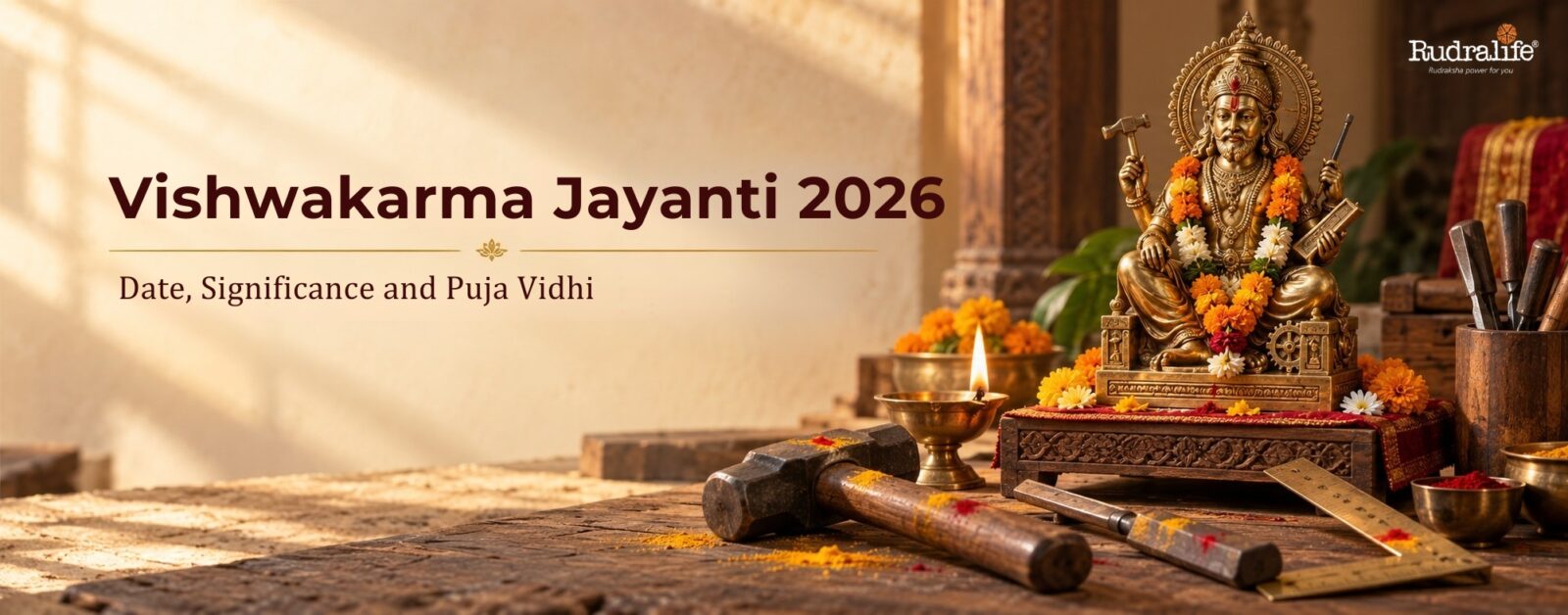
Vishwakarma Jayanti 2026 falls on 17 September, the day devotees honour Vishwakarma, the divine architect and craftsman of the gods. Vishwakarma Jayanti is observed every year in honour of Lord Vishwakarma, revered in the shastras as the divine architect and craftsman of the universe.
In 2026, the festival falls on Thursday, September 17, coinciding with Kanya Sankranti, when the Sun transits into Virgo. This is a fixed solar-calendar date, which is why Vishwakarma Puja does not shift year to year the way lunar festivals do.
For devotees, artisans, engineers and anyone whose work depends on tools and craft, this day carries a simple message: the instruments we use to create and build deserve reverence, not just use.
This guide covers what Vishwakarma Jayanti 2026 marks, when the puja is performed, and how devotees observe it.
Key Takeaways
- Vishwakarma Jayanti 2026 falls on 17 September, aligned with Kanya Sankranti
- Sankranti moment is around 7:58–7:59 AM, with the main puja muhurat typically observed in the afternoon
- Lord Vishwakarma is worshipped as the son of Brahma and the architect of the gods’ palaces, weapons and vehicles
- His creations across the yugas include Lanka, Dwarka, Indraprastha, Amaravati, the Sudarshan Chakra, Trishul, Vajra and the Pushpaka Vimana
- The day is widely observed in West Bengal, Odisha, Assam, Bihar, Jharkhand, Tripura and Karnataka, especially by artisans, craftsmen and industrial workers
- Tools, machinery and instruments of work are cleaned, worshipped with turmeric and vermilion, and set aside for the day
- Rudralife’s Vedic pandits perform Vishwakarma Puja on 17 September at 1:40 PM, centred on the Vishwakarma Stotram paath and performed in your name and gotra.
- The festival is rooted in the Rig Veda and Sthapatya Veda, which describe Vishwakarma’s role in architecture and craftsmanship
- Astrologically, the day is linked to Saturn, and is considered significant for those seeking to ease Saturn’s obstacles in career and new ventures
Who Is Lord Vishwakarma?
Lord Vishwakarma is described in the shastras as Brahma’s son and the presiding deity of creation, architecture and craft. Mythology credits him with building the celestial abodes of the gods, along with their weapons and vehicles, work that required not just skill but discipline and devotion to the act of making itself.
This is what devotees are invited to reflect on during his Jayanti: that creation, whether of a temple, a tool, or a piece of craftsmanship, is a form of worship in itself.
The Story Behind Vishwakarma: A Legacy of Creativity
Vishwakarma Jayanti 2026 is observed as a day of gratitude for tools, machinery and the work they make possible.
The shastras describe Vishwakarma’s creativity as boundless, and the list of his creations across the yugas reflects that. He is credited with building Swarga Lok, the celestial realm of the gods, and Amaravati, Indra’s capital, described in the Puranas as adorned with wish-fulfilling gardens and palaces of divine craftsmanship.
In the Treta Yuga, he built the golden city of Lanka, later home to Ravana. In the Dwapar Yuga, legend holds that he constructed Dwarka, Lord Krishna’s capital, in a single night. He is also credited with Indraprastha and Hastinapur, the cities central to the Mahabharata.
Beyond cities, Vishwakarma is said to have crafted the Divine weapons, or divyastras that gods relied on: Lord Shiva’s Trishul, Lord Vishnu’s Sudarshan Chakra, Indra’s Vajra, and the Pushpaka Vimana, a flying vehicle later associated with the Ramayana.
Each creation, according to the stories, was purpose-built: a weapon to restore balance, a city to shelter the righteous, a vehicle to carry the worthy. Vishwakarma’s craft was never creativity for its own sake, it was always in service of something larger.
That same spirit finds an echo in the way people build today. An engineer designing a bridge, an architect drafting a home, a founder building a product, a craftsman shaping a piece by hand, each is engaged in the same act the shastras describe: giving form to an idea, and doing it with enough care that the work outlasts the moment it was made in.
That is the thread running through Vishwakarma Jayanti 2026: work itself treated as worship.
Vishwakarma Jayanti 2026: Date and Puja Muhurat
| Detail | Timing |
| Date | Thursday, September 17, 2026 |
| Occasion | Vishwakarma Jayanti |
| Main Puja Muhurat | 1:26 PM – 4:14 PM |
Because the festival follows the solar calendar, the date stays fixed at September 17 nearly every year except leap years, unlike most Hindu festivals that move with the lunar tithi.
Puja Vidhi: How Vishwakarma Jayanti Is Observed
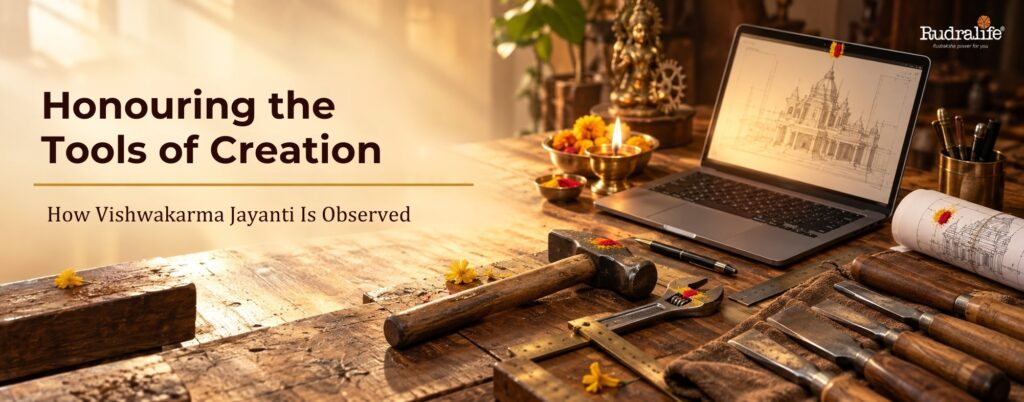
The puja vidhi for Vishwakarma Jayanti 2026 centres on the tools and equipment of one’s trade.
- Tools, machines and instruments are cleaned thoroughly the previous evening
- A Vishwakarma idol or image is placed at the workplace or in the home
- Devotees sit facing east and begin the puja with mantras and an akhanda diya
- Turmeric and vermilion are applied to tools and machinery as a mark of blessing
- Work is paused for the day, craftsmen traditionally do not use their tools on this occasion
- In many workplaces, the day closes with a shared meal for workers and artisans
None of this needs to be elaborate. Vishwakarma Jayanti 2026 asks for care rather than scale.
If arranging the full vidhi yourself is difficult, Rudralife’s Vedic pandits will perform the complete Vishwakarma Puja on 17 September at 1:40 PM, in your name and gotra.
For Those Starting or Building Something New
Vishwakarma Jayanti holds particular meaning for anyone in the early, uncertain stages of building something, a new business, a creative practice, a design studio, an engineering venture, or simply a fresh direction in one’s craft.
Architects, artists, entrepreneurs, engineers, designers and craftsmen have traditionally turned to this day for a reason: creation of any kind comes with setbacks. Plans stall, funding is delayed, ideas don’t land the way they were imagined, and the discipline required to keep going can wear thin. These are the very difficulties the shastras associate with Saturn.
The Saturn Connection
Lord Vishwakarma’s link to Saturn is more than symbolic. According to the Skanda Purana, Surya (the Sun) was married to Sandhya, daughter of Vishwakarma, and their union gave rise to Shani Dev, Saturn, among their children.
Saturn, in Vedic astrology, governs discipline, patience, karma and the pace at which effort turns into results. It is also the planet most associated with delay, struggle and obstacles, particularly in career and new undertakings.
Because of this lineage, Vishwakarma Puja is astrologically regarded as a day that can soften Saturn’s harder edges, the stalled projects, the slow starts, the setbacks that come with building something from nothing.
For someone beginning a new venture or trying to move a stuck creative or professional pursuit forward, this makes the day less of a ritual observance and more of a genuine need: a chance to pair sincere effort with equally sincere devotion, and ask for the discipline to see the work through.
The section above is about Saturn’s obstacles, and the 7 Mukhi Rudraksha is the bead traditionally associated with Shani.
Buy a certified 7 Mukhi Rudraksha →
Devotees marking Vishwakarma Jayanti specifically often look to the 17 Mukhi instead, whose presiding deity is Shree Vishwakarma.
Buy a certified 17 Mukhi Rudraksha →
Read: Rudraksha for Navagraha →
Not sure which suits you? Get a free recommendation based on your date of birth →
Why This Day Matters Beyond the Ritual
Vishwakarma Jayanti is ultimately a festival about respecting the discipline behind any skilled work, whether that is architecture, engineering, or the painstaking craft of shaping and authenticating a Rudraksha bead.
At Rudralife, every bead that reaches a devotee passes through hands trained in this same spirit of care: cleaning, verification, and finishing done with attention rather than haste. Honouring Vishwakarma Jayanti is, in that sense, a reminder that devotion often lives in the quality of the work itself.
For devotees who wish to mark the day with a formal observance, Rudralife’s Vedic pandits will perform Vishwakarma Puja on 17 September at 1:40 PM. At the heart of it is the Vishwakarma Stotra Paath, recited in full, within a complete vidhi that runs from Shanti Paath and Maha Sankalp through the Abhishek of Ganpati, Maha Lakshmi, Shiv and Vishwakarma, and closes with Aarti, Pushpanjali and Maha Prasad. The puja is performed in your name and gotra, so you can take part from wherever you are.
It is observed by devotees in engineering, construction, technical and creative work, and by those in land-related fields, and is traditionally sought for success, protection and growth, particularly when a new venture or project is being started and obstacles need clearing.
FAQs
When is Vishwakarma Jayanti in 2026? Vishwakarma Jayanti 2026 falls on Thursday, 17 September, coinciding with Kanya Sankranti.
Why does the date not change every year? Unlike most Hindu festivals, which follow the lunar calendar, Vishwakarma Puja is tied to Kanya Sankranti, a solar transit, so it falls on or around September 17 consistently.
Who observes Vishwakarma Jayanti? It is widely observed by artisans, craftsmen, engineers and industrial workers, particularly in West Bengal, Odisha, Assam, Bihar, Jharkhand, Tripura and Karnataka, though devotees across India mark the day.
What is worshipped on this day? Tools, machinery, vehicles and instruments of work are cleaned and worshipped, along with an idol or image of Lord Vishwakarma.The puja on Vishwakarma Jayanti 2026 is usually performed at the workplace rather than at home.
What is the connection between Lord Vishwakarma and Saturn? According to the Skanda Purana, Shani Dev (Saturn) was born to Surya and Sandhya, who was Vishwakarma’s daughter, making Saturn linked to Vishwakarma’s lineage. This is why the day is astrologically considered significant for easing Saturn-related setbacks, especially in career and new ventures.
What did Lord Vishwakarma create, according to mythology? He is credited with building Swarga Lok and Amaravati, the golden city of Lanka, Dwarka, Indraprastha and Hastinapur, along with divine instruments such as Shiva’s Trishul, Vishnu’s Sudarshan Chakra, Indra’s Vajra and the Pushpaka Vimana.
Is Vishwakarma Jayanti connected to Rudraksha? Not directly through shastric prescription, but the spirit of the day, honouring the discipline and care behind skilled craft, reflects the same values Rudralife brings to authenticating and preparing each Rudraksha bead for devotees.
The Bottom Line
Vishwakarma Jayanti is a quiet but meaningful festival, a day to pause and honour the tools, skill and discipline behind any act of creation.
For 25 years, Rudralife has approached the craft of Rudraksha authentication with that same reverence for careful, skilled work, offered to devotees with the same spirit this Jayanti calls for.
However you observe Vishwakarma Jayanti 2026, the intention behind it is what matters. Vishwakarma Jayanti 2026 is a quiet but meaningful festival, a day to pause and honour the tools, skill and discipline behind any act of creation.
If you would like the day marked formally, our pandits will perform the full Vishwakarma Puja on 17 September at 1:40 PM, in your name and gotra.







Leave a comment