






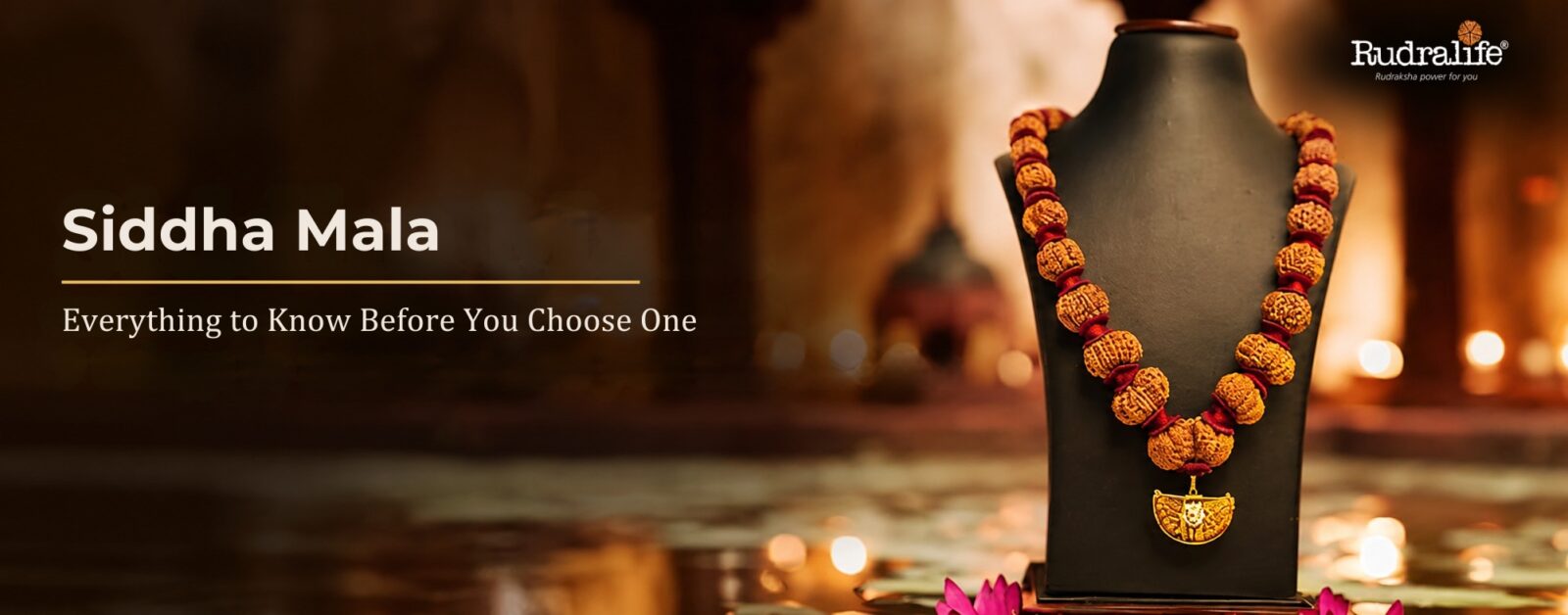
A Siddha Mala is a single mala that brings together every Rudraksha from 1 to 14 Mukhi, along with a Gaurishankar and a Ganesh Rudraksha, strung in a sacred 27+1 arrangement. Because it holds the blessings of every mukhi at once, devotees often call it a complete spiritual companion: one mala for every part of life.
Choosing a Siddha Mala is one of the most meaningful decisions a devotee makes, because it is meant to stay with you for life. This guide explains what it is, what the scriptures say, what is inside it, how Rudralife makes it, and how to wear and care for it.
Key takeaways
- A Siddha Mala combines 1 to 14 Mukhi, Gaurishankar and Ganesh Rudraksha in a 27+1 arrangement of 28 beads
- Rudralife’s Siddha Mala holds three each of 2 to 7 Mukhi, one each of 8 to 14 Mukhi, a Gaurishankar, a Ganesh and a South Indian half-moon 1 Mukhi as the guru bead
- It is traditionally worn to invoke the blessings of all deities and balance all nine planets and all chakras
- Anyone can wear it, regardless of age, gender, religion or background
- Every bead is X-ray authenticated at RRTL, ACE energised, and the mala is consecrated in the wearer’s name and gotra
- Rudralife offers lifetime repair, remaking and re-energisation of every Siddha Mala
1. What is a Siddha Mala?
Siddha means perfected or accomplished. A Siddha Mala is a Rudraksha mala in which every mukhi from 1 to 14 is present, together with a Gaurishankar (two beads naturally joined, representing Shiva and Parvati) and a Ganesh Rudraksha.
Most Rudraksha are worn for a specific purpose: a 7 Mukhi for Mahalakshmi’s blessings, a 9 Mukhi for Maa Durga’s strength. A Siddha Mala does not choose one. It brings all of them together, which is why a classic Rudraksha reference describes it as “an extremely powerful and popular combination” and “a one-stop solution” for the problems of daily life.
The Siddha Mala is a registered and trademarked creation of Rudralife, handcrafted with authentic Nepal Rudraksha for over 25 years.
Prefer to watch? Our new video walks you through every step: selecting the beads, the 27+1 arrangement, ACE energisation, sizes, care and lifetime support.
Watch the Siddha Mala video
2. What do the scriptures say about the Siddha Mala?
The same reference notes that in the Shiva Purana, Lord Shiva says that one who wears all the beads, from 1 to 14 Mukhi, becomes full of Shaivatva, the nature of Shiva himself.
Rudralife’s Note: The Shastras support wearing all mukhi Rudraksha together. Different mukhis do not conflict with one another, and Rudraksha always acts positively, unlike gemstones. A Siddha Mala is the fullest expression of this principle.
3. What is inside a Siddha Mala? The 27+1 arrangement
Rudralife’s Siddha Mala follows a 27+1 arrangement rooted in Sanatan tradition. The 27 beads echo the 27 Nakshatras, and the +1 is the guru bead at the bottom.
| Bead | Number in the mala |
|---|---|
| 2, 3, 4, 5, 6 and 7 Mukhi | 3 of each (18 beads) |
| 8, 9, 10, 11, 12, 13 and 14 Mukhi | 1 of each (7 beads) |
| Gaurishankar Rudraksha | 1 |
| Ganesh Rudraksha | 1 |
| Half-moon 1 Mukhi (Kaju Dana, South India), the guru bead | 1 |
| Total | 27 + 1 = 28 beads |
The 1 Mukhi in a Siddha Mala is the genuine South Indian half-moon bead. A round 1 Mukhi from Nepal does not exist in any shape, so any mala that claims one should be questioned.
Read: 1 Mukhi Nepal: Does It Exist? → Why the genuine 1 Mukhi is the half-moon Kaju Dana.
Every bead has its own place. At Rudralife, the beads follow an odd-even, head-to-head and tail-to-tail arrangement.
Traditional texts also describe other layouts: beads in ascending order from 1 to 14 Mukhi with the Gaurishankar at the bottom, or even mukhis on one side and odd mukhis on the other with the Gaurishankar at the centre. Smaller beads may sit around the neck and bigger beads at the lower end.
4. How does Rudralife make a Siddha Mala?
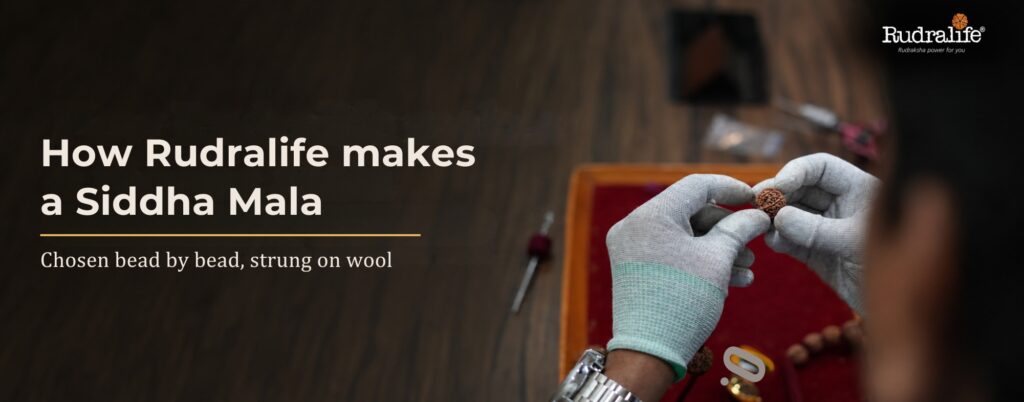
- Selected from the fresh harvest: Rudraksha trees fruit once a year. Rudralife sources a fresh lot directly from the farmers of Nepal and sets aside beads for Siddha Malas in the first month of the harvest itself.
- Chosen bead by bead: Our team inspects each bead for shape, size, weight, compartments and seeds, and selects it for its exact place in the arrangement. We do not use replicas, immature beads, old stock or beads that fall short of our standard.
- X-ray authenticated: Every bead is X-ray tested at RRTL, Rudralife’s own ISO 9001:2015 lab, and comes with its own certificate showing its X-ray.
- Handled with care: Once selected, the beads are vacuum sealed so they are handled as little as possible before stringing.
- ACE energised: Every bead goes through Rudralife’s ACE process, 72 hours of Vedic mantra energisation, including 1,25,000 Beej Mantra chantings, before it reaches you.
- Consecrated in your name: Before it is sent, Rudralife’s Vedic pandits perform the pran pratishtha of the mala with your name and gotra.
Devotees can also be part of the process: choosing their own beads and watching our craftsmen, who have over 20 years of experience, string the mala bead by bead.
Watch: how Rudralife makes a Siddha Mala →
5. Which size and finish should you choose?
Rudralife’s Siddha Mala comes in three sizes: the Large, the Collector and the Super Collector. Each has its own look and feel, but all three follow the same 27+1 arrangement and carry the same blessings.
Every Siddha Mala is strung on wool with woollen spacers, a natural fibre that is comfortable against the skin and allows the beads to stay close to the body. Devotees can also choose silver or gold capping. Traditional texts note that a Siddha Mala can be made in wool or in metals such as copper, silver, gold or panch dhatu.
6. What are the benefits of a Siddha Mala?
Because it holds every mukhi from 1 to 14, the Siddha Mala is traditionally worn to support every area of life. Each bead is associated with its own planet, chakra and blessings, and together they create a balanced flow of energy. Devotees wear it because it is believed to:
- Invoke the blessings of all Gods and Goddesses
- Strengthen the energies of all nine planets (Navagraha)
- Balance all the chakras
- Support peace, prosperity and protection in daily life
- Encourage clarity and growth in career and business
- Protect from negative energies and Nazar Dosh
- Bring harmony to family life and relationships
- Deepen meditation, mantra chanting and spiritual practice
A classic Rudraksha reference also describes it as a support for the obstacles, stress, fear, legal issues and family problems of day-to-day life, helping one see situations clearly so that wrong decisions are not taken.
What devotees say:
“I’ve been connected with Rudralife since 2007. I’ve bought many Rudraksha and Siddha Mala and recommended them to my friends. Very genuine service, fastest service and a very authentic place for genuine Rudraksha.” — Maulik, entrepreneur
“Since I started wearing the Rudraksha Siddha Mala, I have experienced an incredible transformation. I have witnessed the immense grace and love of Lord Shiva and Mata Parvati showering upon me.” — Mahesh Singh Jasrolia
7. Who can wear a Siddha Mala?
The Siddha Mala can be worn by anyone, regardless of age, gender, religion or background. Women can wear it during all phases of life, including menstruation. It is especially suited to:
- Devotees looking for one complete Rudraksha combination
- Business owners, professionals and leaders seeking clarity and growth
- Anyone looking for protection and balance in daily life
- Spiritual seekers who wish to deepen their practice
- Those who already wear Rudraksha and want a more complete combination
| Myth | Fact |
|---|---|
| Only Vedic pandits or advanced seekers can wear a Siddha Mala. | Anyone can wear it. Rudraksha always acts positively. |
| Different mukhis in one mala clash with each other. | The Shastras support wearing all mukhis together. |
| A Siddha Mala should have a round 1 Mukhi from Nepal. | A 1 Mukhi Nepal does not exist; the genuine 1 Mukhi is the South Indian half-moon. |
| Women should not wear it during menstruation. | Women can wear it during all phases of life. |
Read: Can Anyone Wear Rudraksha? Myths vs Facts → What the Shastras actually say.
8. How should you wear a Siddha Mala?
Wear your Siddha Mala with a clear, positive intention, and let the beads touch your skin; that is how its energy reaches you.
Many devotees wear it through the day. If your schedule makes that difficult, wear it at home during puja, meditation and japa, and keep it at your place of worship at other times, at the feet of Lord Shiva’s idol or near the Shivling. Rudralife designs the mala to be light and comfortable for both.
- Before wearing it again after a break, chant Om Namah Shivaya 11 times.
- Remove it before attending a funeral and during intimacy.
- If you eat non-vegetarian food or drink alcohol, you may remove it and wear it again afterwards, according to your own belief.
- Do not wear a Rudraksha that has been worn by someone else, and do not share your mala.
- Keep separate malas for daily wear and for mantra chanting (japa).
9. How do you care for a Siddha Mala, and what support comes with it?

Caring for your Siddha Mala
- Clean it once a month: Gently clean the beads with a soft brush and lukewarm water, then let them dry.
- Oil the beads: Apply a little almond oil afterwards. Rudralife uses a blend of almond and sandalwood oil, which keeps the beads nourished and gives them a lovely aroma.
- Avoid heavy liquids: Do not immerse the mala in ghee or honey; they can settle in the crevices of the beads and make the mala uncomfortable to wear.
- Energise it regularly: Touch it to a Shivling and chant Om Namah Shivaya 11 times. A Rudrabhishek offers additional energisation.
Lifetime support from Rudralife
Our support continues for as long as you wear your mala. Repair, remaking and re-energisation are complimentary at our Mumbai headquarters, our New Delhi branch and at Rudralife exhibitions around the world. Our artisans know how each Siddha Mala is crafted and check its health before beginning any work. If the thread loosens or wears out, we restring it.
What decides the price
Most of the price of a Siddha Mala comes from its rarer beads: three high-quality Nepal 2 Mukhi and a fine 14 Mukhi are part of the arrangement. The price also reflects careful selection, the artisans’ work, ACE energisation and the personalised pran pratishtha. Silver or gold capping and the size you choose also affect the final price.
Listen: Dr Tanay Seetha on the Siddha Mala and Indra Mala. In this episode of the Rudralife Podcast, Dr Tanay explains how a Siddha Mala is built, what each bead brings, and how to wear and care for it.
Watch the Siddha Mala episode of the Rudralife Podcast
Already wear Rudraksha? Upgrade to a Siddha Mala
If you already wear a Rudraksha combination, you do not have to start over. Our team can help you upgrade to a Siddha Mala by adding the beads you still need.
Devotees who wish to go further can explore the Maha Mrityunjay Mala, a protective mala of 1 to 17 Mukhi with Gaurishankar and Ganesh, or the Indra Mala, the rarest of all Rudraksha malas, made only a few times each year with 1 to 21 Mukhi, Gaurishankar, Sawar, Ganesh and Trijuti Rudraksha.
Get a free personalised recommendation →
Speak with our expert about upgrading to a Siddha Mala →
Prefer to see it in person? Find our nearest exhibition →
Frequently asked questions
- What is a Siddha Mala? A Siddha Mala is a Rudraksha mala that combines every mukhi from 1 to 14 with a Gaurishankar and a Ganesh Rudraksha. Rudralife’s Siddha Mala follows a 27+1 arrangement of 28 beads.
- How many beads are in a Siddha Mala? Rudralife’s Siddha Mala has 28 beads: three each of 2 to 7 Mukhi, one each of 8 to 14 Mukhi, a Gaurishankar, a Ganesh and a half-moon 1 Mukhi as the guru bead.
- Why is it called 27+1? The 27 beads are often linked to the 27 Nakshatras, and the +1 is the guru bead, the half-moon 1 Mukhi at the bottom of the mala.
- Can women wear a Siddha Mala? Yes. Women can wear it during all phases of life, including menstruation.
- Can I wear a Siddha Mala with my other Rudraksha? Yes. The Shastras support wearing all mukhis together, and Rudraksha always acts positively.
- Do I have to wear it all day? No. Many devotees wear it through the day, while others wear it during puja, meditation and japa and keep it at their place of worship at other times. What matters is that it touches your skin while you wear it.
- How do I clean a Siddha Mala? Once a month, clean it with a soft brush and lukewarm water, then apply a little almond oil. Avoid ghee and honey.
- Can I upgrade my existing Rudraksha to a Siddha Mala? Yes. Rudralife’s team can add the beads you still need to your current combination.
The bottom line
A Siddha Mala asks for very little: a clear intention, a little care each month and the habit of letting it rest against your skin. In return, it brings every mukhi’s blessings together in one sacred circle.
For 25 years, Rudralife has walked alongside devotees, choosing every bead by hand, testing it in our own lab and energising it before it reaches you. If you are ready to choose your Siddha Mala, we would be honoured to guide you.
Related reading
What Is Rudraksha? A Complete Beginner’s Guide
Which Rudraksha Mala Should You Wear?
Disclaimer: Rudraksha is worn as a spiritual practice. The benefits described here are based on scripture, tradition and devotee experience, and are not a substitute for medical, legal or financial advice.



Leave a comment