







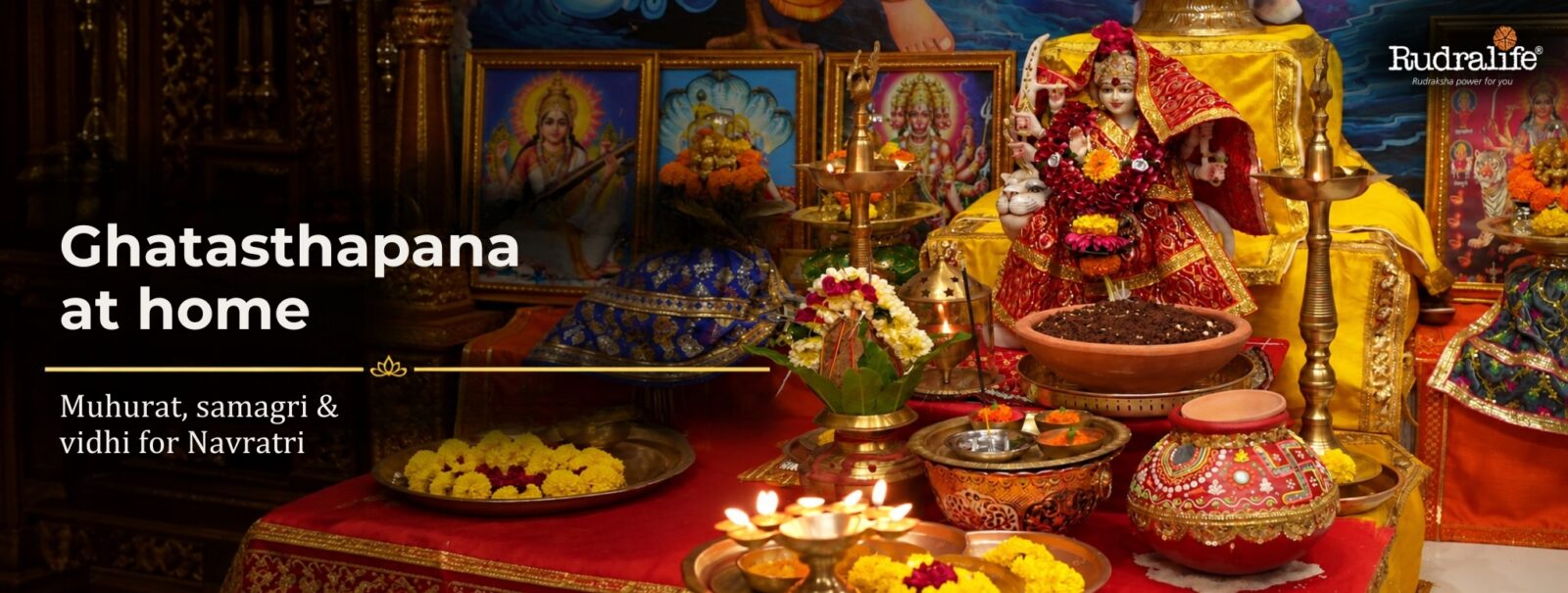
Ghatasthapana at home is the first act of Sharad Navratri 2026, an invitation to Maa Durga to stay in your home for nine nights. It asks for a clean space, a few simple things from the puja shelf, and a quiet heart.
This guide walks you through every step, from setting up the chowki to sowing the jawara, lighting the akhand jyot and closing with the kshama prarthana, so your family can perform it with ease and devotion.
Key takeaways
- Ghatasthapana 2026 falls on Sunday, 11 October, the first day of Sharad Navratri
- The kalash rests on an eight-petal rice lotus (ashtadal) laid over a red cloth on a chowki
- Seven grains (saptadhanya), with jau as the main grain, are sown in clay to grow the jawara, offered to Maa on the last day
- The akhand jyot is lit with ghee over a betel leaf and kept burning through all nine days
- The puja closes with aarti, pushpanjali & a kshama prarthana asking Maa’s forgiveness for anything missed
- A Rudraksha japa mala and a Navchandi Puja can deepen your nine-day practice
What is Ghatasthapana & when is it in 2026?
Ghatasthapana, also called kalash sthapana, is the ritual of installing a sacred pot on Pratipada, the first day of Navratri. The kalash is seen as a seat for the Divine Mother, and its water, leaves and coconut stand for life, growth and abundance. Once it is in place, the home is ready for nine days of Devi worship.
Sharad Navratri 2026 begins on Sunday, 11 October and ends with Vijayadashami on Tuesday, 20 October. As per Drik Panchang, the Ghatasthapana muhurat on 11 October is:
- Main muhurat: 06:31 AM to 10:27 AM
- Abhijit muhurat: 12:01 PM to 12:49 PM
Timings vary by city, so please confirm with your local panchang or family priest before you begin.
Read our full guide to Sharad Navratri 2026 dates & the nine sacred nights →
Ghatasthapana samagri: what to keep ready
Gather everything the evening before, so the morning muhurat flows without a rush.
- For the base: a square chowki, red cloth, mauli & rice for the ashtadal
- For the kalash: a kalash, water, Gangajal, rice, sandalwood, a betel leaf, a coin, durva, panchratna, mango leaves & a coconut (with red cloth and mauli if you like)
- For the clay pot: a clay pot with a lid, moong & a small ghee diya
- For the jawara: an earthen plate, clean clay & saptadhanya (seven grains, with jau as the main grain)
- For Devi puja: a small Devi murti, panchamrit, sandalwood, kumkum, akshat, flowers & shringar
- For the akhand jyot: a large diya, ghee, wicks & a betel leaf
- For upchaar: naivedya, a panchapatra with water, tambul (paan, supari & fruit) & dakshina
- For aarti: an aarti thali or pancharti, and flowers for pushpanjali
How to do Ghatasthapana at home: 7-step vidhi
Prefer to watch?
Follow the complete Ghatasthapana vidhi, step by step
Bathe, wear clean clothes and clean the puja spot before you begin. Face east or north if you can, and keep the space calm and uncluttered.
Step 1: Prepare the sacred base
1. Set up the chowki. Place the square platform at the puja spot, spread the red cloth over it and tie it with mauli.
2. Make the ashtadal. Using rice, draw an eight-petal lotus on the cloth. This becomes the seat for the kalash.
Step 2: Establish the kalash
1. Place the kalash on the rice ashtadal.
2. Tie mauli around the neck of the kalash.
3. Fill it with water. As you fill it, add rice, sandalwood, a betel leaf, a coin, durva, Gangajal and panchratna.
4. Arrange the mango leaves around the mouth of the kalash.
5. Place the coconut on top, wrapped in red cloth and mauli if you like.
6. Draw a swastik on the kalash.
7. Sprinkle some rice on the kalash as an offering.
Next, set up the clay pot beside it:
9. Place the clay pot on the rice ashtadal.
10. Fill the pot with moong.
11. Place a ghee diya on the moong and light it.
12. Close the pot with its lid. Leave a small gap for air to pass through, otherwise the diya inside will go out.
Step 3: Sow the jawara (Jayanti)
1. Prepare the soil. Fill the earthen plate with clay and remove any stones or debris.
2. Sprinkle water over the soil to moisten it.
3. Sow the seven grains. Mix the saptadhanya into the soil, with jau as the main grain. While sowing, chant:
Jayanti Mangala Kali Bhadrakali Kapalini, Durga Kshama Shiva Dhatri Swaha Swadha Namostute
The sprouts that grow are called Jayanti or jawara, and they are offered to Maa on the last day of Navratri.
Water them gently each day.
Step 4: Devi puja
1. Perform abhishek on a small Devi murti with panchamrit. Abhishek isn’t done on a large idol or a photo frame, which is why a small murti is used.
2. Adorn the Devi with sandalwood, tilak, kumkum, akshat, flowers and her shringar.
Step 5: Light the akhand jyot
1. Offer a betel leaf to Maa.
2. Light the akhand diya with ghee, placing a betel leaf beneath it. It should stay lit continuously, so keep checking the ghee and wick through the nine days.
Step 6: Offerings (upchaar)
1. Offer naivedya with the five pranahutis: Prana, Apana, Vyana, Udana & Samana. These mantras are traditionally recited by a Brahmin purohit.
2. Offer water from the panchapatra for achaman and to wash Maa’s hands.
3. Offer tambul, meaning paan, supari and fruit.
4. Offer dakshina.
Step 7: Aarti & closing
1. Perform aarti. You can do one aarti or a pancharti (five-wick aarti).
2. Offer pushpanjali with flowers.
3. Say the kshama prarthana: “I have served Maa as instructed. If I have forgotten anything, please forgive me.”
With this, Ghatasthapana at home is complete, and Maa is welcomed for the nine nights ahead.
After Navratri: what to do with the jawara
On the final day, offer the grown jawara to Maa. Then keep some of it in your cash box, locker or safe as a blessing for prosperity.
Rudraksha for Navratri: deepening your nine-day practice
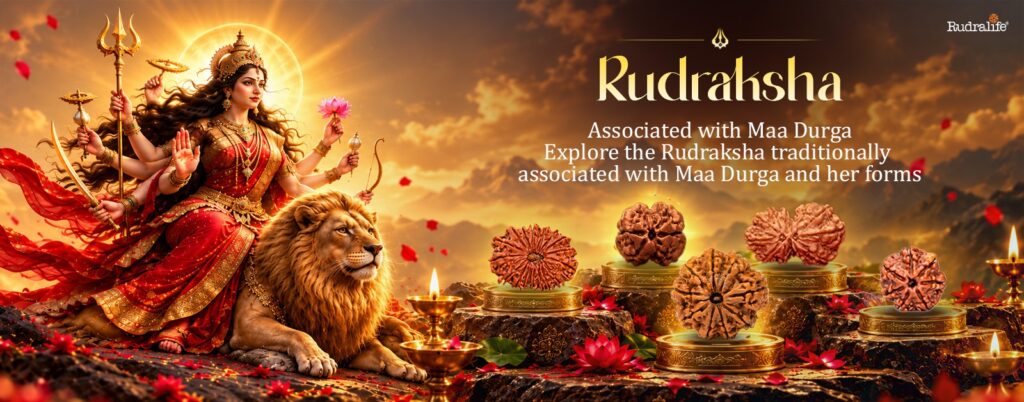
Many devotees begin wearing a Rudraksha or start a daily japa during Navratri, as the nine nights are seen as a meaningful time to turn inward. A few mukhis are traditionally associated with the Divine Mother:
- 9 Mukhi Rudraksha: associated with Maa Durga and her nine forms, the bead most closely linked with Navratri
- 7 Mukhi Rudraksha: associated with Mahalakshmi, the Goddess of abundance
- 18 Mukhi Rudraksha: associated with Bhumi Devi, the Earth Mother
- Gaurishankar Rudraksha: representing the union of Shiva & Shakti
- 2 Mukhi Rudraksha: representing Ardhanarishwara, Shiva and Parvati as one
As per the shastras, different mukhis can be worn together, and Rudraksha acts only positively. A Rudraksha japa mala is also a simple companion through the nine days, helping you keep count as you chant the Jayanti mantra or Maa’s name 108 times each morning.
If you keep the jawara in your cash box after Navratri, Rudralife’s Seven Mukhi Cash Box carries the same wish for prosperity through the year.
The right Rudraksha depends on the individual. Rudralife recommends beads through a date-of-birth analysis using astro-numerology, looking at which ruling planet needs balancing rather than suggesting a bead by default.
Every bead is X-ray verified at RRTL, Rudralife’s own ISO certified lab, and ACE energised before it reaches you.
Get a personalised Rudraksha recommendation based on your date of birth →
Explore Rudraksha japa malas for your Navratri japa →
If you prefer to see Rudraksha in person, come visit us at our upcoming exhibitions in your city.
Check Rudralife’s upcoming exhibitions →
Navchandi Puja this Navratri
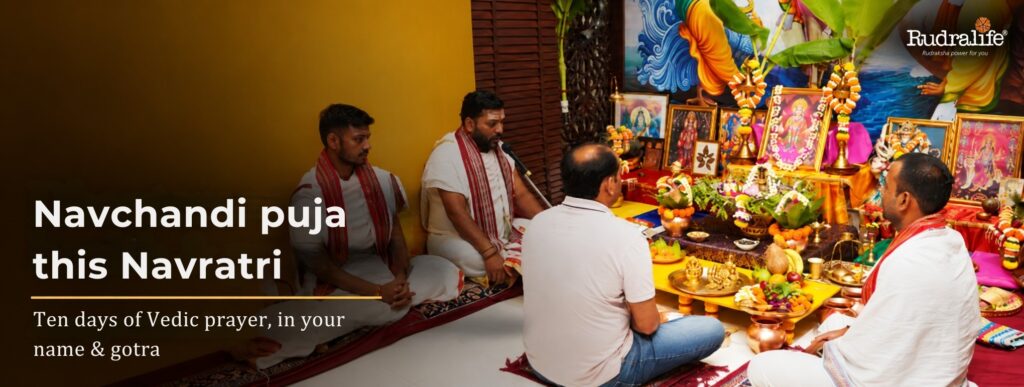
While Ghatasthapana welcomes Maa into your home, a Navchandi Puja is a deeper offering to her during the nine days. It is a Vedic ritual dedicated to Maa Chandi, a fierce form of Durga, centred on the recitation of the Durga Saptashati followed by a havan. Navratri, and especially Ashtami and Navami, is considered one of the most auspicious times to perform it.
Devotees perform Navchandi Puja to seek the Goddess’s protection, to remove obstacles, and for peace and harmony in the home.
At Rudralife, the Navchandi Puja is performed for 10 days as a Vedic Sankalp Puja by experienced pandits. During the sankalp, the pandits speak each devotee’s name and gotra, so the puja is offered on the devotee’s behalf. It is streamed live on YouTube, so devotees anywhere in the world can watch it as it happens.
Puja date & muhurat:
- Maa Shailputri : 11 October (2:05 PM, Shubh Muhurat) IST
- Maa Brahmacharini : 12 October (12:25 PM, Abhijeet Muhurat) IST
- Maa Chandraghanta: 13 October ( 1:05 PM, Amrit Muhurat) IST
- Maa Kushmanda : 14 October (12: 01 PM, Shubh Muhurat) IST
- Maa Skandamata : 15 October (12:50 PM, Laabh Muhurat) IST
- Maa Katyayani: 16 October (1:05 PM, Shubh Muhurat) IST
- Maa Kaalratri: 17 October (1:40 PM, Laabh Muhurat) IST
- Maa Mahagauri: 18 October (2:05 PM, Shubh Muhurat) IST
- Maa Siddhidatri: 19 October (12:28 PM, Abhijeet Muhurat) IST
- Dashami Puja : 20 October (12:30 PM, Amrit Muhurat)IST
2 Pandits daily
Seek Maa Durga’s blessings for your family with Rudralife’s Navchandi Puja →
Frequently asked questions
1. When is Ghatasthapana in 2026? Ghatasthapana falls on Sunday, 11 October 2026, the first day of Sharad Navratri. As per Drik Panchang, the main muhurat is 06:31 AM to 10:27 AM, with the Abhijit muhurat from 12:01 PM to 12:49 PM. Please confirm timings for your city.
2. Can I do Ghatasthapana at home without a pandit? Yes. Families can perform Ghatasthapana at home with devotion by following the steps above. Some parts, such as the five pranahuti mantras during naivedya, are traditionally recited by a Brahmin purohit.
3. Why is the kalash placed on an eight-petal rice lotus? The ashtadal, an eight-petal lotus drawn in rice, serves as a sacred seat for the kalash, which is seen as the seat of the Divine Mother for the nine days.
4. Why is a small murti used for abhishek? Abhishek isn’t done on a large idol or a photo frame, so a small Devi murti is used for the panchamrit abhishek.
5. What if the akhand jyot goes out? The akhand jyot is meant to burn continuously, so keep checking the ghee and wick. If it goes out by accident, relight it calmly and offer a short prayer to Maa. The kshama prarthana at the close of the puja asks forgiveness for anything missed.
6. What do I do with the jawara after Navratri? Offer the grown jawara to Maa on the final day, then keep some in your cash box, locker or safe as a blessing for prosperity.
7. Which Rudraksha is associated with Navratri? The 9 Mukhi Rudraksha is associated with Maa Durga and her nine forms. The 7 Mukhi, 18 Mukhi, 2 Mukhi and Gaurishankar are also linked with the Divine Mother. Rudralife recommends the right bead through a date-of-birth analysis.
8. Can I take part in Rudralife’s Navchandi Puja from outside India? The Navchandi Puja is streamed live on YouTube, so devotees anywhere can watch it as it happens.
The bottom line
Ghatasthapana at home needs no grand setup, only care, clean hands and a sincere heart. Once the kalash is in place and the akhand jyot is lit, the nine nights of Sharad Navratri 2026 can unfold with Maa’s presence in your home.
For 25 years, Rudralife has walked alongside devotees through every festival season, and we wish you and your family a blessed Navratri.










Leave a comment