






What Is Different About Shravan Across India?
Shravan is not observed the same way everywhere in India , different states follow regions mark the lunar month differently, so the month begins and ends on different dates, and each region layers its own local deity worship, fasting customs, and festivals on top of the shared devotion to Lord Shiva.
Both Shravan 2026 windows, with every Somwar date, are listed here.
See the full Shravan 2026 calendar →
Rudralife has spent 25 years working closely with devotees across the country, and every Shravan we’re reminded of how one sacred month can look so different depending on where you’re standing , a Kanwar Yatra procession in Uttar Pradesh, a Mangala Gauri Vrat gathering in Pune, a Shravani Mela in Deoghar, or a Kantha Sashti observance in Tamil Nadu.
This piece walks through those regional differences, and why understanding them matters if you’re observing Shravan away from home this year.
Key Takeaways
- Shravan doesn’t start on the same date everywhere , North India follows the Purnimanta calendar, most southern and western states follow the Amanta calendar, and a few Himalayan regions follow a solar calendar.
- North India’s Shravan is defined by the Kanwar Yatra and Sawan Somvar temple visits to Lord Shiva.
- Jharkhand hosts the Shravani Mela, a month-long pilgrimage to the Baidyanath Temple in Deoghar.
- Maharashtra and Goa mark Shravan with the Mangala Gauri Vrat, observed by married women on Tuesdays.
- West Bengal and Odisha add Devi Lakshmi worship to their Shravan observances.
- Nag Panchami, Hariyali Teej, and Raksha Bandhan fall on the same dates across all of India, since they are fixed by lunar tithi.
- South Indian states follow a different calendar altogether, observing the period as Aadi or Aavani with a stronger focus on goddess worship and, in Tamil Nadu, on Kantha Sashti dedicated to Bhagwan Murugan.
Why Shravan Doesn’t Begin on the Same Date Everywhere
Before looking at regional customs, it helps to understand why the calendar itself shifts.
North Indian states , Uttar Pradesh, Bihar, Rajasthan, Madhya Pradesh, Punjab, and Delhi among them , follow the Purnimanta calendar, a lunar calendar where the month ends on a Purnima or full moon.
South Indian states like Karnataka, Andhra Pradesh, and Tamil Nadu instead follow the Amanta calendar, where the month ends on the new moon, and Maharashtra, Goa, Gujarat, and Telangana also follow this system.
This creates a roughly two-week gap between the two calendars. In 2026, Shravan runs from July 30 to August 28 in North India under the Purnimanta calendar, while Amanta states observe it from August 13 to September 11.
A few regions, including Nepal, Uttarakhand, and Himachal Pradesh, follow a solar calendar instead, placing their Shravan from July 16 to August 16. This is exactly why Rudralife’s own exhibitions this year are timed differently by city , our Delhi exhibition falls within the Purnimanta Shravan window, while our Mumbai and Rajkot exhibitions lead into the Amanta window just before it begins locally.
Not sure which dates apply to your state?
Check the Shravan 2026 calendar, both systems side by side →
North India: Kanwar Yatra and Sawan Somvar
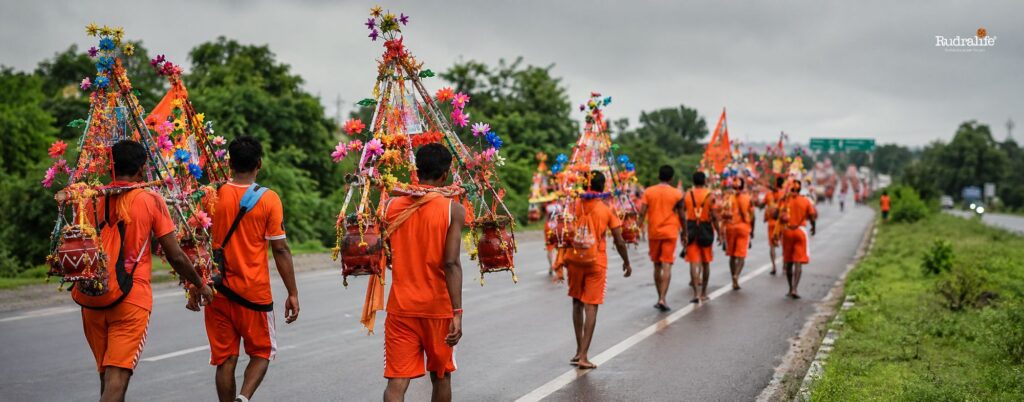
In Uttar Pradesh, Bihar, Punjab, Haryana, and Delhi, Shravan is marked by intense devotion to Lord Shiva, with devotees observing Sawan Somvar and visiting temples like the Kashi Vishwanath Temple and the Neelkanth Mahadev Temple.
The most visible expression of this devotion is the Kanwar Yatra, in which devotees known as Kanwariyas walk for days carrying decorated pitchers of Ganga water to offer at Shiva temples back home.
Streets across these states fill with saffron-clad pilgrims through the month, and Monday temple visits become a weekly ritual for entire families.
Kashi Vishwanath is one of Shiva’s twelve most sacred shrines.
Read: The 12 Jyotirlingas of Lord Shiva →
Jharkhand: The Shravani Mela at Deoghar
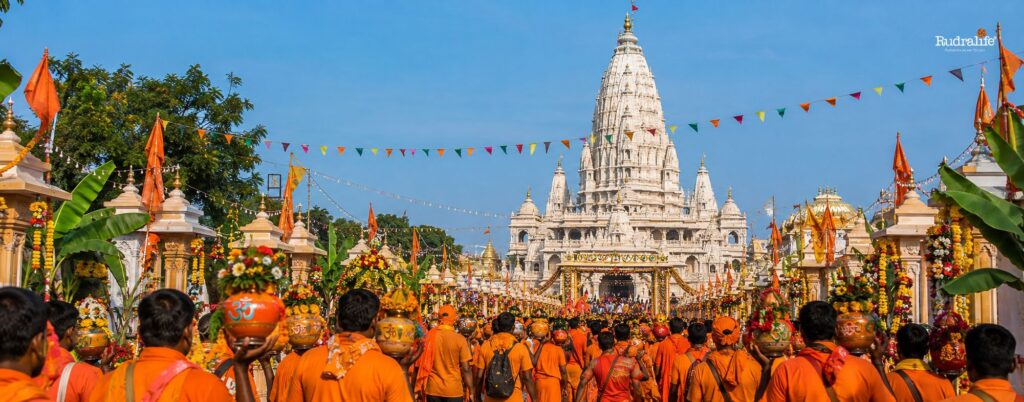
Jharkhand observes Shravan through one of India’s largest annual pilgrimages.
The Shravani Mela at the Deoghar Baidyanath Temple, one of the 12 Jyotirlingas of Lord Shiva, draws millions of devotees who carry holy water from the Ganges for the entire month-long festival.
Many of these pilgrims are the same Kanwariyas seen walking through neighbouring states, converging on Deoghar as their final destination.
Maharashtra, Gujarat, and Goa: Mangala Gauri Vrat and Shravani Purnima
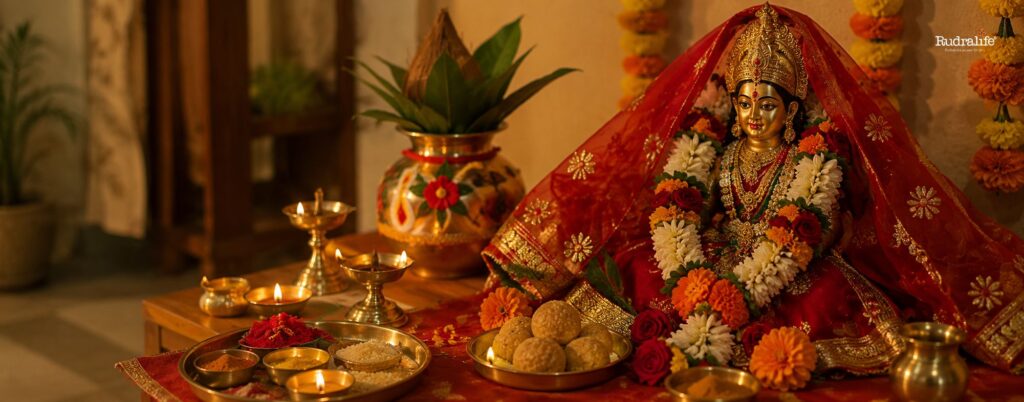
Maharashtra, Gujarat, and Goa all follow the Amanta calendar, and Shravan here takes on a distinctly domestic and feminine character.
The Mangala Gauri Vrat is observed on Tuesdays through the month across all three states, dedicated to Goddess Gauri, a revered form of Maa Parvati, with Lord Shiva also worshipped alongside her during the puja.
In Maharashtra, newly married women traditionally observe the vrat for the first five years of marriage, dressing in traditional attire and gathering with family for the puja, story-telling, and aarti.
In Gujarat, married women observe the same Tuesday vrat, and many also keep the Jaya Parvati Vrat, a separate fast for prosperity, health, and family peace.
The related festival of Shravani or Shravani Purnima is also celebrated in Maharashtra and Goa during this month.
For 2026, the first Mangala Gauri Vrat across this region falls on 18 August, with further Tuesdays following through early September.
All four Mangala Gauri Tuesdays are listed with the month’s other dates.
See the Shravan 2026 calendar →
West Bengal and Odisha: Devi Lakshmi Worship
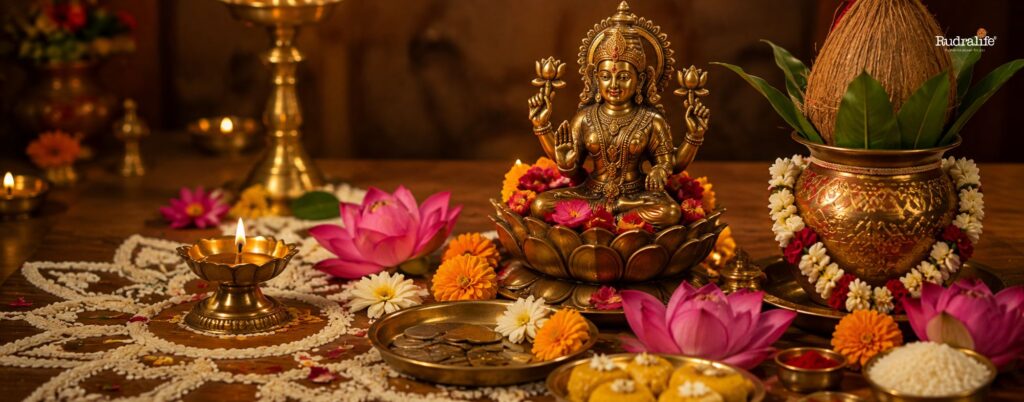
Eastern India brings a different emphasis. While Lord Shiva continues to be worshipped, many families in West Bengal and Odisha also perform prayers dedicated to Goddess Lakshmi during Shravan, seeking prosperity and happiness.
South India: Aadi, Aavani, and Kantha Sashti
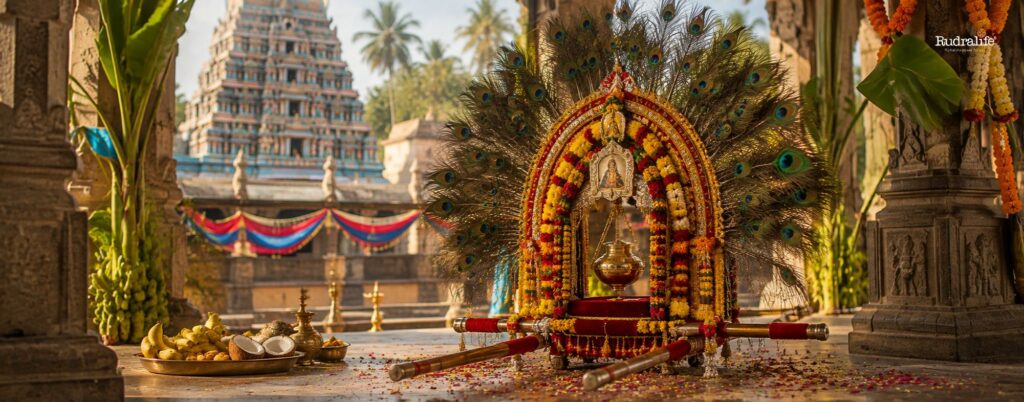
South India experiences Shravan on an entirely different calendar and, in many ways, a different set of observances.
While North India is deep into Shravan, South Indian states like Karnataka, Andhra Pradesh, and Tamil Nadu are still in the middle of the preceding month, known locally as Ashada Masam. Tamil Nadu, Karnataka, Andhra Pradesh, and Kerala refer to this period as Aadi or Aavani, and the focus shifts more toward goddess worship and family rituals.
In Tamil Nadu specifically, the Kantha Sashti festival honours Bhagwan Murugan, with devotees observing fasts, singing devotional songs, and carrying Kavadi offerings.
Each Somvar is assigned its own puja based on the tithi it falls on. Dr. Tanay Seetha breaks down all six, covering both the North and South Somvar dates.
What Stays the Same Across India
Not everything about Shravan changes with the region. The month’s biggest festivals are fixed by lunar tithi rather than by calendar system, so they fall on the same date across the country regardless of whether your state follows Purnimanta or Amanta.
Nag Panchami (17 August 2026) is observed nationwide, with devotees offering milk and prayers to serpent deities for protection and prosperity. This year it also falls on a Shravan Somwar, and on the same day in both calendars, making it one of the most significant days of the month in every region.
Raksha Bandhan (28 August 2026) falls on Shravan Purnima, when sisters tie a rakhi on their brothers’ wrists as a thread of protection, which is what “raksha” means. What differs is where the day sits in the month
In the Purnimanta calendar it closes Shravan altogether, while in Amanta states it falls mid-month with several Somwars still ahead. Regional names differ too, the day is observed as Jhulan Purnima in West Bengal and Gamha Purnima in Odisha, alongside the tying of rakhis.
Many devotees mark the day with a Rudraksha bracelet instead, worn through the year as the same kind of protection the rakhi stands for. Explore Rudraksha Bracelets →
Hariyali Teej (15 August) and Shravan Putrada Ekadashi (23 August) likewise fall on the same dates everywhere.
Independence Day (15 August) also falls within Shravan this year in both calendars, north and south alike. It is not a Shravan observance in the religious sense, but it is one more day the whole country marks together.
This year it shares the date with Hariyali Teej, and falls on a Saturday, so temples and travel routes are likely to be busier than usual that weekend.
Read: How to Perform Shiva Puja at Home During Shravan →
Every step, from Abhishek to aarti.
Book a Shravan Somvar Sankalp Puja →
For the Mondays you can’t keep yourself.
One Sacred Month, Many Regional Expressions
What ties all of this together is not the calendar or the deity but the underlying spirit. Whether it is Kanwariyas in the north walking for days to offer Ganga water to Lord Shiva, or women in the south praying for their families’ prosperity, the devotion carried through Shravan remains the same.
At Rudralife, we see this every year in the way devotees across our exhibitions, from Rajkot to Delhi to Singapore, carry the same sincerity into very different rituals.
Whichever calendar your Shravan follows, we may already be in your city before the month ends.
Check Our Exhibition Dates →
Free consultations, on-site Vedic puja, and exclusive Shravan offers.
And if you can’t join us in person, you can still get your recommendation online.
Speak With a Rudralife Expert, Free Personalised Consultation →
You can perform your Somvar puja at home yourself, wherever you are this Shravan, our guide on how to perform Shiva Puja at home →
walks you through it step by step. And if you’re not able to manage it every Monday, you can book Rudralife’s Sankalp Puja instead.
As part of Rudralife’s 25th anniversary, this Shravan brings offers like never before, take a look before the month ends.
Frequently Asked Questions
I live in North India but I’m visiting Maharashtra during Shravan. Whose calendar should I follow? Most devotees follow the calendar of the state where they are physically observing the festival, especially for community events like Mangala Gauri Vrat.
If you’re simply continuing a personal puja routine, either calendar is acceptable , it comes down to family tradition rather than a fixed rule.
Does the deity worshipped in my region affect which Rudraksha bead is right for me? No, our recommendation method is based on date of birth alone, using astro-numerology, regardless of which regional Shravan tradition you follow.
Read: Which Rudraksha Mala Should You Wear This Shravan? →
Can I wear my Rudraksha mala while travelling for the Kanwar Yatra or a pilgrimage? Yes, Rudraksha is commonly worn during travel and pilgrimage. If you’re unsure about the specific mala you own, our team can review it during a consultation.
Talk to a Rudraksha Expert (Free) →
If I’ve never observed Shravan formally, is it too late to start this year? No. Devotees begin Shravan observances at any stage of life, and starting partway through the month with sincerity is considered acceptable across most regional traditions.
Can I observe Mangala Gauri Vrat and other Shravan vrats, like Sawan Somvar, together? Yes. Many households observe Mangala Gauri Vrat on Tuesdays and Sawan Somvar on Mondays within the same month, they’re not exclusive of each other, and combining vrats dedicated to Lord Shiva and Maa Parvati during Shravan is a common practice in states like Maharashtra and Gujarat.
Observing both means fasting twice a week.
Read: Shravan Fasting Diet, the Types of Vrat and What to Eat →
Bottom Line
Shravan’s regional variety is really a reflection of India’s own diversity, the same reverence for Lord Shiva expressed through a dozen different calendars, deities, and family customs, depending on where you happen to be standing in the country.
Whether your household follows the Purnimanta calendar and is already deep into Sawan Somvar rituals, or you’re in an Amanta state just beginning your Mangala Gauri Tuesdays, the thread connecting all of it is the same intention: devotion, discipline, and renewal during the monsoon’s holiest month.
Wherever your Shravan falls this year, and whichever calendar your family follows, the right Rudraksha is chosen the same way, by your date of birth using Astro-numerology.
Speak With a Rudralife Expert, Free Personalised Consultation →
See This Shravan’s Exclusive Offers →
Rudralife’s 25th anniversary brings exclusive offers across the collection, open through the month.
Disclaimer: This article is intended for general informational and educational purposes only. Regional customs, dates, and rituals may vary between families and communities, and readers should confirm specific observances with their local temple or family tradition.








Leave a comment