





Samudra Manthan, the churning of the cosmic ocean, is one story that quietly shapes many of the festivals we celebrate through the year.
Shiva holding the poison in his throat, Lakshmi rising from the waves, Dhanvantari carrying the pot of amrit, the moon finding its place on Shiva’s head.
Each of these moments lives on in a festival, a fast or a puja. In this guide we walk through the story, the festivals rooted in it, & the Rudraksha & pujas that help you carry its blessings into daily life.
Key takeaways
- Samudra Manthan festivals include Shravan & Maha Shivratri (Neelkanth), Sharad Purnima, Dhanteras, Diwali, Mohini Ekadashi, Kurma Jayanti & the Kumbh Mela
- Shiva drank the halahala poison to protect creation, which is why Shravan abhishek is offered to cool his throat
- Lakshmi & Dhanvantari both emerged from the ocean, linking the churning to prosperity on Diwali & health on Dhanteras
- Each blessing of the churning has a Rudraksha that resonates with it, such as 1 Mukhi for Shiva, 7 Mukhi for Lakshmi & 10 Mukhi for Vishnu
- The story’s deeper message is patience: the poison came before the nectar, & steady inner effort brings its own amrit.
The story of Samudra Manthan
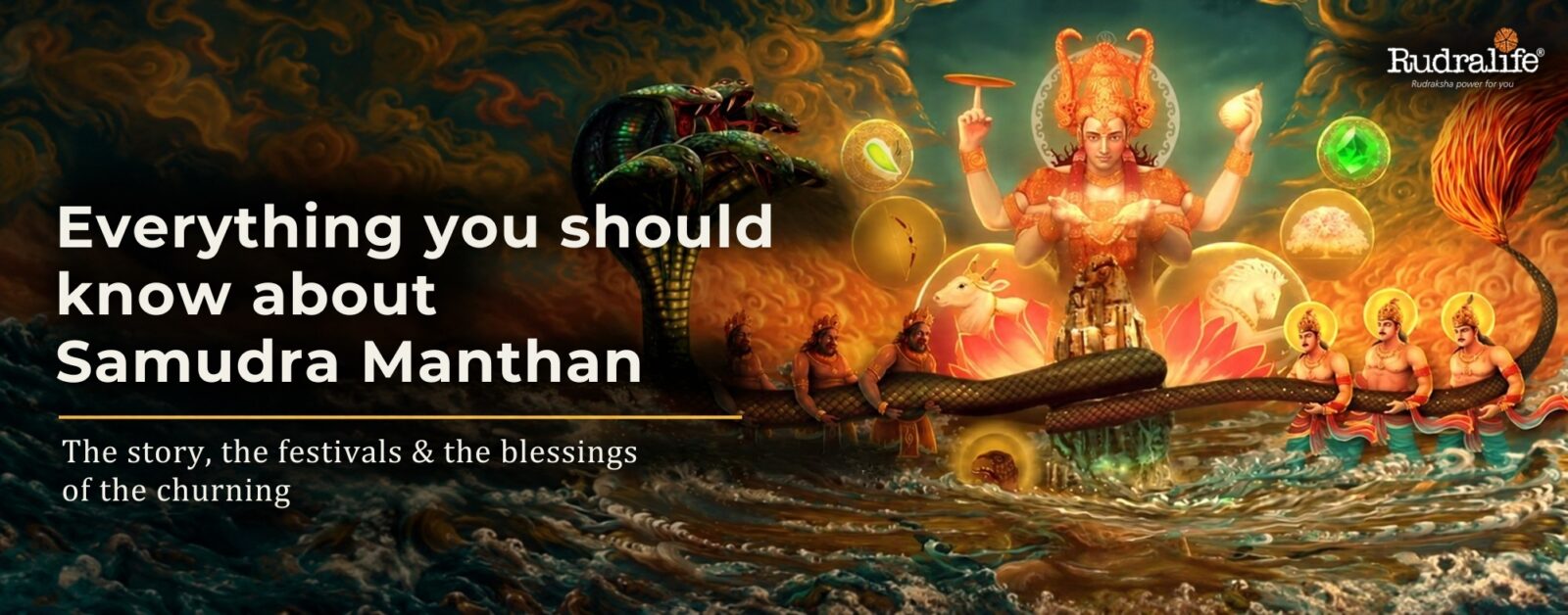
The story of Samudra Manthan is told in the Bhagavata Purana, the Vishnu Purana & the Mahabharata. After sage Durvasa’s curse, the devas lost their strength & their prosperity. Lord Vishnu advised them to churn the Ksheer Sagar, the ocean of milk, to bring out amrit, the nectar of immortality.
The task was too great for the devas alone, so they joined hands with the asuras. Mount Mandara became the churning rod & Vasuki, the serpent king, became the rope. When the mountain began to sink, Lord Vishnu took the form of Kurma, the tortoise, & held it steady on his back.
The first thing to rise from the ocean was not nectar but halahala, a poison strong enough to burn all of creation. Lord Shiva drank it to protect the worlds, & Goddess Parvati held his throat so it would not go further. His throat turned blue, & he came to be known as Neelkanth.
Only after this did the treasures begin to appear, one by one, ending with Dhanvantari & the pot of amrit. When the asuras seized the pot, Vishnu took the form of Mohini & served the nectar to the devas.
The story carries a quiet lesson for every devotee. Inner churning, through prayer, japa & self-reflection, often brings up what is difficult first. Patience & surrender are what allow the nectar to follow.
Prefer to watch? This walks through how japa is practised.
Begin your own japa practice with an authentic Rudraksha mala →
The 14 ratnas that rose from the ocean
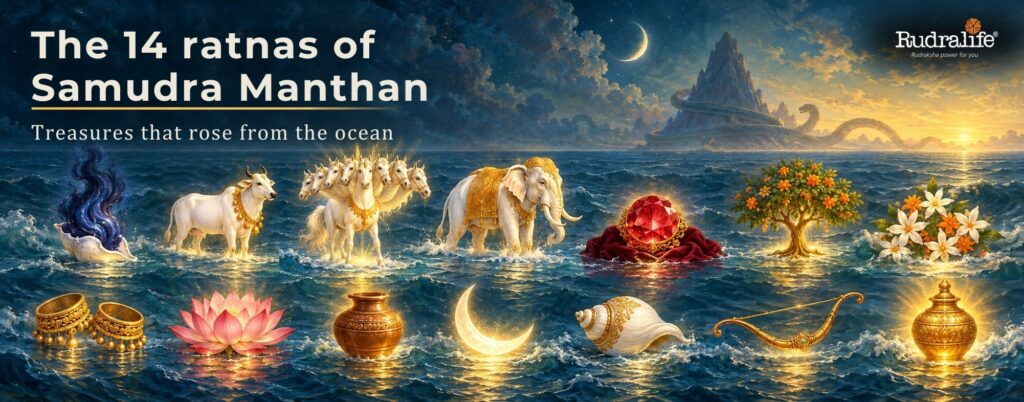
The Puranas speak of 14 ratnas, or treasures, that emerged during Samudra Manthan. The exact list varies a little between texts, but these are the ones most commonly named.
- Halahala (हलाहल विष): the poison, held by Lord Shiva in his throat.
- Kamadhenu (कामधेनु गाय): the wish-fulfilling cow, given to the rishis.
- Uchchaihshravas (उच्चैःश्रवा घोड़ा): the seven-headed white horse.
- Airavata(ऐरावत हाथी): the white elephant, taken by Indra.
- Kaustubha mani (कौस्तुभ मणि): the jewel worn by Lord Vishnu on his chest.
- Kalpavriksha(कल्पवृक्ष): the wish-fulfilling tree.
- Parijata (पारिजात वृक्ष): the celestial flowering tree.
- Apsaras (अप्सरा): celestial dancers, led by Rambha.
- Goddess Lakshmi (देवी लक्ष्मी): who chose Lord Vishnu as her consort.
- Varuni (वारुणी): the goddess of wine.
- Chandra (चंद्रमा): the moon, placed by Lord Shiva on his head.
- Panchajanya shankha (पाञ्चजन्य शंख): the conch of Lord Vishnu.
- Sharanga (शारंग) : the bow of Lord Vishnu.
- Dhanvantari & the amrit kalash (भगवान धन्वंतरि और अमृत कलश) : the physician of the devas, carrying the nectar of immortality.
Many of these treasures are honoured on specific days of the Hindu calendar, which is how one story became the root of so many festivals.
Samudra Manthan festivals through the year
These are the festivals most closely tied to the churning of the ocean, along with the moment of the story each one honours.
Shravan & Mahashivratri: honouring Neelkanth
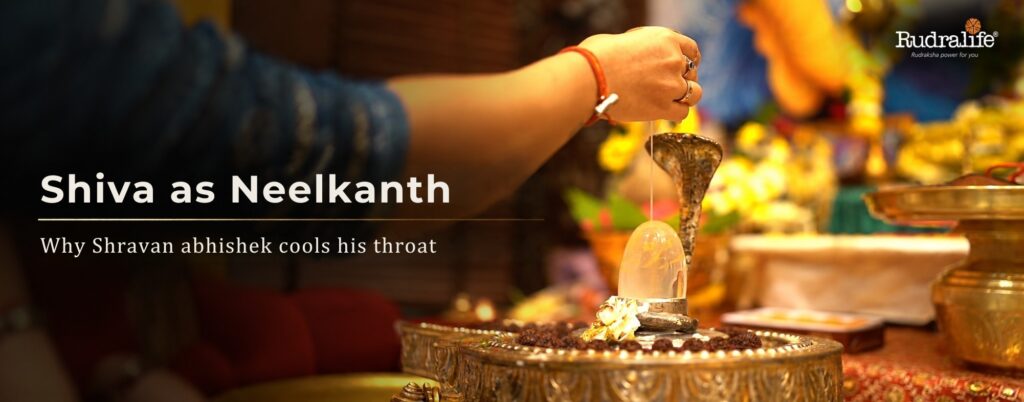
Tradition holds that the churning took place in the month of Shravan. To cool the burning of the poison, the devas poured water on Lord Shiva, which is why jal abhishek & Rudra Abhishek carry special meaning through Shravan. Many devotees also remember Shiva as Neelkanth on Maha Shivratri, offering bel patra, milk & water through the night.
Prefer to watch? This is the Rudra Abhishek our pandits perform during Mahashivratri.
Sharad Purnima: the night of amrit
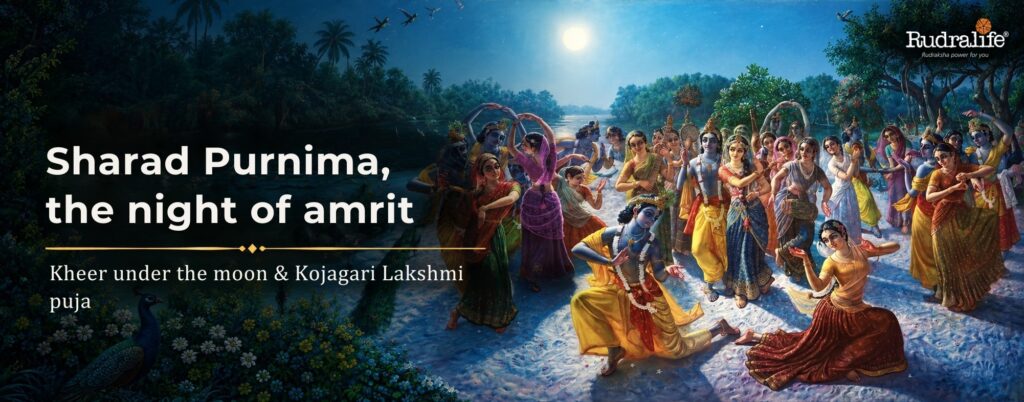
The moon is one of the treasures of the churning, & in some traditions Goddess Lakshmi is said to have emerged on this full moon too. On Sharad Purnima, the moon is believed to shine with all 16 kalas & shower amrit.
Devotees keep kheer under the moonlight & stay awake for Kojagari Lakshmi Puja. In 2026, the night rituals fall on Sunday, 25 October, when the Purnima tithi prevails through the night. Some calendars list the date as 26 October, the udaya tithi, but the kheer & Kojagari puja are observed on the night of the 25th.
Dhanteras: Dhanvantari & Lakshmi
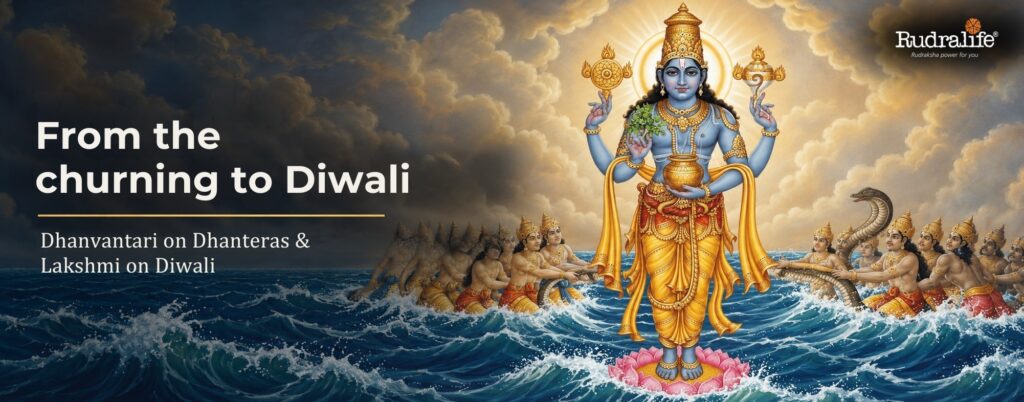
Dhanteras marks the day Lord Dhanvantari rose from the ocean with the pot of amrit, which is why it is also observed as Dhanvantari Jayanti. Per Drik Panchang, Goddess Lakshmi also emerged on this Trayodashi, so she is worshipped along with Lord Kubera. In 2026, Dhanteras falls on Friday, 6 November.
Diwali: welcoming Lakshmi home
Lakshmi Puja on Kartik Amavasya, two days after Dhanteras, celebrates the goddess who chose Lord Vishnu after rising from the ocean. Lamps are lit so she finds her way into every clean & prepared home. In 2026, Diwali Lakshmi Puja falls on Sunday, 8 November.
Read: Lakshmi Puja 2026, muhurat, vidhi & Rudraksha →
Mohini Ekadashi: the nectar protected
Mohini Ekadashi, in the Shukla Paksha of Vaishakh, remembers Lord Vishnu’s Mohini avatar, who protected the amrit for the devas.
Kurma Jayanti: the steady foundation
Observed on Vaishakh Purnima, Kurma Jayanti honours the tortoise avatar who held Mount Mandara on his back so the churning could continue.
Kumbh Mela: where the drops fell
As the amrit kalash was carried away after Samudra Manthan, drops of nectar are said to have fallen at Prayagraj, Haridwar, Ujjain & Nashik. These four places host the Kumbh Mela, where millions bathe in the sacred rivers.
Grahan: the story of Rahu & Ketu
The asura Swarbhanu disguised himself to drink the amrit. The Sun & Moon recognised him, & Lord Vishnu’s Sudarshan Chakra separated his head & body, which became Rahu & Ketu. This is why eclipses are linked to Rahu & Ketu in Vedic tradition.
Rudraksha for the blessings of the churning
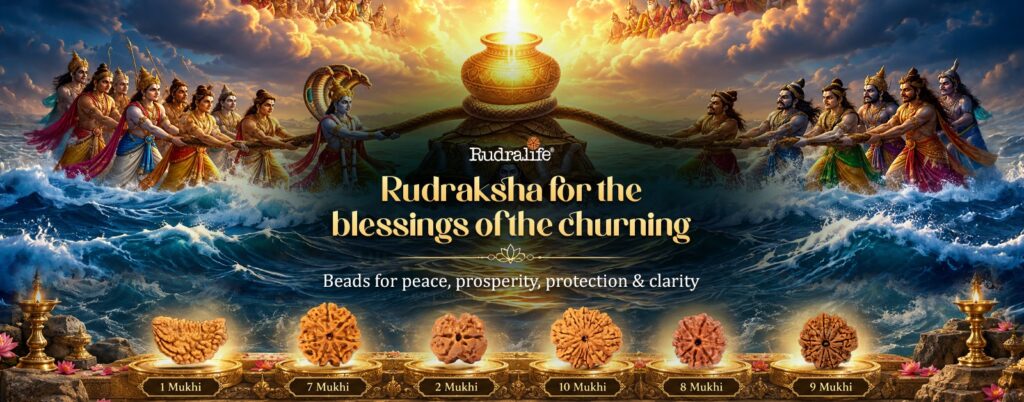
Rudraksha itself is born of Lord Shiva’s tears, so it carries a natural connection to Neelkanth, the one who held the poison for the world. Each blessing of Samudra Manthan also resonates with a particular mukhi.
- 1 Mukhi Rudraksha (Neelkanth & Shravan): Representing Lord Shiva, this bead blesses the wearer with calm, health & a peaceful mind. The genuine one Mukhi comes from South India in a half-moon shape; beads sold as “1 Mukhi Nepal” are not authentic. Read: 1 Mukhi Nepal, Does It Exist? →
Explore 1 Mukhi → - 7 Mukhi Rudraksha (Lakshmi on Diwali & Sharad Purnima): Representing Goddess Mahalakshmi, this bead blesses the wearer with prosperity, abundance & steady financial growth.
Explore 7 Mukhi → - 10 Mukhi Rudraksha (Vishnu, Kurma & Mohini): Representing Lord Vishnu, this bead blesses the wearer with protection, stability & peace at home.
Explore 10 Mukhi → - 2 Mukhi Rudraksha (Chandra): Ruled by Chandra, the moon that rose from the churning, this bead blesses the wearer with harmony in relationships & emotional balance.
Explore 2 Mukhi → - 8 & 9 Mukhi Rudraksha (Rahu & Ketu): Representing Lord Ganesha & Goddess Durga, these beads bless the wearer with clarity, courage & the removal of obstacles.
Explore 8 Mukhi → · Explore 9 Mukhi →
For the home, the Seven Mukhi Cash Box & the Ganesh Lakshmi Bandh suit Dhanteras & Diwali, while the Swasthya Bandh reflects the spirit of Dhanvantari & good health.
Rudralife’s Note: Every mukhi can be worn together, so there is no conflict in combining beads. Our experts suggest the right combination through a date-of-birth analysis using astro-numerology, so you wear what truly supports you.
Get your free Rudraksha recommendation →
If you prefer to see Rudraksha in person, come visit us at our next exhibition.
Pujas that honour Samudra Manthan
Each festival of the churning has a puja that carries its blessing into the home.
- Rudra Abhishek (Shravan & Maha Shivratri): offering water, milk & panchamrit to the Shivling, echoing the devas who cooled Neelkanth’s throat.
- Kojagari Lakshmi Puja (Sharad Purnima): a night puja with kheer under the moonlight, inviting Lakshmi’s grace.
- Dhanvantari & Kubera Puja (Dhanteras): prayers for health & wealth, done in Pradosh Kaal along with the Yama Deepam.
- Mahalakshmi Puja (Diwali): worship of Lakshmi & Ganesha on Amavasya, so prosperity comes with wisdom.
Over 25 years, Rudralife has conducted pujas like these for devotees through our Vedic Sankalp Puja. Our pandits perform each puja according to Vedic vidhi vidhan in the devotee’s name, speaking their name & gotra in the sankalp, & the devotee receives mahaprasad energised in the puja itself.
The puja is streamed live on YouTube, so devotees anywhere in the world can watch it as it happens.
Frequently asked questions
1. Which festivals are connected to Samudra Manthan? Shravan, Maha Shivratri, Sharad Purnima, Dhanteras, Diwali, Mohini Ekadashi, Kurma Jayanti & the Kumbh Mela all trace back to moments from the churning of the ocean.
2. Why is Lord Shiva called Neelkanth? He drank the halahala poison that rose first during Samudra Manthan, & it turned his throat blue. Goddess Parvati held his throat so the poison would not spread.
3. Why is Dhanteras linked to Samudra Manthan? Lord Dhanvantari emerged with the pot of amrit on Kartik Krishna Trayodashi, & Goddess Lakshmi is also said to have risen on this day.
4. Which Rudraksha is best for Diwali? 7 Mukhi Rudraksha is associated with Goddess Mahalakshmi & is traditionally worn for prosperity. The Seven Mukhi Cash Box is a gentle way to welcome her into your home or workplace.
5. Which Rudraksha connects with Lord Shiva as Neelkanth? Every Rudraksha is a blessing of Lord Shiva. 1 Mukhi, representing Lord Shiva, is the most commonly worn for daily japa & peace of mind.
6. Can I wear Rudraksha for different deities together? Yes. According to the shastras, all mukhi Rudraksha can be worn together without any conflict.
7. When are Sharad Purnima, Dhanteras & Diwali in 2026? Sharad Purnima night rituals fall on 25 October, Dhanteras on 6 November & Diwali Lakshmi Puja on 8 November 2026.
8. Can I join a Rudralife puja from outside India? Yes. The pandits speak your name & gotra in the sankalp wherever you are, & the puja is streamed live on YouTube so you can watch it as it happens.
Bottom line
Samudra Manthan reminds us that the poison often rises before the nectar. The festivals born from it, from Shravan to Diwali, invite us to honour Shiva’s sacrifice, welcome Lakshmi’s grace & seek Dhanvantari’s healing. With the right Rudraksha & a puja done with devotion, these blessings can stay with you long after the lamps are put away.
Disclaimer: Festival dates & muhurat timings follow the Panchang & can vary by location, so please confirm with your local Panchang or family pandit. Accounts of Samudra Manthan differ between the Puranas, & regional customs vary between families & communities.




Leave a comment