







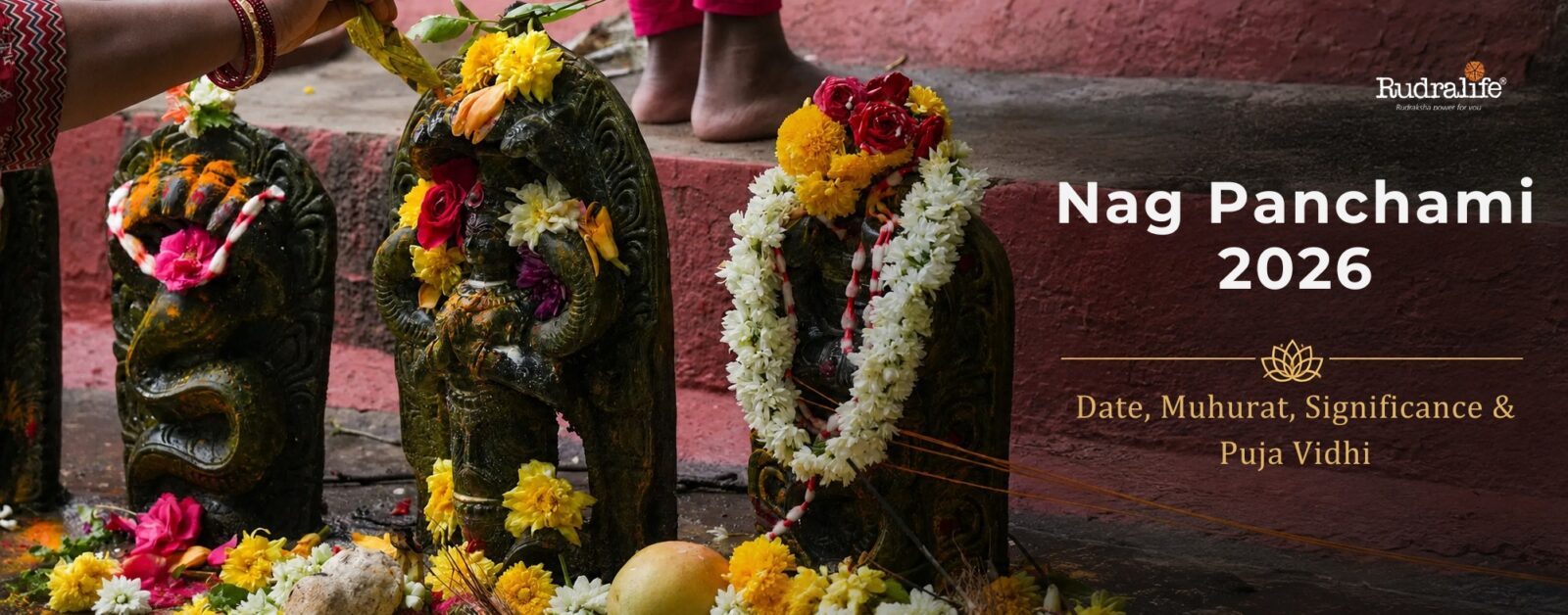
Nag Panchami 2026 falls on Monday, 17 August, observed during the sacred month of Shravan across most of India, and is dedicated to the worship of Nag Devta and Lord Shiva for protection, prosperity, and relief from fear and obstacles.
Rudralife brings you this Nag Panchami 2026 guide, covering the date, puja muhurat, and complete vidhi for the festival observed on Monday, 17 August 2026.
Key Takeaways
- Nag Panchami 2026 falls on Monday, 17 August, on the Panchami Tithi of Shukla Paksha in the month of Shravan.
- Gujarat observes Nag Pancham separately on 1 September 2026, following the Amanta lunar calendar.
- Bola Choth, when cattle and cows are worshipped, is observed in Gujarat the day before Nag Pancham, on 31 August 2026.
- The auspicious puja muhurat on 17 August falls in the early morning hours, roughly between 6:04 AM and 8:39 AM.
- The auspicious puja muhurat on 1 September in Gujarat falls between roughly 7:41 AM and 8:32 AM, a shorter window of about 51 minutes.
- The festival honours Nag Devta and is closely tied to Lord Shiva, who is depicted wearing a serpent, making it especially significant during Shravan.
- Puja vidhi includes bathing, creating a symbolic Nag Devta image, offering milk and flowers, and listening to the Nag Panchami Katha.
When Is Nag Panchami 2026?
Nag Panchami is observed on the Panchami Tithi (fifth lunar day) of Shukla Paksha in the Hindu month of Shravan. Since Hindu festivals follow lunar tithis rather than fixed Gregorian dates, the day shifts every year.
In 2026, the Panchami Tithi begins around 4:52 PM on 16 August and ends around 5:00 PM on 17 August. As a result, Nag Panchami will be celebrated on Monday, 17 August 2026 across most of India, including Uttar Pradesh, Bihar, Madhya Pradesh, Rajasthan, Maharashtra, Karnataka, Andhra Pradesh, and Tamil Nadu.
Gujarat follows the Amanta lunar calendar, under which Nag Panchami, locally known as Nag Pancham, is observed roughly two weeks later, falling on or around 1 September 2026, just a few days ahead of Krishna Janmashtami.
Shravan continues until 28 August in North India and 11 September across the South and West. See the full Shravan 2026 calendar →
Nag Panchami Puja Muhurat 2026
Most of India, 17 August 2026: The most auspicious window for Nag Panchami puja is the early morning period, approximately 6:04 AM to 8:39 AM.
The Nag Panchami 2026 puja muhurat differs by region, since the festival falls on two different dates.
Gujarat, 1 September 2026: The Nag Pancham puja muhurat runs from approximately 7:41 AM to 8:32 AM, a shorter window of about 51 minutes, so devotees in Gujarat may want to plan the puja a little more closely around it.
Performing the puja within the muhurat is considered ideal, though devotees who begin their rituals slightly outside this window with sincerity need not worry, the sincerity and completeness of the puja matter more than the exact minute. Timings shift by location, so it is always worth confirming against your local Panchang.
Who is Nag Devta?
“Nag Devta” isn’t one single deity, it’s the collective name for the Nagas, the serpent deities of serpent deities, worshipped individually across regions (Vasuki, Shesha, Takshak, Kaliya, Manasa, etc., or a generic “Nag Devta” idol/image in North Indian households).
“Naga” comes from the Sanskrit word for serpent while “Devata” means deity, so Naga Devata translates to “serpent deity.” In North India they’re commonly called “Nag Devta,” while in South India the terms “Nagaraja” (King of Serpents) and “Nagakanya” (Serpent Maiden) are more common.
These are the deities honoured on Nag Panchami 2026, whether the puja is performed at home or at a temple.
Where the Nagas Come From
Kadru, daughter of Daksha and consort of the sage Kashyapa, is best known as the mother of the Nagas. Pleased with her service, Kashyapa granted her a boon, and she asked for a thousand sons; she then delivered a thousand eggs, which she kept warm for 500 years until they hatched into a thousand serpents.
Kashyapa’s other wife, Kadru’s sister Vinata, bore two sons instead, Aruna and Garuda, who became Vishnu’s vahana.
The two sisters made a wager over the colour of the divine horse Uchchaihshravas’s tail. Kadru claimed it was black, Vinata insisted it was white, and the loser was to become the other’s servant. Kadru had her serpent sons cling to the horse’s tail to make it look black, and this is why Garuda and the serpents have been enemies ever since.
The Nine Nagas
1. Ananta, the endless cosmic serpent, the eldest of Kadru’s serpent children, who left his cruel brothers to take up penance.
2. Shesha, The celestial serpent upon whom Lord Vishnu rests, holding the earth steady on his thousand hoods.
3. Vasuki, the king of the nagas, bearing the gem Nagamani on his head, closely tied to Shiva as the ring on Shiva’s finger and the churning rope during the Samudra Manthan.
4. Padmanabha (Padma), born to Kashyapa and Kadru, holding up the north-west of the earth, with a single hood marked by a trident, red in colour like a lotus.
5. Kambala, one of the nine principal nagas named in the Navnag Stotra, invoked alongside his brothers for protection.
6. Shankhapala, a fiery, many-headed naga who looks ferocious but is not harmful, one of the important nagas present at Balarama’s death.
7. Dhritarashtra, another of the nine named in the Navnag mantra, part of the principal group invoked for protection from evil.
8. Takshaka, one of Kadru’s naga sons who was cursed and exiled to the Khandava forest; a sage’s curse on King Parikshit was fulfilled through Takshaka’s bite, which is what led Janamejaya to hold the sarpasatra sacrifice.
9. Kaliya, the venomous naga who lived in the Yamuna at Vrindavan until Krishna subdued him.
Connection to Shiva: Lord Shiva is often depicted with a serpent coiled around his neck, symbolising his mastery over desire. Vasuki in particular is considered Shiva’s ornament, which is the closest direct link between the Nagas and Shravan itself.
Read: Powerful Lord Shiva Mantras to Chant During Shravan →
Ten mantras with meanings and pronunciation.
Nagas are associated with water bodies, believed to reside in Patala, linked to connected with both Vishnu and Shiva, and are worshipped for protection, fertility, and prosperity.
Farmers pray to them for good harvests, rain, and protection from drought and calamities, and they’re regarded as couples hoping for children pray to them.
Why Nag Panchami Is Celebrated: Significance and Legends
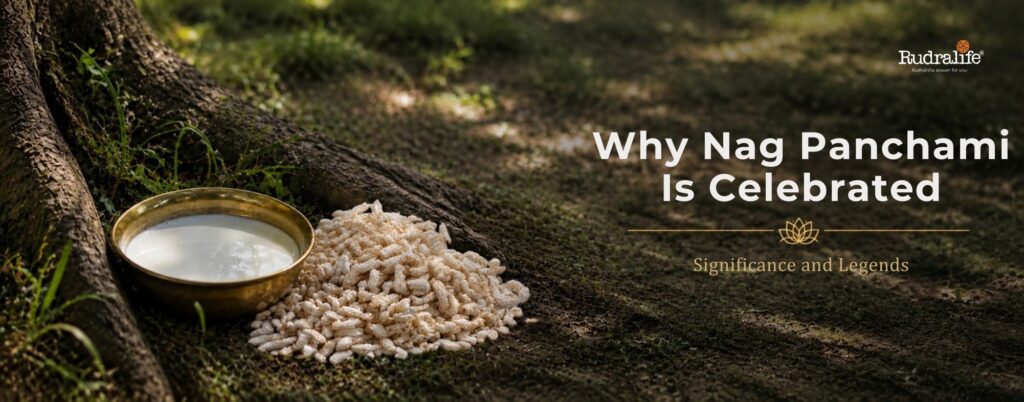
Nag Panchami is observed for several reasons, each with its own story behind it, with several legends explaining its origin:
The Krishna–Kaliya legend: One of the most familiar stories tells of Lord Krishna subduing the serpent Kaliya in the Yamuna river, saving the residents of Gokul from its poison. This victory is remembered by every Shravan as is observed for several reasons, each with its own story behind it.
The Astika–Janamejaya legend: According to another account, King Janamejaya organised a yajna to destroy the entire Naga clan after his father Parikshit was killed by the serpent king Takshak. The sage Astika intervened, persuading Janamejaya to halt the yajna and recognise the essential role serpents play in nature’s balance. The day this yajna was stopped is remembered as Nag Panchami.
The connection to Lord Shiva: Lord Shiva is often depicted wearing a serpent coiled around his neck, a symbol of mastery over fear and the forces of nature that cannot be controlled. Since Nag Panchami falls within Shravan, the month most closely associated with Lord Shiva, worship of Nag Devta on this day is considered deeply connected to Shiva worship itself.
Relief from Kaal Sarp Dosh: Many devotees believe that worshipping serpent deities on Nag Panchami helps ease the effects of Kaal Sarp Dosh and the influence of Rahu and Ketu in one’s birth chart. This is especially for those who feel the same difficulties returning again and again, though the ritual holds value for all devotees, not only those with this specific placement.
Nag Panchami Within the Sacred Month of Shravan
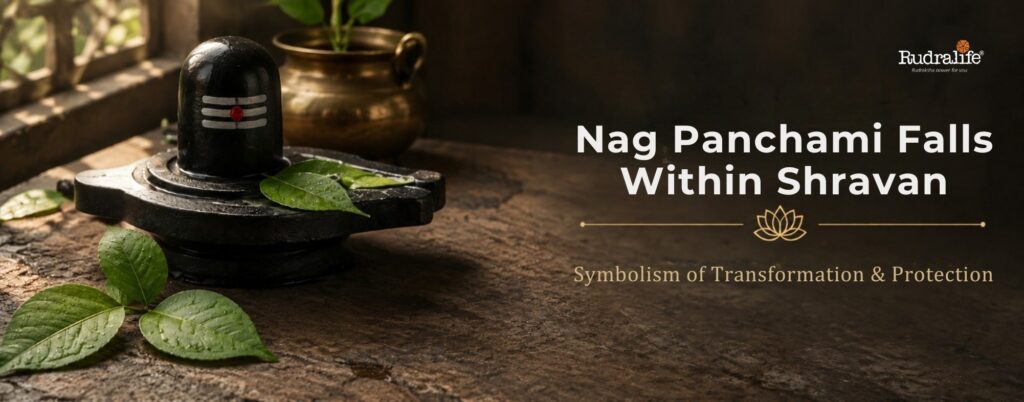
Nag Panchami 2026 falls squarely within Shravan, making it one of the month’s most significant observances. Shravan is already devoted to Lord Shiva, and the serpent, a constant companion in Shiva’s traditional depictions, carries the symbolism of transformation, protection, and either cut, or say what it refers to specifically throughout this period.
For many devotees, this is also a time to reflect on the Rudraksha they wear, since Rudraksha has long been associated with Lord Shiva and with the same qualities of protection and inner steadiness that Nag Panchami calls upon.
At Rudralife, an organisation established 25 years ago to educate, promote, and supply the best quality Nepal Rudraksha, now the world’s leading organisation in this field, every bead reaching a devotee has been sourced directly from Rudraksha farmers in Nepal, with roughly 90% of collected beads set aside for not meeting quality standards, before the final ACE energisation step enhances each bead’s energy.
Nag Panchami Puja Vidhi: Three Ways to Observe the Day
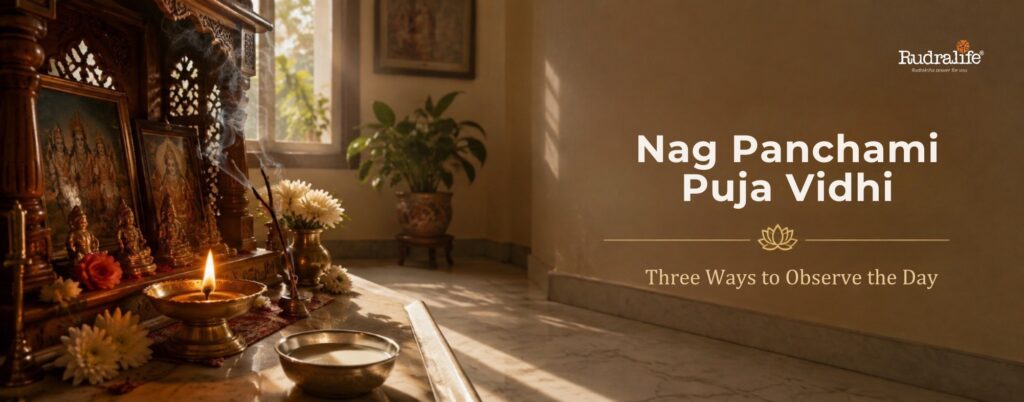
Nag Panchami 2026 can be observed in more than one way, depending on what is accessible to you.
1. At Home or a Nearby Nag Devta Temple
Wake early and bathe. Begin the day with a bath and wear clean clothes before starting any rituals.
Set up the puja. If you have a photo or idol of Nag Devta at home, perform the puja there. Otherwise, visit a nearby Nag Devta temple.
Offer milk and dhaan ki kheel. Along with flowers, offer milk and dhaan ki kheel (धान की खील, also known as धान का लावा) to Nag Devta.
Light the diya and incense. A diya and incense sticks are lit as part of the puja.
2. At a Nearby Forest or Open Green Area
Many devotees also visit a nearby jungle or open green patch and leave an offering of milk with dhaan ki kheel in the name of Nag Devta. This is a widely followed practice, based on the belief that a real serpent in its natural habitat may accept the offering. It is a gesture of reverence towards Nag Devta in his own domain, rather than a substitute for the home or temple puja.
3. Navnag Stotra Paath
The Navnag Stotra, invoking the nine principal Nagas, can be recited with the guidance of a Vedic pandit for the correct rituals and chanting.
The Navnag Stotra, invoking all nine Nagas by name.
If arranging this on your own feels difficult, you can also join our Sankalp Puja, performed with complete vidhi on your behalf.
Book a Sankalp Puja performed on your behalf →
Performed in your name and gotra by Vedic pandits.
Fasting on Nag Panchami
Many devotees observe a fast on Nag Panchami 2026, beginning at sunrise and continuing until sunset.
Fried and salty foods are typically avoided on this day, with some devotees choosing to begin their fast a day in advance.
Since Nag Panchami falls within Shravan, many devotees are already observing a vrat through the month. Read: Shravan Fasting Diet, the four types of vrat →
Wearing Rudraksha During Nag Panchami and Shravan
Since Nag Panchami sits within Shravan, many devotees choose this period to wear or re-energise their Rudraksha mala, drawing on its long-standing association with Lord Shiva. As with any Rudraksha purchase, recommendations at Rudralife are made using date of birth only, through astro-numerology, so that the mala chosen is suited to the wearer.
Beads that are rare or infrequently found in nature are best purchased in person, since online purchase removes the physical verification methods available at an exhibition or store.
Read: What Is Rudraksha? A Complete Beginner’s Guide →
What the bead is and where it comes from, with no prior knowledge assumed.
Frequently Asked Questions
Is one method of puja, home, forest offering, or Stotra paath, considered more effective than the others? No single method is considered superior. Each reflects a different way of honouring Nag Devta, and devotees choose based on accessibility and personal preference; sincerity matters more than the specific method.
What if I am unable to complete the Nag Panchami 2026 puja within the 6:04 AM–8:39 AM muhurat? While this window is considered most auspicious, the puja can still be performed later in the day. Devotion and completeness of the ritual matter more than performing it within the exact minute.
What is Bola Choth? Bola Choth, also called Bahula Chauth, is observed in Gujarat the day before Nag Pancham, falling on 31 August 2026. Cattle and cows are worshipped on this day, as part of the same festival period.
Is the Kaal Sarp Dosh remedy relevant only to those who have it in their birth chart? The remedy holds particular significance for those with Kaal Sarp Dosh or Sarpa Dosha, but the Nag Panchami puja itself is meaningful for all devotees seeking protection and blessings, regardless of their birth chart.
Why does Gujarat celebrate Nag Panchami on a different date? Gujarat follows the Amanta lunar calendar, under which Nag Pancham falls roughly two weeks after the date observed in most other states, landing on or around 1 September 2026 this year.
Can I check whether my existing Rudraksha mala is suited for Shravan and Nag Panchami? Yes. A consultation based on date of birth can confirm whether your current mala aligns with what would typically be recommended, and whether any additional bead would complement it during Shravan.
Speak with a Rudralife expert, free →
Bottom Line
Nag Panchami 2026 falls on Monday, 17 August, within the sacred window of Shravan, making it a day that draws together serpent worship, devotion to Lord Shiva, and the wider spiritual energy of the month.
Whether observed through the traditional vidhi at home, a fast carried through to sunset, or a quiet moment of reflection with your Rudraksha mala, the day is best approached with sincerity rather than a race against the clock.
For those wearing or considering Rudraksha this Shravan, the same principles that guide Nag Panchami, protection, steadiness, and respect for what one cannot fully see, sit naturally alongside the practice.
However you observe Nag Panchami 2026, sincerity matters more than the exact minute.
See This Shravan’s Rudraksha Collection →
Disclaimer
This article is intended for general informational and educational purposes only and reflects commonly followed traditions and beliefs associated with Nag Panchami.
Dates, tithi timings, and muhurat windows are based on the Hindu Panchang and may vary slightly across regional calendars and calculation methods.
Readers are encouraged to consult a local priest or trusted almanac for exact timings specific to their location.








Leave a comment