







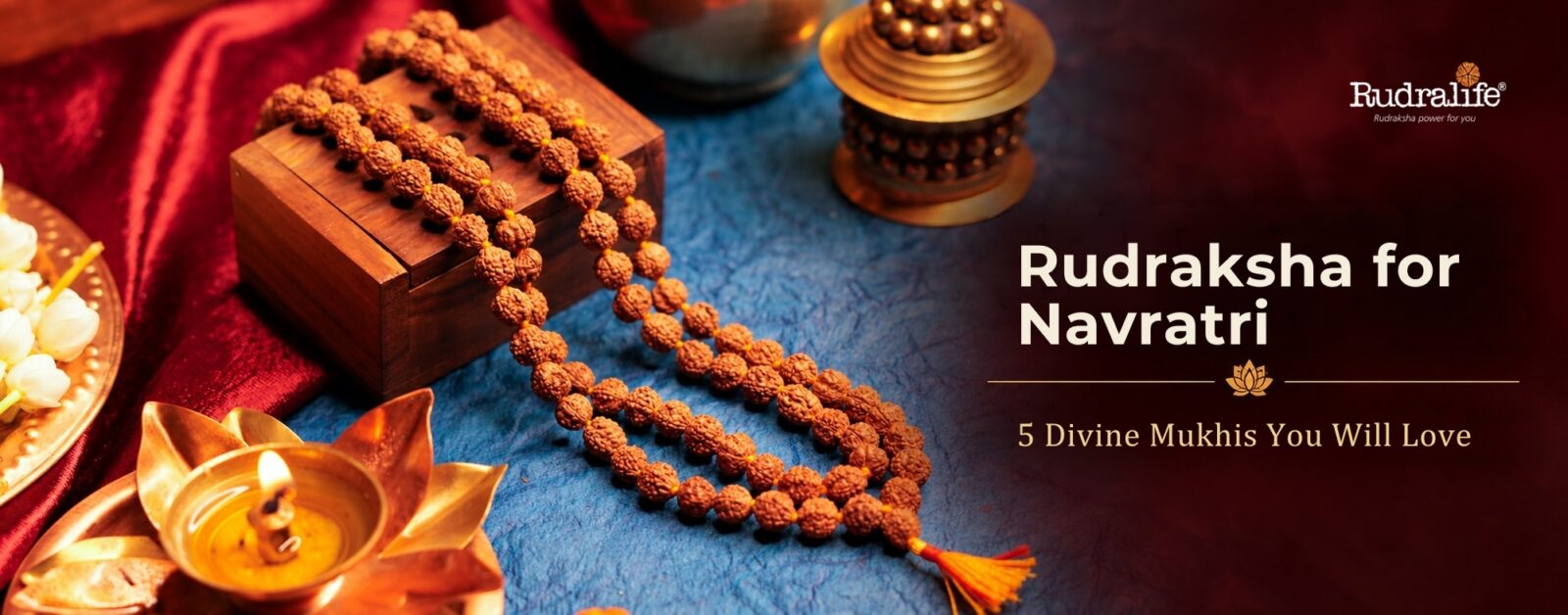
Rudraksha for Navratri has a story behind it, and it begins on the second night. Sharad Navratri 2026 starts with Ghatasthapana on Sunday, 11 October.
On the second day, devotees across India bow a Goddess who carries no weapon. Maa Brahmacharini walks barefoot, a kamandalu in one hand and a Rudraksha mala in the other. Her strength does not come from battle. It comes from tapasya, the deep and patient devotion that eventually won her Lord Shiva.
This Navratri, her mala gives devotees a beautiful way to understand why Rudraksha belongs in these nine nights
Key Takeaways
- Sharad Navratri 2026 begins with Ghatasthapana on Sunday, 11 October and concludes with Vijayadashami on Tuesday, 20 October
- Rudraksha for Navratri is chosen by date of birth through astro-numerology, not by the festival alone
- Maa Brahmacharini, worshipped on the second day, is traditionally depicted holding a Rudraksha japa mala, a symbol of her tapasya for Lord Shiva
- Nine Mukhi is the primary Rudraksha for Navratri, linked directly to Goddess Durga
- Eighteen Mukhi, Seven Mukhi, Gaurishankar and Two Mukhi each carry a connection to a form of the Divine Mother or to the union of Shiva and Shakti
- Mukhis do not conflict with one another, so devotees can wear more than one together through the nine nights
- A Rudraksha japa mala is a natural companion for Navratri mantra chanting
Sharad Navratri 2026: Dates at a Glance
Sharad Navratri 2026 begins with Ghatasthapana on Sunday, 11 October 2026, and the nine nights conclude with Vijayadashami (Dussehra) on Tuesday, 20 October 2026.
Each day honours one of the Navadurga, the nine forms of the Divine Mother, beginning with Maa Shailputri, continuing with Maa Brahmacharini on the second day, and culminating with Maa Siddhidatri on the ninth.
Muhurat and tithi timings vary by location. Please check Drik Panchang for your city before beginning Ghatasthapana.
Read our complete Sharad Navratri 2026 guide →
Who Is Maa Brahmacharini?
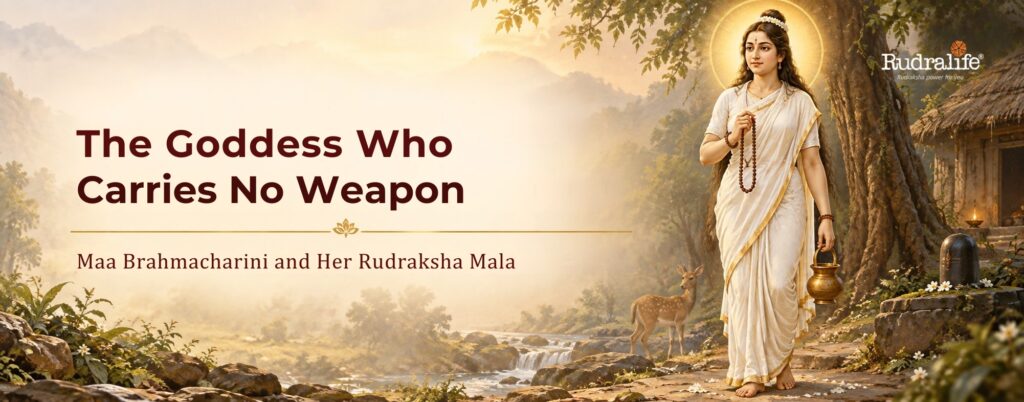
Maa Brahmacharini is the second of the Navadurga and the form of Goddess Parvati in her years of penance.
The Puranas describe how, as a young woman, Parvati resolved to win Lord Shiva as her consort. She left behind the comforts of palace life and undertook tapasya so intense that she lived for years on fruits and leaves, and later gave up even those.
Her name reflects this. It comes from brahmacharya, the disciplined life of a devoted spiritual student, and “charini” means one who follows or practises. She is the Goddess who walks the path of devotion, discipline and restraint. In many retellings, it was Lord Brahma himself who, moved by the intensity of her tapasya, blessed her that Lord Shiva would accept her as his consort.
Her iconography is simple and deliberate. She is shown dressed in white, walking barefoot, holding a kamandalu (water pot) in her left hand and a japa mala in her right. Her prarthana (prayer) describes her this way:
Dadhana Kara Padmabhyam Akshamala Kamandalu
Devi Prasidatu Mayi Brahmacharinyanuttama
“O Goddess Brahmacharini, who holds the rosary and water pot in her lotus hands, please bless me.”
In temple iconography and devotional tradition, the mala in her hand is widely depicted as a Rudraksha mala.
Why Maa Brahmacharini Holds a Rudraksha Mala
The connection is deeply meaningful. According to the Shiva Purana, Rudraksha was born from the tears of Lord Shiva. The very Goddess whose entire penance was directed towards Shiva holds in her hand the bead that came from him.
Every bead she turns on that mala is a mantra offered to the one she sought. The Rudraksha in her hand is not ornamental. It is the instrument of her tapasya, the thread that connects her discipline to her devotion.
For devotees, this carries a gentle lesson. Maa Brahmacharini did not win Shiva through a single grand gesture. She won him through quiet, repeated, patient effort. A japa mala works the same way: one bead, one mantra, and then the next.
Learn how to perform japa with a Rudraksha mala
This is why many devotees choose the second day to begin a daily japa practice, and why Rudraksha for Navratri carries more meaning than a seasonal purchase.
Explore authenticated Rudraksha japa malas →
Aksha Mala and Japa Mala: What Is the Difference?
Maa Brahmacharini’s prarthana calls the beads in her hand an akshamala. Many devotees today know the same object as a japa mala. Both names describe a string of prayer beads, but each looks at it from a different angle.
Aksha Mala: the scriptural name. Aksha is the ancient term found in scripture and ritual. It carries layered meanings in Sanskrit, including “eye,” as in Rudraksha, the eye of Rudra. The Akshamalika Upanishad gives the name another meaning. It explains that the beads represent the letters of the Sanskrit alphabet, from “a” to “ksha,” so the mala becomes a garland of sacred sound itself. This is why the term appears in consecration rites, ancient texts and formal sadhana.
Japa Mala: the practical name. Japa means the meditative repetition of a mantra or divine name. A japa mala describes what the beads are used for: keeping count while chanting, traditionally 108 times, with one additional sumeru bead marking the start and end of each round.
| Aksha Mala | Japa Mala | |
| Context | Scriptural, ritual and philosophical | Practical, meditative and devotional |
| Meaning of the name | Garland of sacred syllables (a to ksha) | Garland for repetition and chanting |
| Where it appears | Ancient texts, consecration rites, specific sadhanas | Daily practice, counting mantra repetitions |
When Maa Brahmacharini holds her akshamala, both meanings come together. It is the sacred garland of the scriptures and, at the same time, the tool of her daily tapasya.
Read: Japa Mala, How To Use a Rudraksha Japa Mala →
Rudraksha for Navratri: The Mukhis of the Divine Mother
At its heart, Sharad Navratri is a season devoted to the Divine Mother, and Rudraksha for Navratri usually means one of five beads.
Nine Mukhi (Nau Mukhi) is the primary Rudraksha associated with this festival, linked directly to Goddess Durga. Devotees traditionally turn to it for courage, protection and inner strength, the very qualities the nine nights are meant to awaken.
Shop Nine Mukhi Nepal Rudraksha →
Eighteen Mukhi (Athara Mukhi) carries the energy of Bhumi Devi, the Earth Goddess, another revered form of the Divine Mother associated with stability, grounding and abundance.
Shop Eighteen Mukhi Nepal Rudraksha →
Seven Mukhi (Sapta Mukhi) is associated with Goddess Mahalakshmi, and devotees often turn to it during this season of worship for her blessings of prosperity and well-being.
Shop Seven Mukhi Nepal Rudraksha →
Gaurishankar Rudraksha, a naturally joined bead formed of two Rudraksha grown together as one, represents the union of Gauri (Parvati) and Shankar (Shiva). It is a fitting presence during a festival that honours the Goddess alongside Lord Shiva.
Shop Gaurishankar Rudraksha Nepal →
Two Mukhi (Do Mukhi) represents Ardhanarishwara, the combined form of Shiva and Shakti as one being, half masculine and half feminine. Devotees wear it seeking harmony in relationships and within themselves.
Shop Two Mukhi Nepal Rudraksha →
Devotees who prefer a bracelet often choose our 9 Mukhi Durga Shakti Bracelet, which carries the same association with Maa Durga in a form bracelet made for daily wear.
Buy the 9 Mukhi Durga Shakti Bracelet →
Any of these can be worn as your Rudraksha for Navratri, and mukhis do not conflict with one another.
Bringing Maa Brahmacharini’s Devotion Into Your Navratri
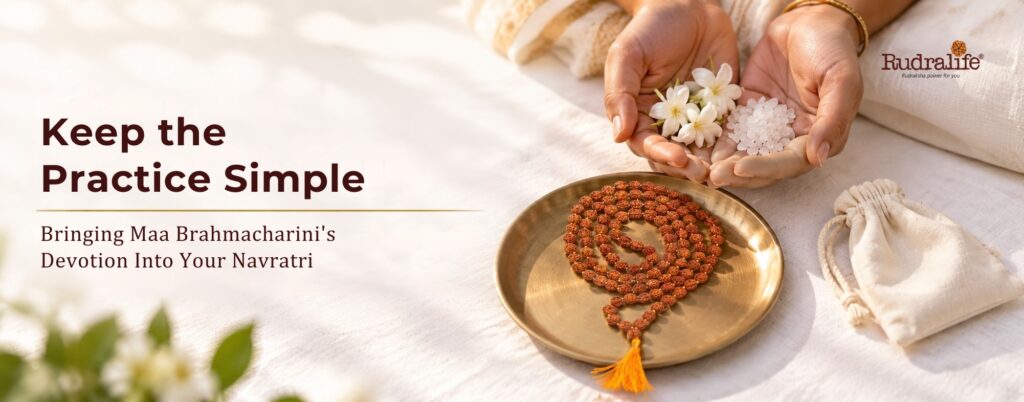
Devotees choosing a Rudraksha for Navratri can keep the practice itself simple:
- Begin a daily japa practice on the second day of Navratri, using a Rudraksha mala of 108 beads plus the sumeru bead.
- Chant with consistency rather than quantity. One sincere mala a day through all nine nights reflects her spirit far better than an ambitious number abandoned halfway.
- Offer white flowers and sugar to Maa Brahmacharini on her day, as is traditional in many households.
- Keep your mala personal. A japa mala is traditionally used by one devotee only and kept in a clean cloth pouch when not in use.
Every Rudralife Rudraksha is X-ray authenticated and energised through ACE before it reaches the devotee, so it is ready to wear or use for japa from the first day.
Explore Rudralife’s Navratri collection →
How to Know Which Mukhi Is Right for You
The right Rudraksha for Navratri depends on more than the festival.
Rudralife’s experts recommend Rudraksha using the devotee’s date of birth through astro-numerology. Based on your Mulank and the planetary influences that need balancing, they suggest the mukhis most suited to you.
Having a particular Mulank does not automatically mean you need the Rudraksha for that planet; it becomes relevant only when that ruling planet needs balancing.
Book a free Rudraksha consultation →
FAQ
1. Which Rudraksha for Navratri is best? Nine Mukhi is the primary Rudraksha associated with Navratri, as it is linked directly to Goddess Durga. Eighteen Mukhi, Seven Mukhi, Gaurishankar and Two Mukhi also carry strong connections to the Divine Mother or to the union of Shiva and Shakti.
2. Why does Maa Brahmacharini hold a Rudraksha mala? Maa Brahmacharini represents Goddess Parvati during her tapasya to win Lord Shiva. The akshamala in her right hand, traditionally understood as a Rudraksha mala, is the instrument of her japa. Since Rudraksha is said to have been born from Shiva’s tears, it symbolises her devotion to him.
3. On which day of Navratri is Maa Brahmacharini worshipped? She is worshipped on the second day of Navratri. In Sharad Navratri 2026, this falls on Monday, 12 October, though devotees should confirm the tithi for their location on Drik Panchang.
4. Can I start wearing Rudraksha during Navratri? Yes. Navratri is considered one of the most auspicious periods to begin wearing Rudraksha, and Rudraksha for Navratri is often a devotee’s first bead.
5. Can I wear more than one mukhi during Navratri?
Yes. As the Shastras confirm, mukhis do not conflict with one another, and devotees can wear several together.
6. Which mala should I use for japa during Navratri? A Rudraksha japa mala of 108 beads plus the sumeru is the traditional choice, following Maa Brahmacharini’s own example.
7. Is an aksha mala the same as a japa mala?Yes, both refer to a string of prayer beads. Aksha mala is the scriptural term used in ancient texts and rituals, while japa mala describes its practical use in counting mantra repetitions.
8. How do I know which Rudraksha suits me? Rudralife’s experts recommend Rudraksha based on your date of birth through astro-numerology, looking at your Mulank and which planetary influences need balancing.
The Bottom Line
Maa Brahmacharini reminds devotees that devotion is built one bead at a time. Her Rudraksha mala is a symbol of patience, discipline and a heart turned wholly towards the Divine. This Sharad Navratri 2026, whether you wear Nine Mukhi for Goddess Durga’s protection, Gaurishankar for the union of Shiva and Shakti, or simply begin a daily japa practice, Whatever Rudraksha for Navratri you choose, you carry a small part of her tapasya with you.
For 25 years, Rudralife has offered devotees authenticated Nepal Rudraksha, each bead X-ray verified at RRTL, Rudralife’s own ISO 9001:2015 accredited lab, and energised through ACE before it reaches you.
Explore Rudralife’s Navratri collection →
Related Reading
- Brahmacharini — Wikipedia — the second of the Navadurga and her tapasya
- Navaratri — Wikipedia
- Sharad Navratri 2026: Complete Guide




Leave a comment