





Sharad Navratri 2026 begins with Ghatasthapana on Sunday, 11 October and ends with Vijayadashami on Tuesday, 20 October.
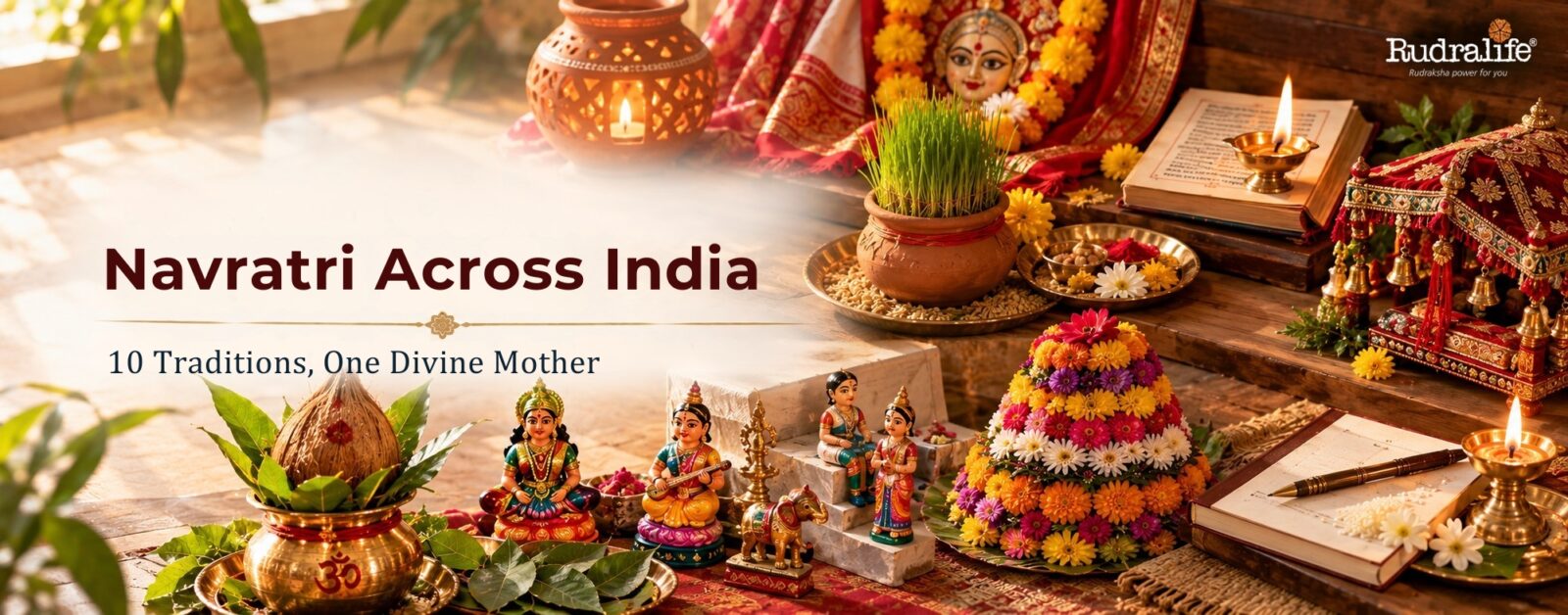
The goddess being worshipped is the same everywhere, but Navratri celebrations across India look very different from one state to the next.
In Gujarat, people dance through the night. In Bengal, whole neighbourhoods build pandals for Durga Puja. In Tamil Nadu, families arrange dolls on steps, and in Kerala, children write their first letters.
This guide walks through how each region observes the nine nights, and what these traditions share underneath.
Key Takeaways
- Sharad Navratri 2026 runs from 11 October (Ghatasthapana) to 20 October (Vijayadashami). Confirm local muhurat timings on Drik Panchang for your city
- Navratri celebrations across India fall into a few broad themes: devotional dance, Durga Puja, the Ramayana, doll displays, and the worship of learning and tools
- Two regional traditions are recognised by UNESCO as Intangible Cultural Heritage: Durga Puja in Kolkata (2021) and Garba of Gujarat (2023)
- Regional traditions range from Garba in Gujarat and Durga Puja in Bengal to Golu in Tamil Nadu, Bathukamma in Telangana and Vidyarambham in Kerala
- Rudraksha traditionally associated with the Divine Mother: 9 Mukhi, 18 Mukhi, 7 Mukhi, Gaurishankar and 2 Mukhi
Why Navratri Celebrations Across India Differ
Navratri honours the Divine Mother in her nine forms, known as the Navadurga.
Two stories sit at the heart of the festival: Goddess Durga’s victory over the buffalo demon Mahishasura, and Lord Rama’s victory over Ravana. Both are remembered on Vijayadashami, the tenth day.
Different regions give weight to different parts of this story.
Eastern India focuses on Durga’s return and battle. Northern India focuses on Rama and the Ramayana. Southern India gives the final days to Saraswati, the goddess of learning, and to the worship of tools and instruments. Local history, royal patronage and farming seasons have shaped each version over centuries.
1. Gujarat: Garba and Dandiya Raas
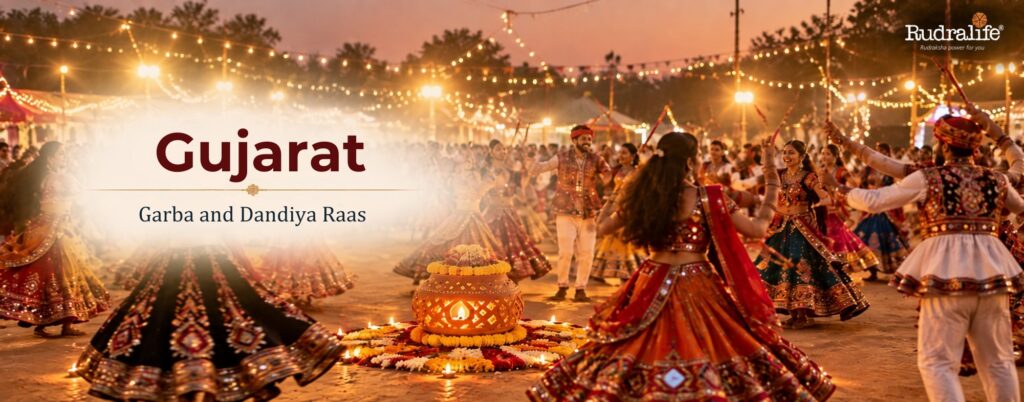
Gujarat is the first place many people picture in Navratri celebrations across India. Every evening, devotees gather in circles around a garbo, an earthen pot with a lamp burning inside it.
The lamp represents the goddess, and the circular dance around it represents the cycle of life that begins and ends with her.
Garba is danced with hand claps and steps, while Dandiya Raas is danced in pairs with decorated sticks. Many devotees fast during the day and dance late into the night. Garba of Gujarat was added to UNESCO’s list of Intangible Cultural Heritage in December 2023.
UNESCO’s list of Intangible Cultural Heritage →
2. West Bengal, Assam, Odisha and Tripura: Durga Puja
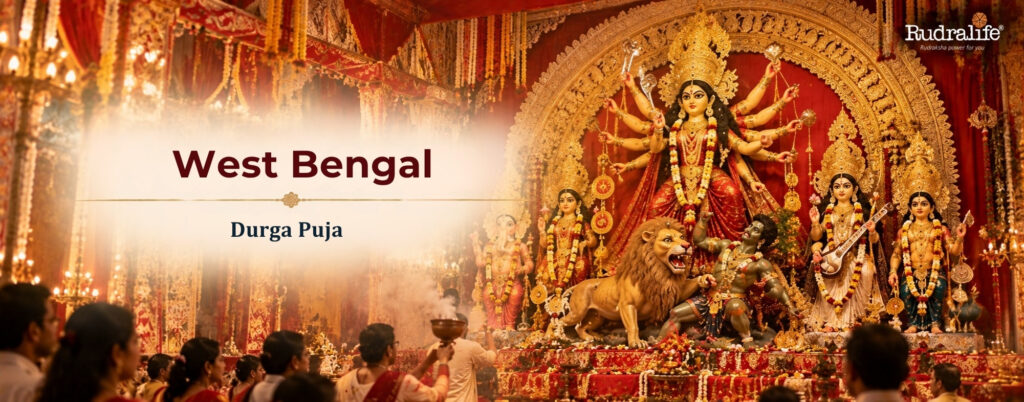
In eastern India, the last five days of Navratri, from Shashthi to Vijayadashami, are celebrated as Durga Puja. The belief is that the goddess returns to her parental home with her children, Ganesha, Kartikeya, Lakshmi and Saraswati, for these few days.
Large clay idols showing Durga slaying Mahishasura are installed in pandals, many built around an artistic theme.
Devotees perform the dhunuchi dance with clay incense burners. On Vijayadashami, married women apply sindoor to the goddess and to each other in Sindoor Khela, and the idols are immersed in rivers or water bodies. Durga Puja in Kolkata was inscribed on UNESCO’s Intangible Cultural Heritage list in 2021.
3. Uttar Pradesh, Delhi, Bihar and Madhya Pradesh: Ramlila and Kanya Pujan
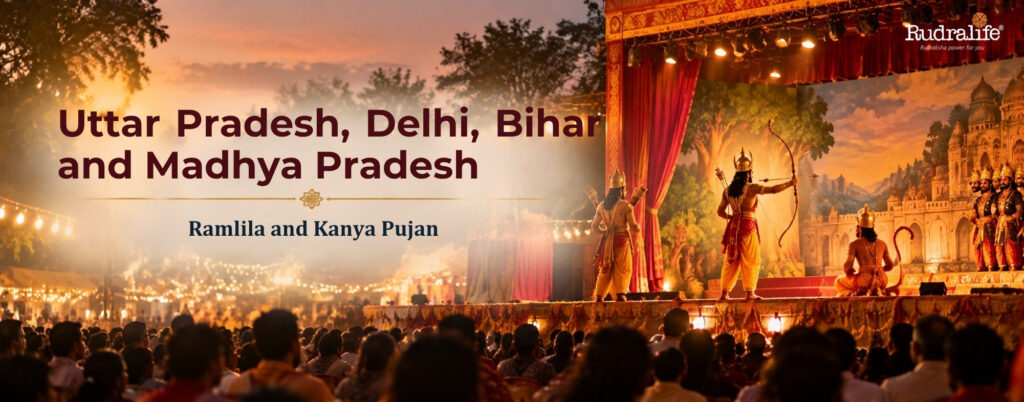
Across North India, Navratri takes the form of the Ramayana. Ramlila, a nightly theatrical retelling of Lord Rama’s life, is staged in towns and neighbourhoods.
On Dussehra, large effigies of Ravana, Meghnad and Kumbhakarna are burned to mark the victory of good over evil.
Inside homes, many families keep the nine-day fast and set up a clay pot with sown barley. On Ashtami or Navami, young girls are invited home and worshipped as living forms of the goddess in Kanya Pujan. Their feet are washed, and they are served puri, kala chana and halwa before being given small gifts.
Read the Sharad Navratri 2026 guide for day-wise rituals →
4. Punjab and Jammu: Jagratas and Kanjak
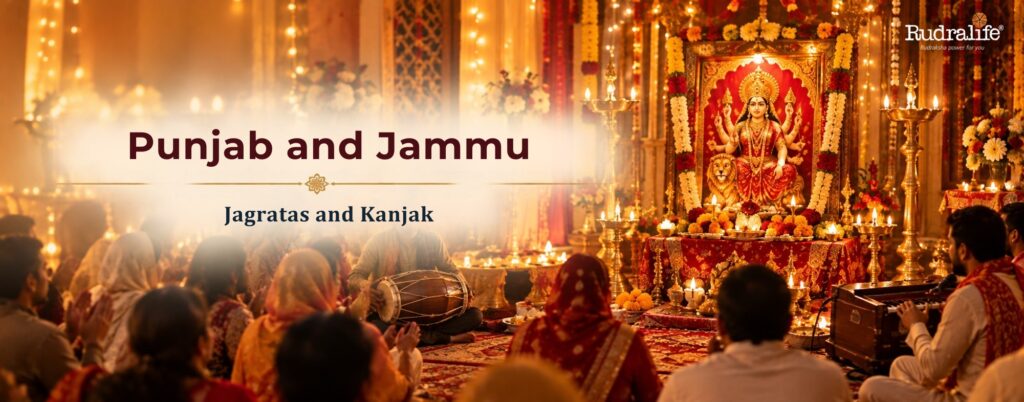
In Punjab and Jammu, devotees hold jagratas, night-long gatherings of devotional singing in honour of the goddess.
Many families fast for the first seven days and break the fast on Ashtami with Kanjak, the local name for Kanya Pujan. Pilgrimages to Vaishno Devi in Jammu see heavy footfall through the Navratri period.
5. Himachal Pradesh: Kullu Dussehra
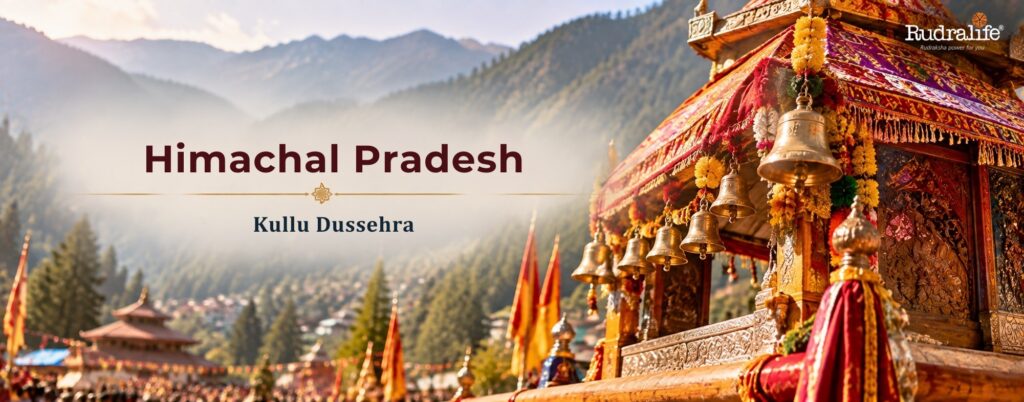
Kullu Dussehra follows its own calendar. While most regions end their celebrations on Vijayadashami, Kullu begins on that day and continues for a week.
Deities from villages across the valley are carried in palanquins to Kullu’s Dhalpur ground to join Lord Raghunath in procession. The tradition is traced back to the 17th century.
6. Maharashtra: Ghatasthapana, Colours and Apta Leaves
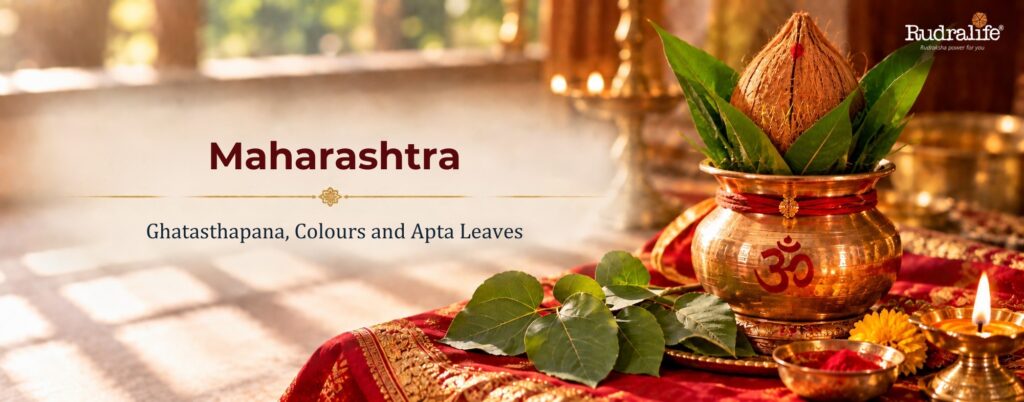
In Maharashtra, Navratri begins with Ghatasthapana, where a kalash is placed on a bed of soil sown with grains. The sprouts that grow over nine days are seen as a sign of the goddess’s blessing. Many women wear an assigned colour on each day, and in parts of the state, girls sing Bhondla or Hadga songs around a drawing of an elephant.
On Dussehra, people exchange leaves of the apta tree as symbolic “gold,” a custom linked to the story of Kautsa and King Raghu. Temples of Tulja Bhavani and Mahalakshmi (Kolhapur) see large gatherings during these days.
7. Karnataka: Mysuru Dasara and Gombe Habba
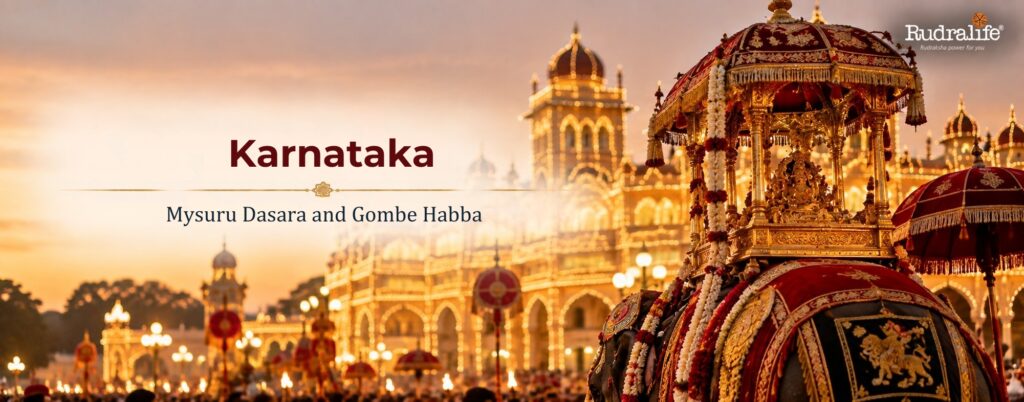
Among Navratri celebrations across India, Mysuru Dasara is the one with the longest royal history.
Mysuru Dasara has been celebrated with royal patronage since the early 17th century. The Mysore Palace is lit with thousands of bulbs every evening. On Vijayadashami, an idol of Goddess Chamundeshwari is carried on a decorated elephant through the city in the Jamboo Savari procession.
Homes across Karnataka also set up Gombe Habba, a display of traditional dolls, similar to the Golu of Tamil Nadu.
8. Tamil Nadu and Andhra Pradesh: Golu and Ayudha Puja
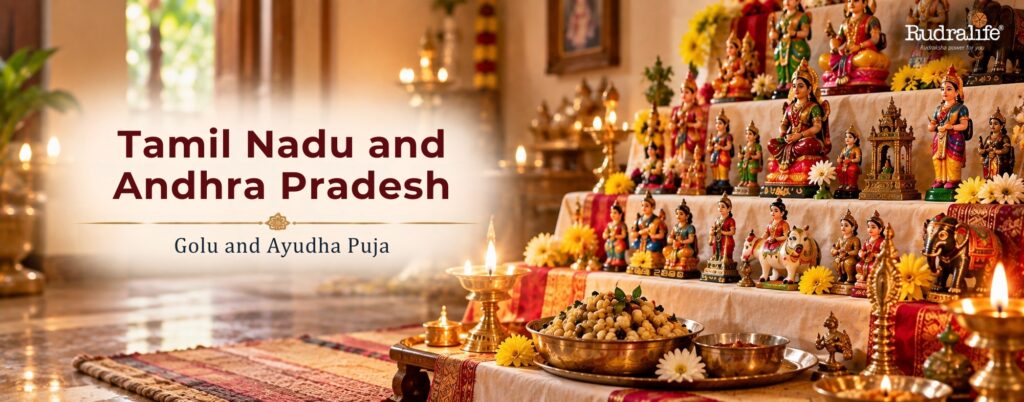
In Tamil Nadu, families arrange Bommai Kolu (called Bommala Koluvu in Andhra Pradesh), dolls of deities, saints and everyday life placed on steps, usually in an odd number such as five, seven or nine. Women visit each other’s homes in the evenings, sing, and exchange sundal (a lentil dish) and small gifts.
The ninth day is Ayudha Puja, when tools, vehicles, books and instruments are cleaned, decorated and worshipped. The idea is to give thanks for the means by which a family earns its living and gains knowledge. Saraswati Puja is observed on the same day or the day before.
9. Telangana: Bathukamma
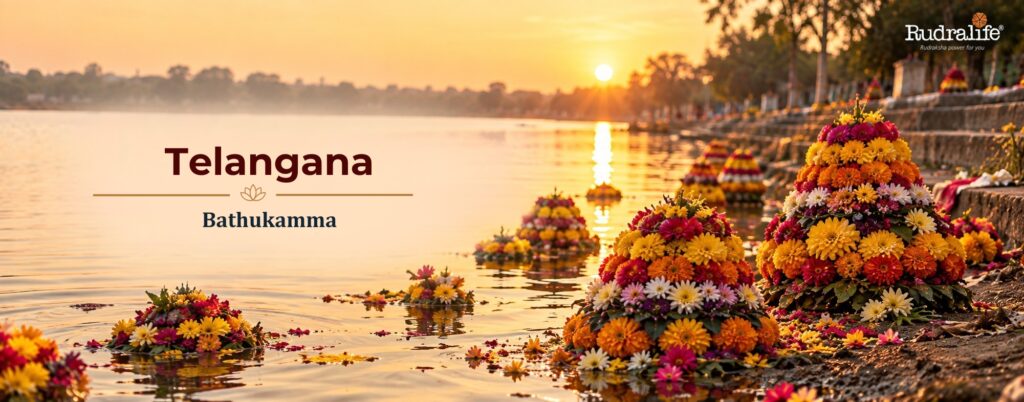
In Telangana, women celebrate Bathukamma by stacking seasonal flowers into cone shapes. They sing and dance around them in circles, and on the final day, float them in lakes and ponds. The festival honours Goddess Gauri and the flowering season.
10. Kerala: Saraswati Puja and Vidyarambham
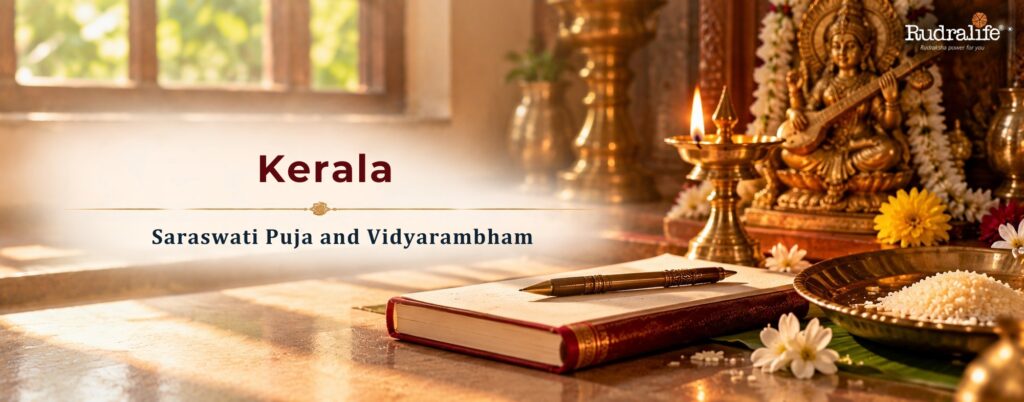
In Kerala, the last three days are dedicated to Saraswati. Books, pens and musical instruments are placed before the goddess and not used until Vijayadashami.
On that morning, young children are introduced to learning in Vidyarambham, writing their first letters in rice or sand, often guided by a teacher or elder. Of all the Navratri celebrations across India, it is one of the few centred entirely on learning.
What Navratri Celebrations Across India Have in Common
Despite the differences, a few threads run through every region:
- The kalash or sacred vessel appears in some form almost everywhere, from Ghatasthapana in Maharashtra to the garbo in Gujarat.
- Sown grains that sprout over nine days are a shared symbol of growth and the goddess’s presence.
- Worship of girls and women as forms of Shakti is central, whether through Kanya Pujan, Sindoor Khela or the Golu visits.
- Vijayadashami closes the festival everywhere as a day of victory and new beginnings, including new learning, new work and new purchases.
Rudraksha Associated with the Divine Mother
Many devotees choose Navratri to begin wearing Rudraksha linked to the Divine Mother. Five beads are traditionally associated with her forms.
9 Mukhi Rudraksha (Goddess Durga): The 9 Mukhi is associated with Goddess Durga and her nine forms, which makes it the bead most closely connected to Navratri. It is believed to support courage, self-confidence and inner strength.
Buy the 9 Mukhi Durga Shakti Bracelet →
18 Mukhi Rudraksha (Bhumi Devi): The 18 Mukhi is associated with Bhumi Devi, the Earth Mother. It is traditionally worn for stability, grounding and the well-being of the home.
7 Mukhi Rudraksha (Mahalakshmi): The 7 Mukhi is associated with Goddess Mahalakshmi and is traditionally worn for prosperity and financial stability.
Gaurishankar Rudraksha (Gauri and Shankar): Two beads naturally joined together, the Gaurishankar represents the union of Goddess Gauri and Lord Shiva. It is traditionally worn for harmony in marriage and family relationships.
Explore Gaurishankar Rudraksha →
2 Mukhi Rudraksha (Ardhanareshwara): The 2 Mukhi represents Ardhanareshwara, the form in which Shiva and Shakti are one. It is traditionally worn for understanding and balance in relationships.
Any devotee can wear any of these Rudraksha, and Rudraksha has no negative effects. However, we recommend choosing Rudraksha according to your date of birth, so the beads you wear suit you best.
Book a Rudraksha consultation →
FAQ
1. What are the dates of Sharad Navratri 2026? Sharad Navratri 2026 begins with Ghatasthapana on Sunday, 11 October and ends with Vijayadashami on Tuesday, 20 October. Muhurat timings vary by city, so check Drik Panchang for your location.
2. What is the difference between Navratri and Durga Puja? Navratri is the nine-night festival of the Divine Mother observed across India. Durga Puja is the eastern Indian form of the festival, celebrated mainly during the last five days, from Shashthi to Vijayadashami.
3. Do Navratri fasting rules differ from region to region? Yes. Fasting practices vary as much as other Navratri celebrations across India. In North and West India, many devotees avoid grains, onion and garlic, and use sendha namak (rock salt). Some fast all nine days, while others fast only on the first and last days. In Bengal, Durga Puja is not traditionally a fasting festival, though many devotees fast on Ashtami morning until they offer pushpanjali (flowers) to the goddess.
4. Why do the Navratri colours change every year? The custom of wearing a set colour each day is followed mainly in Maharashtra and Gujarat. Each colour is linked to a weekday, and since Navratri begins on a different weekday each year, the sequence of colours changes too.
5. What foods are prepared for Navratri in different regions? Food is one of the most distinct parts of Navratri celebrations across India. North India prepares fasting dishes such as kuttu puri and singhara halwa. Maharashtra and Gujarat make sabudana khichdi. Bengal offers bhog khichuri and labra (mixed vegetables) to the goddess, and Tamil Nadu prepares a different sundal each day for Golu visitors.
6. Can I begin wearing Rudraksha during Navratri? Yes. Navratri is considered an auspicious time to begin wearing Rudraksha. Rudralife’s beads are ACE energised before they reach devotees, so they can be worn as soon as they arrive.
7. Which Rudraksha is associated with Goddess Durga? The 9 Mukhi Rudraksha is traditionally associated with Goddess Durga and her nine forms. Rudralife recommends Rudraksha through date-of-birth analysis based on astro-numerology.
8. How many Navratris are there in a year? There are four Navratris in the Hindu calendar. Sharad Navratri (September–October) and Chaitra Navratri (March–April) are the two widely celebrated ones, while the two Gupt Navratris are observed mainly by sadhaks.
Bottom Line
Navratri celebrations across India show how one devotion can take many forms. Whether it is a Garba circle in Ahmedabad, a pandal in Kolkata, a Golu in Chennai or a child’s first letters in Kerala, each tradition honours the same Divine Mother in its own language.
For 25 years, Rudralife has worked with devotees across India and around the world to help them find authentic Nepal Rudraksha through X-ray verification and date-of-birth analysis.If you are planning to begin wearing Rudraksha this Navratri, you can choose any of these beads.
For a more personalised start, we recommend choosing Rudraksha according to your date of birth.
Explore our Navratri collection → Get your Rudraksha recommendation →
Wherever you are, Navratri celebrations across India honour the same Divine Mother.


Leave a comment