





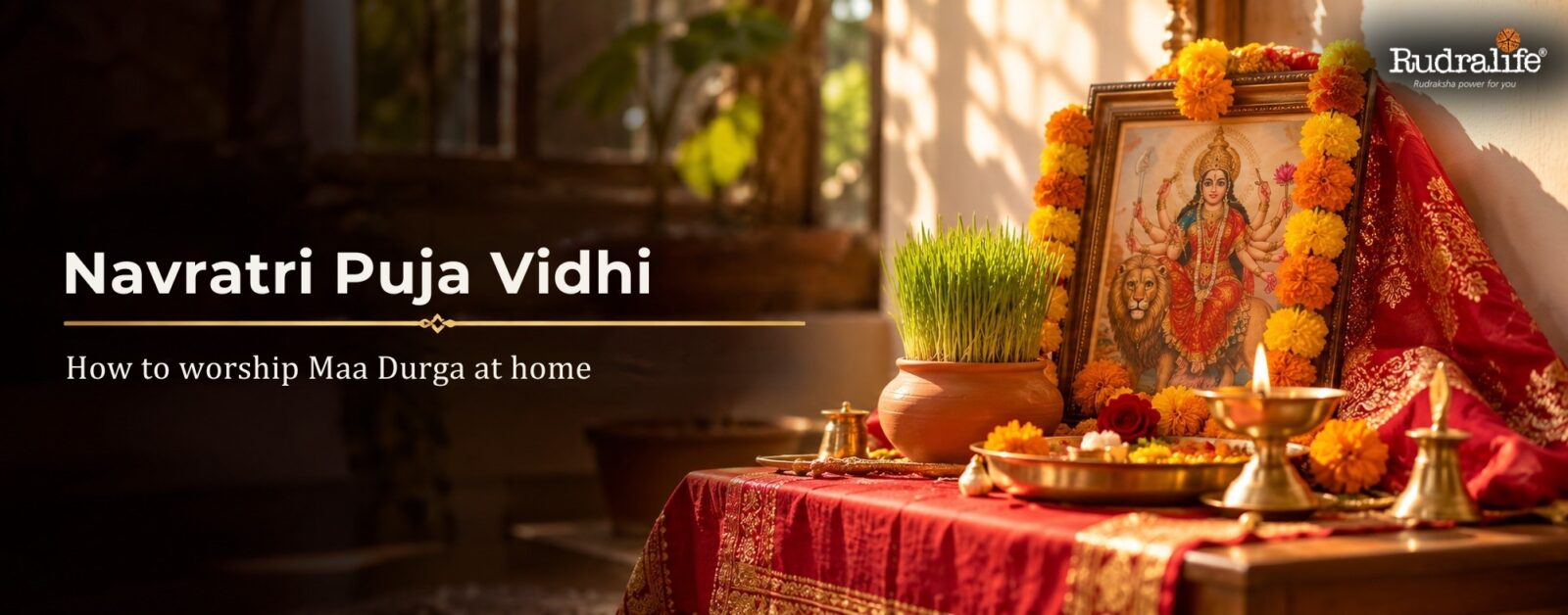
Navratri asks very little of us, a clean corner, a lit diya, and a heart turned towards the Mother for nine nights.
This Navratri puja vidhi walks you through how to worship Maa Durga at home, from setting up the kalash on the first morning to the quiet farewell on Vijayadashami.
Whether you are keeping the puja for the first time or returning to a practice your family has always followed, these steps are meant to be gentle, simple & doable.
Key Takeaways
- Sharad Navratri 2026 begins on Sunday, October 11, & ends with Vijayadashami on Tuesday, October 20
- The Navratri puja vidhi begins with Ghatasthapana, the installing of the sacred kalash, on the first morning
- A simple daily puja, lamp, sankalp, offerings, mantra & aarti, is kept every morning & evening for nine days
- Each of the nine days honours one form of Maa Durga, with a traditional bhog offered to her
- Ashtami & Navami bring Kanya Pujan, where young girls are honoured as forms of the Goddess
- Sincerity matters more than scale, a small, steady puja is complete in itself
Before Navratri Begins: Preparing Your Home & Altar
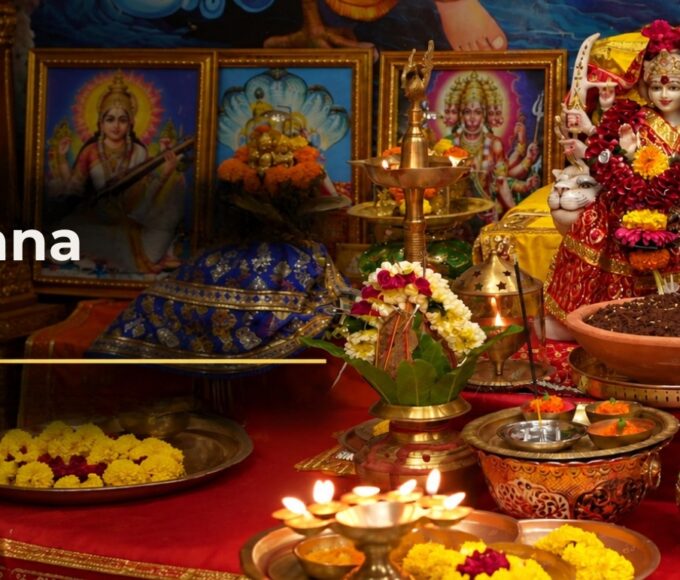
The Navratri puja vidhi truly begins a day before the first puja, with cleaning. Sweep & wipe the home, especially the space where Maa Durga will sit, & choose a spot that faces east or north-east if you can.
Lay a wooden chowki there, cover it with a red or yellow cloth, & place an image or murti of the Goddess at its centre.
Keep these things ready before the first morning:
- For the kalash: a copper, brass or clay pot, Ganga jal or clean water, mango or betel leaves, a coconut wrapped in red cloth, a coin, supari & a little rice
- For sowing jau: a shallow clay pot, clean soil & barley seeds
- For daily worship: a ghee or oil diya, incense, roli, haldi, akshat (unbroken rice), red flowers, a red chunri, & a bell
- For bhog: fruits, sweets & the day’s traditional offering
- For the Mother’s shringaar: bangles, sindoor, a bindi & a mirror, offered with love, not as a checklist
Many families also keep an akhand jyot, a lamp that burns without break through all nine days. If you choose to keep one, make sure someone is home to tend it, & place it safely away from cloth & curtains.
Day 1: How to Do Ghatasthapana at Home
Ghatasthapana, the installing of the kalash, invites Maa Durga into the home and opens the nine nights. In 2026 it falls on Sunday, 11 October, As per Drik Panchang, the main muhurat in Mumbai is 06:31 AM to 10:27 AM, with the Abhijit muhurat from 12:01 PM to 12:49 PM.
The full vidhi has seven steps, from laying the chowki to lighting the akhand jyot.
Read: Ghatasthapana at Home, the complete step-by-step vidhi →
The Daily Navratri Puja Vidhi for All Nine Days
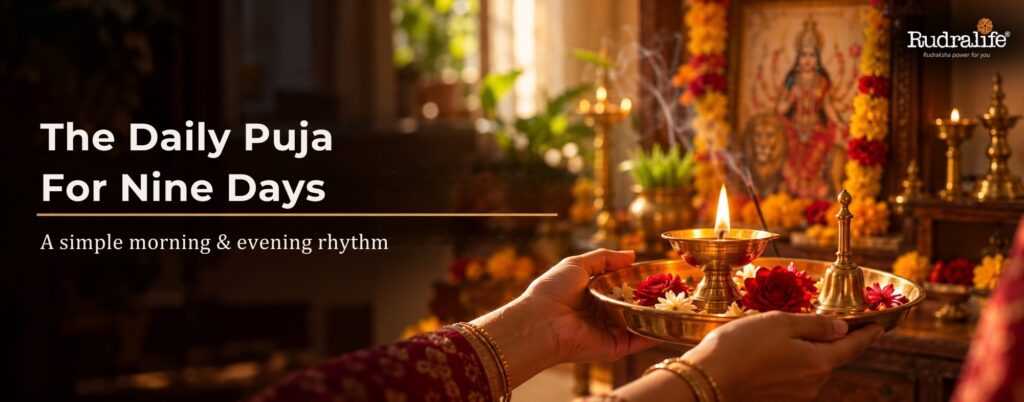
Once the kalash is in place, the daily Navratri puja vidhi follows the same gentle rhythm each morning, with a shorter aarti at dusk. It takes about twenty to thirty minutes.
1. Purify: bathe, sprinkle a little Ganga jal on yourself & the altar, & sit quietly for a moment.
2. Light the lamp: light the diya & incense, & tend the akhand jyot if you keep one.
3. Remember Ganesha: offer a short prayer to Lord Ganesha so the puja moves without obstacle.
4. Take the sankalp: silently renew your intention to worship the Mother through Navratri.
5. Offer to the kalash & the Goddess: water, roli, akshat, red flowers & the chunri.
6. Chant: recite a Durga mantra or a chapter of the Durga Saptashati (see below).
7. Offer bhog: place the day’s offering before her, then share it as prasad.
8. Aarti: sing the Durga aarti, ring the bell, & take the warmth of the flame with both hands.
9. Close with kshama prarthana: ask the Mother to forgive any mistake made in the puja.
Water the jau each day, & keep the altar clean & the flowers fresh. If a day is rushed, a lamp, one mantra & a few honest minutes are still a complete offering.
The Nine Forms of Maa Durga & What to Offer Each Day
Each day of Navratri is devoted to one of the Navadurga, the nine forms of the Mother. Traditionally, a simple bhog is offered to each form:
- Day 1 — Maa Shailaputri: pure ghee, offered for good health
- Day 2 — Maa Brahmacharini: sugar & fruits, for a long & steady life
- Day 3 — Maa Chandraghanta: milk or kheer, to ease worry & sorrow
- Day 4 — Maa Kushmanda: malpua, for clarity of mind
- Day 5 — Maa Skandamata: bananas, for the wellbeing of the family
- Day 6 — Maa Katyayani: honey, for warmth in relationships
- Day 7 — Maa Kalaratri: jaggery, for protection from fear
- Day 8 — Maa Mahagauri: coconut, for peace in the home
- Day 9 — Maa Siddhidatri: sesame or halwa-puri-chana, for fulfilment
Bhog customs differ from family to family & region to region, so follow your own family’s way where it has one.
Read: Sharad Navratri 2026, dates, story and the nine colours →
Mantras & the Durga Saptashati Path
Chanting is the heart of the Navratri puja vidhi. You do not need many mantras; one, repeated with attention, is enough.
Navarna mantra
Om Aim Hreem Kleem Chamundayai Vichche
ॐ ऐं ह्रीं क्लीं चामुण्डायै विच्चे
Navarna Mantra is a very powerful mantra because in this mantra lies the powers of three goddesses Mahasaraswati, Mahalakshmi and Mahakali. It is described in Durga Saptashati that by worshipping these three goddesses, Mother Durga herself becomes happy.
So when the mother is pleased in all forms ie knowledge, wealth, power and the form of the mother, then the seeker gets benefits in all these areas of life. The Navakshari mantra of Mata is as follows.
Durga Mantra
Sarva Mangala Mangalye Shive Sarvartha Sadhike, Sharanye Tryambake Gauri Narayani Namostute
सर्वमङ्गलमाङ्गल्ये शिवे सर्वार्थसाधिके। शरण्ये त्र्यम्बके गौरि नारायणि नमोऽस्तुते।।
The Durga mantra, known for its profound potency, is chanted during various festivities, ceremonies, and occasions dedicated to the worship of Goddess Durga.
It acknowledges the divinity of the Goddess as the epitome of auspiciousness and the source of blessings for the world.
Many devotees chant 108 times on a mala each morning. Prefer to watch? This walks through how japa is practised.
For a deeper practice, families read the Durga Saptashati, also called the Chandi Path, 700 verses in 13 chapters from the Markandeya Purana. It can be read in full each day, or spread across the nine days so the whole text is completed by Navami.
Read: How To Cover the Durga Saptashati in 9 Days →
Ashtami, Navami & Kanya Pujan
Durga Ashtami & Maha Navami, the eighth & ninth days, are the most intense of the nine. Many households perform Kanya Pujan on one of these two days, honouring young girls as living forms of the Goddess. Confirm the exact Ashtami & Navami tithi on Drik Panchang, as the days can shift.
1. Invite nine young girls, & traditionally one young boy as Langur or Batuk Bhairav.
2. Welcome them at the door & gently wash their feet.
3. Seat them on a clean mat, apply a tilak, & tie a mauli on their wrists.
4. Serve halwa, puri & black chana with love.
5. Offer a small gift, a red chunri or dakshina, & touch their feet for blessings before seeing them off.
If you cannot invite nine, even one or two girls, honoured with sincerity, carries the same meaning.
Vijayadashami: Bidding Farewell to Maa Durga
On Vijayadashami, the tenth day, the nine nights close with gratitude. Offer a final aarti & bhog, & gently move the kalash as a sign of farewell.
Sprinkle the kalash water around the home, keep the coconut as prasad, & share the jau sprouts with family or keep a few at the altar. The rest of the samagri can be offered to flowing water or placed at the root of a tree.
Read: Vijayadashami 2026, date, muhurat and meaning →
Rudralife’s Navchandi Puja This Navratri
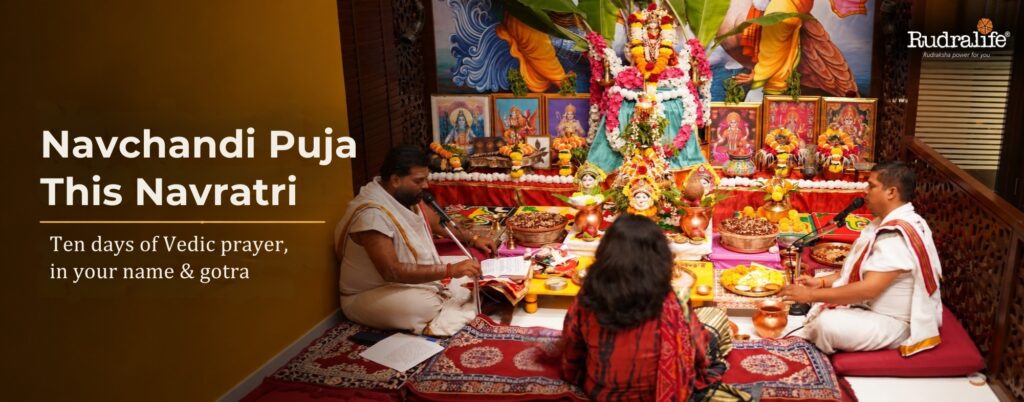
Navchandi Puja is a Vedic ritual dedicated to Maa Chandi, a fierce form of Durga. It centres on the recitation of the Durga Saptashati, followed by a havan with offerings to the Goddess. Navratri, & especially Ashtami & Navami, is considered one of the most auspicious times to perform it.
At Rudralife, the Navchandi Puja is performed as a Vedic Sankalp Puja by experienced pandits.
The puja includes a sampurna Chandi Path, along with an archan of the Goddess with kumkum, haldi, kamal gatte & red flowers. During the sankalp, the pandits speak each devotee’s name & gotra, so the puja is offered on the devotee’s behalf. It is streamed live on YouTube, so devotees anywhere in the world can watch it as it happens.
Puja date & muhurat:
- Maa Shailputri : 11 October (2:05 PM, Shubh Muhurat) IST
- Maa Brahmacharini : 12 October (12:25 PM, Abhijeet Muhurat) IST
- Maa Chandraghanta: 13 October ( 1:05 PM, Amrit Muhurat) IST
- Maa Kushmanda : 14 October (12: 01 PM, Shubh Muhurat) IST
- Maa Skandamata : 15 October (12:50 PM, Laabh Muhurat) IST
- Maa Katyayani: 16 October (1:05 PM, Shubh Muhurat) IST
- Maa Kaalratri: 17 October (1:40 PM, Laabh Muhurat) IST
- Maa Mahagauri: 18 October (2:05 PM, Shubh Muhurat) IST
- Maa Siddhidatri: 19 October (12:28 PM, Abhijeet Muhurat) IST
- Dashami Puja : 20 October (12:30 PM, Amrit Muhurat)IST
2 Pandits daily
Book Rudralife’s Navchandi Puja this Navratri →
Rudraksha Associated with the Divine Mother
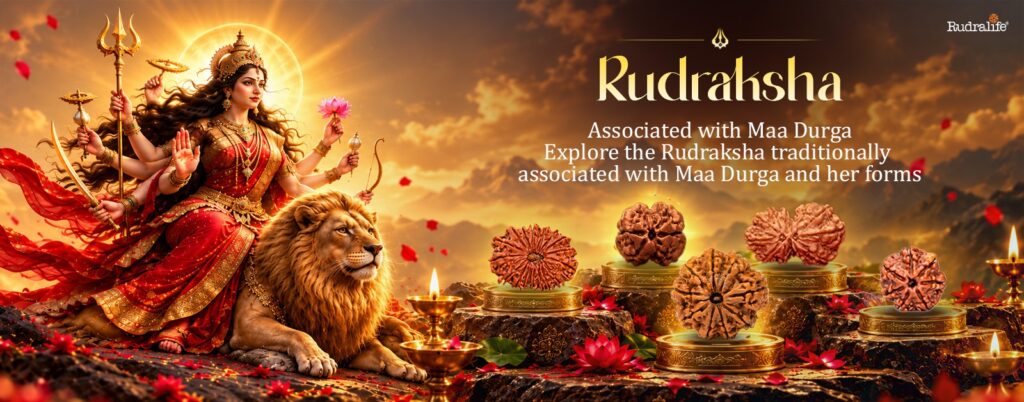
Many devotees choose Navratri to begin wearing Rudraksha linked to the Divine Mother. Five beads are traditionally associated with her forms.
9 Mukhi Rudraksha (Goddess Durga): The 9 Mukhi is associated with Goddess Durga and her nine forms, which makes it the bead most closely connected to Navratri. It is believed to support courage, self-confidence and inner strength.
Buy the 9 Mukhi Durga Shakti Bracelet →
18 Mukhi Rudraksha (Bhumi Devi): The 18 Mukhi is associated with Bhumi Devi, the Earth Mother. It is traditionally worn for stability, grounding and the well-being of the home.
7 Mukhi Rudraksha (Mahalakshmi): The 7 Mukhi is associated with Goddess Mahalakshmi and is traditionally worn for prosperity and financial stability.
Gaurishankar Rudraksha (Gauri and Shankar): Two beads naturally joined together, the Gaurishankar represents the union of Goddess Gauri and Lord Shiva. It is traditionally worn for harmony in marriage and family relationships.
Explore Gaurishankar Rudraksha →
2 Mukhi Rudraksha (Ardhanareshwara): The 2 Mukhi represents Ardhanareshwara, the form in which Shiva and Shakti are one. It is traditionally worn for understanding and balance in relationships.
Any devotee can wear any of these Rudraksha, and Rudraksha has no negative effects. However, we recommend choosing Rudraksha according to your date of birth, so the beads you wear suit you best.
Book a Rudraksha consultation →
Frequently Asked Questions
1. What is the simplest Navratri puja vidhi for beginners? Light a diya each morning & evening, offer water, flowers & a little bhog to Maa Durga, chant one mantra such as the Navarna mantra, & close with the aarti. Done with sincerity, this is a complete puja.
2. Can I worship Maa Durga during Navratri without doing Ghatasthapana? Yes. Ghatasthapana is traditional, but many devotees simply light a lamp before the Goddess’s image & keep the daily puja for nine days.
3. When is Ghatasthapana in 2026? On Sunday, October 11, 2026. As per Drik Panchang, the main muhurat in Mumbai is 06:31 AM to 10:27 AM, & the Abhijit muhurat is 12:01 PM to 12:49 PM. Timings vary by city.
4. Is it necessary to fast while doing the Navratri puja? No. Fasting is a personal choice, & the puja is complete without it. Elders, children & those with health concerns can keep the puja without a fast.
5. What should I do if the akhand jyot goes out? Relight it calmly with a short prayer asking the Mother’s forgiveness. It is not considered a bad sign.
6. Which mantra should I chant during Navratri? The Navarna mantra, Om Aim Hreem Kleem Chamundayai Vichche, is the mantra most associated with Navratri. Those who wish to go deeper read the Durga Saptashati through the nine days.
7. Can Kanya Pujan be done on Navami instead of Ashtami? Yes. Families perform it on either Ashtami or Navami, according to their own tradition.
8. What do I do with the kalash & jau after Navratri? On Vijayadashami, sprinkle the kalash water around the home, keep the coconut as prasad, & share or keep the jau sprouts as a blessing.
The Bottom Line
The Navratri puja vidhi is less about getting every step right & more about showing up for the Mother, morning & evening, for nine nights.
For 25 years, Rudralife has walked alongside devotees through every festival season. If you would like a Rudraksha recommendation this Navratri, simply share your date of birth with us. Wishing you a blessed Navratri 2026.





Leave a comment