







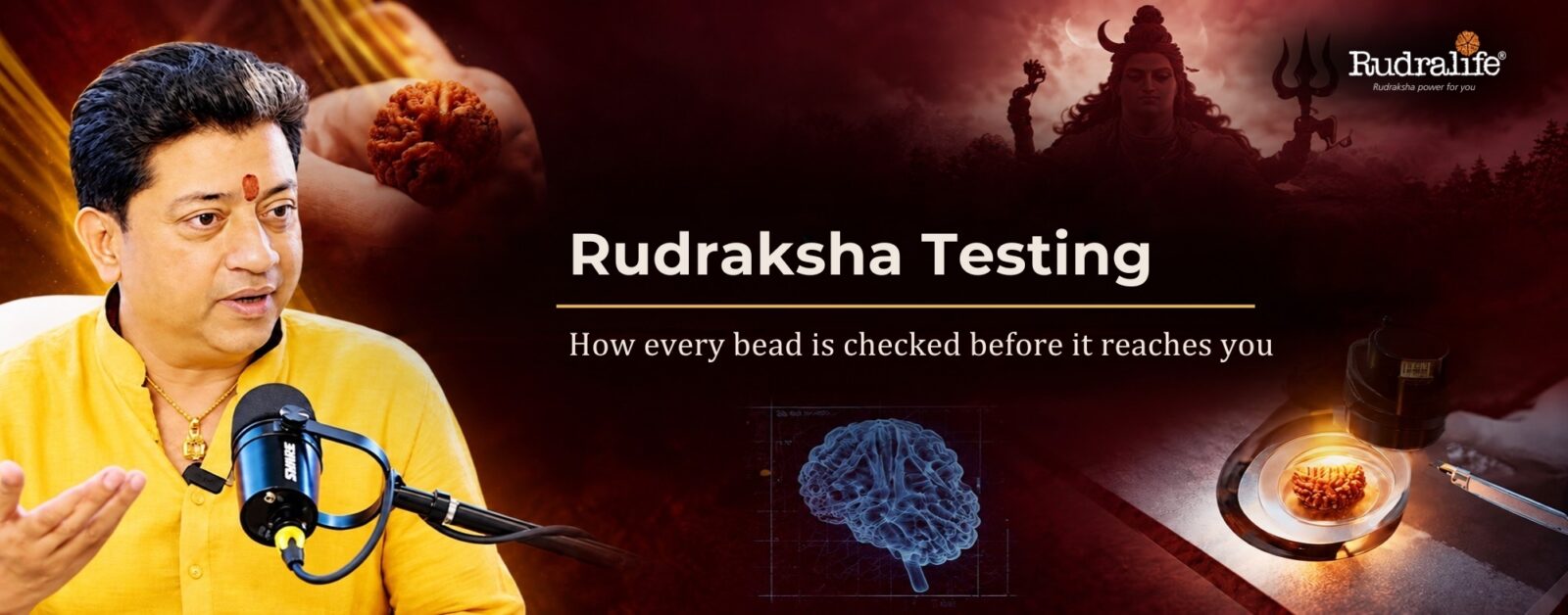
Rudraksha testing at Rudralife began with a simple question asked over 25 years ago: what is the science behind the bead? In this podcast, Dr. Tanay Seetha, an electrical engineer & the son of a chemical engineer, walks through that journey.
This blog covers the early research at ICT Mumbai, why Rudralife began X-ray testing back in 2003, how fakes are caught at RRTL, & how every bead is energised & sealed before it reaches a devotee.
Key takeaways
- Rudralife began X-ray testing of Rudraksha in 2003, after imaging showed that a 5 Mukhi bead holds five compartments & a 10 Mukhi holds ten
- RRTL (Rudralife Research & Testing Lab) checks six to seven parameters, including compartments, cut lines, weight to diameter ratio, density & specific gravity
- Trijuti is the hardest bead to verify, as fakes are joined with fine glue & sometimes need a CT scan
- A microscopic evaluation catches carved lines: a natural mukh has soft, lip-like edges, while a cut line has sharp edges
- Every bead goes through ACE (Aura Certified & Energised), a 72-hour process with beej mantra chanting, & is then handled under a no-touch policy
- “One Mukhi round” & “Nirakar” beads brought in for testing almost always turn out to be 5 Mukhi
- Dr. Seetha’s advice: avoid capped beads, as a cap can hide half lines, a damaged base or reshaping
Dr. Tanay Seetha in conversation with Saumil Seetha on Rudraksha research, RRTL & ACE.
Why Rudraksha research began
Rudralife began holding exhibitions across India in 2001. When the team returned to the same cities, devotees would share how Rudraksha had touched their lives.
Devotees’ experiences raised a natural question: what is the science behind the bead? That curiosity became the starting point for Rudralife’s research.
What the early research at ICT Mumbai explored
Rudralife sponsored around seven studies at the Institute of Chemical Technology (ICT), Matunga, in the Department of Pharmacology & Pharmacy. The studies looked at Rudraksha in relation to heart health, stress, blood pressure & memory. The memory study came about because devotees wearing the Saraswati Bandh in 2001–2002 often said their children seemed more focused in their studies.
According to Dr. Seetha, Rudraksha holds trace elements such as gold, silver, manganese, iron & barium in alkaloid form. Tradition holds that wearing the bead creates subtle vibrations that help balance the chakras, which is why the shastras speak of wearing Rudraksha.
Rudralife’s Note: These studies are shared as part of Rudralife’s research journey, not as medical claims. Rudraksha is not a substitute for medical advice or treatment. Please continue any treatment your doctor has advised.
How X-ray testing changed Rudraksha authentication
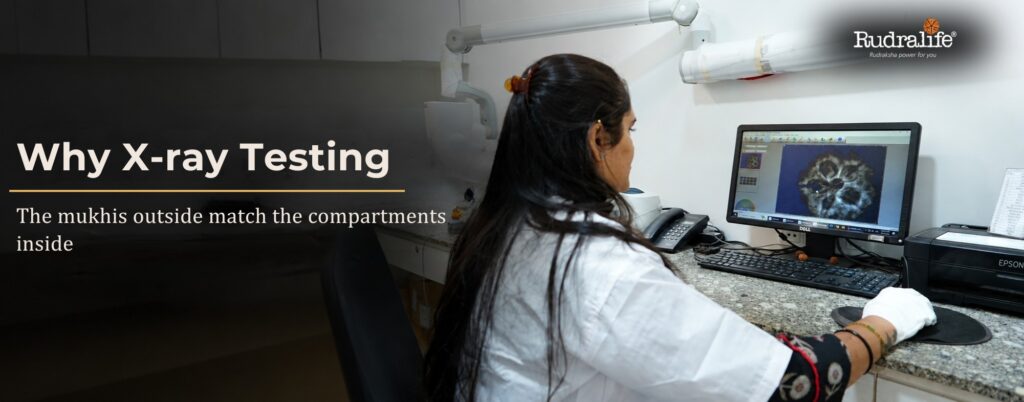
For years, the popular belief was that a real Rudraksha sinks in water & a fake one floats. Rudralife wanted a more reliable, technical way to check a bead. Imaging tests showed that the number of mukhis matches the number of inner compartments: a 5 Mukhi has five, a 10 Mukhi has ten. Rudralife began this X-ray testing in 2003.
The early dental X-ray sensors were only about 1 inch wide, so only small beads could be tested. A larger 2.5 inch sensor now makes it possible to test bigger round beads & see them more clearly.
Reading a Rudraksha X-ray takes years of hands-on experience, especially for beads of 17 Mukhi & above.
Why Trijuti is the hardest bead to verify
Trijuti is larger, with three joined lobes, & Dr. Seetha shares that very convincing fakes are made in Nepal. Fakers use high quality glue, & even a CT scan can be difficult to read. Here, Rudralife leans on its sourcing. So few genuine Trijuti beads arrive each season (only four this season) that an unfamiliar one stands out. When it does, local experts in Nepal can often point out a carved line or a joint.
Rudraksha testing beyond the X-ray
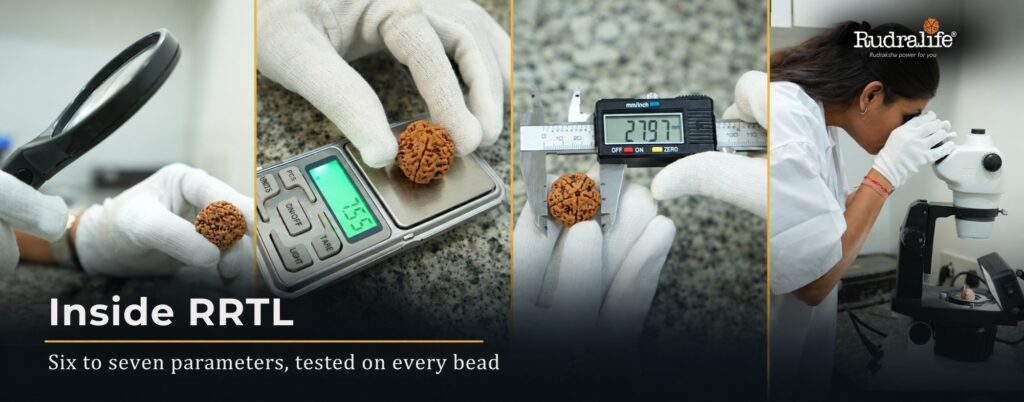
Compartments are only one part of Rudraksha testing. Devotees sometimes say a 5 Mukhi from Rudralife feels more effective than a 14 Mukhi they bought elsewhere, even when both were genuine. Dr. Seetha explains this through potency, which RRTL checks through factors such as:
- Weight to diameter ratio: how dense the bead is for its size
- Density & specific gravity: a sign of the bead’s maturity & quality
- Spores & insect eggs: fresh beads can carry them, & over time they can hollow, damage or lighten the bead
Rudralife buys the full year’s inventory in one lot, so every fresh bead is processed early using desiccators & a vacuum dryer.
The journey of a Rudraksha from Nepal to a devotee
Every step after the tree is planned so the bead reaches the devotee as pure as it can be.
1. Segregation in Nepal: wholesalers know Rudralife’s quality standard & set those beads aside, checking density, weight & half lines. The beads are sealed on the spot.
2. Physical inspection in Mumbai: a team with 8 to 12 years of experience checks every bead by eye & by weight. Around 15 to 20% are rejected & returned to the supplier.
3.Treatment: the accepted beads go through a complete herbicide treatment, so they are free of insects.
4. ACE energisation: each mukhi is energised separately for about 72 hours.
5. RRTL testing: beads pass through six to seven testing parameters, with three machines so even lower-priced beads are tested.
6. Sealing & grading: each bead is sealed & graded as a collector or super collector bead, then moved to the store.
From ACE onwards, a no-touch policy applies. The team wears gloves to handle beads, & mala makers wear gloves too.
Dr. Seetha also reminds us that every bead deserves the same care. In his words, 5 Mukhi & 14 Mukhi both come from the eyes of Shiva, so a 3, 5, 7, 14 or 21 Mukhi is given the same respect.
Choosing a Rudraksha that connects with you
Dr. Seetha believes Rudraksha also chooses you. That is why Rudralife has never sold a bead by photograph. Devotees are encouraged to see, feel & choose, & when they ask for help, he shortlists two of the finest from a lot & lets them feel which one they connect with.
Before you choose, a recommendation can help you understand which mukhi suits you, based on your date of birth through astro-numerology.
Get your Rudraksha recommendation →
If you prefer to see Rudraksha in person, come visit us →
Why Rudralife seals every bead
Rudraksha is a natural, potent seed. Just as stored wheat can attract insects, a Rudraksha left in the open can attract borer insects drawn to the seed inside. Once a borer makes a hole that reaches the seed, the bead is called khandit.
Sealing protects the bead from insects & keeps it untouched until it reaches its wearer. Dr. Seetha’s suggestion is to keep your Rudraksha in a clean place, & he shares that keeping it in the refrigerator overnight can also help.
What ACE energisation means
ACE stands for Aura Certified & Energised Rudraksha. Dr. Seetha points to the shastras, which say that seeing a good Rudraksha is beneficial, touching it is many times more so, wearing it more still, & chanting mantras while wearing it the most. ACE grew from the wish to make every bead as meaningful as possible.
The beads rest on bel patra in a sub-zero environment, in a Shiva-filled atmosphere with aroma. They are sprayed with energised water, & each mukhi’s beej mantra is chanted over it for 72 hours. Rudralife spent about one & a half years testing each mukhi before & after ACE using biofield aura software, & Dr. Seetha shares that the aura appeared more cleansed & enhanced afterwards.
ACE began with higher mukhi beads. Today it is done for every bead, including a 5 Mukhi, before it reaches a devotee.
Real vs fake: cases from the lab
One case Dr. Seetha remembers well: a Mumbai builder sent a 1 to 19 Mukhi mala for testing under another name. Only one bead from 14 Mukhi upwards was genuine, the 17 Mukhi. A few days later, he admitted the 17 Mukhi was from Rudralife & the rest came from elsewhere. Some fakes were skilfully carved: a genuine 12 Mukhi had been converted into a 14, & a 15 or 16 into a 19.
A microscopic evaluation helps catch what an X-ray may miss. A natural mukh, like a mouth, has soft curved lips along its line. A carved line has very sharp edges.
More cases like this one, in Dr. Seetha’s own words. Watch: the hidden reality about Rudraksha vendors
Dr. Seetha also notes that rare higher mukhis are easy to track, because so few arrive each season. This season, he shares, two 26 Mukhi, one small 24 Mukhi & three 21 Mukhi beads came in, & no 22, 25, 27 or 28. If someone suddenly offers three 22 Mukhi beads, that alone is a sign to be careful.
As he says in every podcast, beads sold as “One Mukhi round” or “Nirakar” almost always turn out to be 5 Mukhi. His advice is simple: please do not buy them, whatever the price.
Why capped beads need a second look
Some sellers encase beads in caps. Dr. Seetha advises against buying capped beads, as a cap can hide half lines, a damaged top or base, or make a slightly Gauri Shankar shaped bead look larger. A capped bead cannot be properly tested either. If you have one, ask for the cap to be removed, inspect the bead, & then get it tested.
He also suggests reorganising an existing mala: keep the main mala to well-certified beads in a configuration known to work, wear it for 45 to 60 days, & keep other beads in a separate mala.
Bring your mala for a remake or upgrade at our next exhibition →
Why size does not decide a bead’s potency
In Nepal, some beads are chemically treated to enlarge them. Dr. Seetha shares that in his checks, the potency of these treated beads was at least 35 to 40% lower than untreated ones. That is why Rudralife does not buy them, & why bigger is not always better.
The future of Rudraksha testing
Dr. Seetha sees better imaging & AI as RRTL’s next step. AI researchers, some of them Rudralife devotees, have suggested that a system trained on thousands of genuine beads could flag a fake almost instantly, much like face recognition. He also hopes to go deeper into Nepal to study climate & help educate farmers, & to counter misleading viral videos with honest information.
Prefer to watch? The full conversation with Dr. Tanay Seetha
In his words, Rudraksha is Lord Shiva’s gift to mankind, & Rudralife’s role is simply to provide the finest quality beads.
Subscribe to Rudralife on YouTube for more podcasts →
FAQ
1. How does Rudralife test a Rudraksha? Every bead is inspected by eye & by weight, treated, energised through ACE & then tested at RRTL across six to seven parameters. These include X-ray compartments, cut lines, weight to diameter ratio, density & specific gravity.
2. Is the water test a reliable way to check a Rudraksha? No. The belief that a real bead sinks & a fake one floats is not reliable. X-ray testing, which matches the number of compartments to the number of mukhis, is a far more dependable check.
3. Why is Trijuti so difficult to verify? Trijuti beads are large with three joined lobes, & fakes are made with very fine glue. Even a CT scan can be hard to read, so Rudralife also relies on knowing exactly which genuine Trijuti beads arrived that season.
4. What is ACE energisation? ACE stands for Aura Certified & Energised Rudraksha. Each mukhi rests on bel patra in a sub-zero environment while its beej mantra is chanted for 72 hours. This happens before the bead reaches a devotee.
5. Should I buy a capped Rudraksha? Dr. Seetha advises against it. A cap can hide half lines, a damaged base or a reshaped bead, & a capped bead cannot be properly tested. Ask for the cap to be removed before you buy.
6. Are “One Mukhi round” or “Nirakar” beads genuine? In Rudralife’s experience, beads sold under these names almost always turn out to be 5 Mukhi. Dr. Seetha’s advice is not to buy them, whatever the price.
Watch our podcast on 1 Mukhi Nepal →
7. Does a bigger Rudraksha mean a more powerful one? Not necessarily. Some beads are chemically treated to enlarge them, & Dr. Seetha shares that their potency was found to be 35 to 40% lower. Rudralife does not buy treated beads.
8. How should I store my Rudraksha? Keep it in a clean place so insects are not drawn to it. Dr. Seetha also suggests keeping it in the refrigerator overnight.
Bottom line
Rudraksha testing at Rudralife is a long chain of care, from the first sorting in Nepal to the sealed bead in your hands. Over 25 years, curiosity about the science behind Rudraksha has grown into RRTL, ACE & a no-touch policy, all so that every bead, whether a 5 Mukhi or a 21 Mukhi, reaches you as it should.
Get your Rudraksha recommendation →





Leave a comment